Gencho or Inoko(玄猪 or 亥の子) is an ancient custom to eat rice cakes at the time of the boar(between 9 p.m. and 11 p.m) on the day of the boar in the 10th month in the lunar calendar.
An old literature says that people will be healthy all year round if they eat them on the day. It seems that the custom started in the Emperor's court, but the exact origin is unclear.
Some people say that the custom came from an ancient Chinese custom to eat rice cakes containing soybeans, adzuki beans, cowpeas, sesame, chestnuts, kaki and sugar.
According to another theory, wild boars came to symbolizes a wish to be gifted with children due to their fertility. The families of samurai warriors valued fertility to carry on the family name, so Gencho was actively held in Edo Castle.
The rice cakes appear in "The Tale of Genji". They are served to Hikaru Genji and Murasaki no Ue(紫の上) on the day after their nuptial night.
Wild boar was thought to be a messenger of the god of fire prevention. People put heaters such as hibachi(火鉢, brazier) and kotatsu(炬燵) in rooms to pray for fire prevention on the day of the boar.
A kotatsu is a wooden low table whose frame covered with blanket. A table top sits on it and a heat source is placed under the table.
A pig-shaped burner for mosquito coil(蚊取り線香) is popular, but the burner is said to be boar-shaped to pray for fire prevention originally.
In the tea ceremony, a charcoal water heater embedded in the floor is used in place of furo(風炉) from this day to late April. Furo is a portable water heater for the tea ceremony. It's used from early May to late October.
A confection named zenzai(善哉) is served in the Ura Senke school of the tea ceremony on this day. Zenzai is a sweet soup containing mixture of bean paste and unbroken beans with rice cakes or rice dumpling.
It is customary that one of Oribe wares is used in the tea ceremony on this day. Oribe ware (織部焼, Oribe-yaki) is a type of Japanese pottery which features green copper glaze and avant-garde design. Its name comes from tea master Furuta Oribe(古田織部, 1544–1615).
A confection named Oribe manju(織部饅頭) is also served on this day.
Inoko-mochi(亥の子餅)
Inoko(亥の子) means a boar piglet. This confection is shaped into a boar. Inoko-mochi varies in different confectionery shops.
This blog mainly introduces traditional Japanese things including seasonal events, flowers, confectionery, handicrafts, bunraku(Japanese puppet theater). Short introductions and links to all of my blog posts are shown on four calendar pages on sidebar.
Events:
Cherry Blossom Forecast 2026
https://www.japan-guide.com/sakura/
https://n-kishou.com/corp/news-contents/sakura/?lang=en
https://sakura.weathermap.jp/ (Japanese version only)
https://tenki.jp/sakura/expectation/ (Japanese version only)
https://www.otenki.jp/sp/art/sakura/?pg=11 (Japanese version only)
when and where to see fall foliage(Japanese version only):
https://hanami.walkerplus.com/
https://sp.jorudan.co.jp/hanami/
Tuesday, November 9, 2010
Monday, November 8, 2010
Bellows Festival
The Lotte Marines became Japan Series champions on November 7th, after defeating the Chunichi Dragons in the seventh game at Nagoya Dome. Recently the professional baseball games hover at a low level. The first, second and fifth games of the Japan Series were not telecast on a national network. But the seventh game received an average viewer rating of 20.6 percent in the Kanto area. I am not very interested in baseball.
Fuigo Matsuri(鞴祭り:Bellows Festival) is a festival to thank the god of fire and pray for workplace safety held by artisans using fire such as blacksmiths, casters and metalsmiths. It was also called Hotake(火焼).
In the Edo period, the artisans damped a fire and got a day off work on this day. They made offerings such as mikan(citrus unshiu) to the god named Inari(稲荷) and threw those mikan to children.
A large amount of mikan were consumed for this festival, so merchant Kinokuniya Bunzaemon(紀伊国屋文左衛門) from Kisyu(now Wakayama Prefecture) made big profits by carrying mikan for this festival to Edo during stormy weather.
Sanjo Kokaji Munechika(三条小鍛冶宗近) was a great swordsmith in Kyoto in the 10th century. In a yokyoku(the noh singing) named Kokaji(小鍛冶), he acknowledged a royal command to make the emperor a present of a sword and finished a celebrated sword with the help of Inari.
Originally Inari is the god of agriculture. It is said that blacksmiths came to worship Inari due to this story.
Even now, the descendants of Munechika make the production and sale of cuttery as Sanjyokokajimunechika Ltd.(有限会社三條小鍛冶宗近本店) in Nara Prefecture.
Now many cutlery companies and iron factories hold this festival. Some of them do it on the 8th day of the 11th month in the lunar calendar(corresponding to December in the solar calendar).
Sunday, November 7, 2010
the first day of winter and the Cock Fair
Today is the first day of winter(立冬,rittou), which is one of the 24 solar terms in traditional East Asian lunisolar calendars.
Tori no Ichi(酉の市:the Cock Fair) is an annual festival held at the Otori Shrines(鷲神社) on the days of the cock in November. November 7th is the first day of the cock in November this year. Its second day is November 19th.
It is said that the festival derives from a harvest festival by farmers near a Otori Shrine.
In the Edo Period, kumade(竹把, 熊手:bamboo rake), awa-mochi(粟餅) and imogashira(芋魁, 芋頭) were popular as auspicious objects to wish for the safety of families and success in business at the fair.
Tori no Ichi Fair at Asakusa started at the stroke of the midnight on November 7th this year. A lot of decprated bamboo rakes are sold at the fair. They are regarded as a tool for raking good luck.
decorated bamboo rakes at the Otori Shrine at Sugamo
Awa-daifuku(粟大福)
This is about the same confection as awa-mochi. Awa means foxtail millet. Awa-mochi is a soft rice cake containing grains of foxtail millet and is filled with adzuki bean paste. Awa-mochi is also known as kogane-mochi(黄金餅:golden rice cakes) because awa's yellow color is associated with gold.
Foxtail millet used to be cultivated as substitute for rice, but it came to be cooked with rice as expensive nutrient-rich food now. Awa-mochi is not available at the fair in Asakusa.
kirizansho(切山椒)
Now kirizansho(切山椒) is well known as a specialty of the fair. Kirizansho is a rice cake containing sansho(山椒 Sichuan pepper, Zanthoxylum piperitum). Its name comes from being cut into long sticks. It's one of New Year's confections.
sansho-mochi(山椒餅)
This confection also contains sansho.
sansho(山椒 :Sichuan pepper,Zanthoxylum piperitum)
Imogashira means tou-no-imo(唐の芋), which is a kind of taro. It was also called kashira-no-imo(頭の芋) that means the head of taros, so people ate its corm in the hope that they would become a leader as it.
Thursday, November 4, 2010
Culture Day
November 3rd is Culture Day (文化の日, Bunka no hi). The day was established as a national holiday for the purpose of "the love of freedom, peace and the promotion of culture" in 1948. Originally the day was celebrated as the Meiji emperor's birthday.
On this day, the emperor confers the Order of Culture on people who have contributed to Japanese culture at the Imperial Palace. The Agency for Cultural Affairs hosts art festivals around the day.
According to meteorological data, this day is usually sunny every year. It was sunny yesterday.
The recipients of the orders in Japan are also announced on this day and around the end of April twice a year.
In 2006, 13 Turkish people were presented with The Order of the Rising Sun. They include the former Turkish ambassador to Iran, the former president of the Turkish Airlines and the crew members of the flight from Teheran to Japan(Narita) on the 19th of March 1985.
During the war with Iran, Iraq warned that Iraq intercepted any aircraft overflying Iraq's territory 48 hours later. Many countries sent rescue aircrafts for protecting their own citizens, but Japanese aircrafts were able to fly to Teheran because of opposition from a labor union. The Japanese government requested many countries to get Japanese expatriates on their planes, they were loaded down with protecting their own citizens.
There was nothing the Japanese government can do. However, two planes of the Turkish Airlines arrived at Teheran to get Japanese expatriates to safety. When the planes vacated the Iraq's air space, they had only one and a half hours until the time limit.
Turkey helped Japan because of the incident of Ertuğrul.
Ertuğrul was a sailing frigate of the Ottoman Navy and was wrecked off the coast of Wakayama Prefecture in 1863. The villagers of Kushimoto-cho strove to rescue the crew members of the ship, and 69 survivors were delivered back to Turkey by two Japanese naval ships.
The newspaper announced the recipients of the Order of the Rising Sun, but it didn't refer to the reason behind them receiving the orders. I guess younger people don't know those affairs.
Waseda University and Keio University met in the final game of the Tokyo Big6 Baseball League in 50 years on November 3rd. These two Universities are referred to as the "twin jewels of the private universities." Waseda flung down a challenge to Keio In 1903.
Tuesday, November 2, 2010
Leaf-viewing and Shichi Go San
In the Heian period, noblemen in Kyoto enjoyed leaf-viewing.
This year's foliage season will be from mid November to early December in Kyoto. Many good spots for viewing autumn leaves in Kyoto will be full of visitors.
Tsuzumi(鼓:Japanese hand drum) and yokobue(横笛:a Japanese transverse flute made of bamboo)
Kougou(香合:incense container) in the shape of kaki
six-panel folding screen with a painting of colored maple leaves
Shichi Go San(七五三:The Seven-Five-Three Festival) is a traditional event to celebrate children's growth and pray for their future good health. It's an ancient event and came to be held on the 15th day of the 11th month in the early Edo Period.
On November 15th, 3-year-old boys and girls, 5-year-old boys and 7-year-old girls in formal dress such as kimono are taken by parents to a shrine. It comes from the ancient three events of obitoki(帯解) for 7-year-old girls, hakamagi(袴着) for 5-year-old boys and kamioki(髪置) for 3-year-old boys and girls.
Obitoki was a custom done by the families of commoners. From this day, 7-year-old girls started to put on obi(sash) in place of cloth bands . Fathers visited to the guardian deity of their birthplace hoisting their daughter on to their shoulders.Hakamagi was a custom done by the families of warriors.
Kamioki was a event that 3-year-old boys and girls grew their hair out from this day. Mothers visited the guardian deity with their childen in their arms.
We can see chidren in formal dress on weekends around November 15th. I gradually became uncomfortable with securely-tied obi(belt) when I was a child and visited a shrine.
Chitose-ame(千歳飴) is a stick of red or white hard candy in a bag with a painting of auspicious symbols such as "crane and turtle" and "pine, bamboo and ume".
Chitose-ame literally means thousand year candy and its length symbolizes long life. It contains rice and malt. It is made using malt to break down rice starch into sugar.
There are hand-rolled sushi on the table.
Ringo-ame(リンゴ飴:apple coated with sugar), Takoyaki(たこ焼き:octopus dumpling) and Wata-ame(綿飴:cotton candy) are sold from stands at a festival.
a pair of zori(草履:Japanese sandals) are placed on the step-stone.
An imperial autumn-leaves viewing party named Momiji no Ga(紅葉賀) is described in the 7th chapter of "The Tale of Genji". Musicians perform a variety of music on the boats. A large dragon's head or a bird's neck was attached to their bows. Selected dancers give performances. Hikaru Genji performs a dance named seigaiha(青海波) wearing colored leaves (and a chrysanthemum) in his hair.
Even now we can see the dance in the gagaku performance. Gagaku(雅楽) is Japanese traditional music and dance.
This year's foliage season will be from mid November to early December in Kyoto. Many good spots for viewing autumn leaves in Kyoto will be full of visitors.
Tsuzumi(鼓:Japanese hand drum) and yokobue(横笛:a Japanese transverse flute made of bamboo)
Kougou(香合:incense container) in the shape of kaki
six-panel folding screen with a painting of colored maple leaves
Shichi Go San(七五三:The Seven-Five-Three Festival) is a traditional event to celebrate children's growth and pray for their future good health. It's an ancient event and came to be held on the 15th day of the 11th month in the early Edo Period.
On November 15th, 3-year-old boys and girls, 5-year-old boys and 7-year-old girls in formal dress such as kimono are taken by parents to a shrine. It comes from the ancient three events of obitoki(帯解) for 7-year-old girls, hakamagi(袴着) for 5-year-old boys and kamioki(髪置) for 3-year-old boys and girls.
Obitoki was a custom done by the families of commoners. From this day, 7-year-old girls started to put on obi(sash) in place of cloth bands . Fathers visited to the guardian deity of their birthplace hoisting their daughter on to their shoulders.Kamioki was a event that 3-year-old boys and girls grew their hair out from this day. Mothers visited the guardian deity with their childen in their arms.
We can see chidren in formal dress on weekends around November 15th. I gradually became uncomfortable with securely-tied obi(belt) when I was a child and visited a shrine.
Chitose-ame(千歳飴) is a stick of red or white hard candy in a bag with a painting of auspicious symbols such as "crane and turtle" and "pine, bamboo and ume".
Chitose-ame literally means thousand year candy and its length symbolizes long life. It contains rice and malt. It is made using malt to break down rice starch into sugar.
There are hand-rolled sushi on the table.
Ringo-ame(リンゴ飴:apple coated with sugar), Takoyaki(たこ焼き:octopus dumpling) and Wata-ame(綿飴:cotton candy) are sold from stands at a festival.
a pair of zori(草履:Japanese sandals) are placed on the step-stone.
Sunday, October 31, 2010
Halloween
Halloween has recently become known in Japan, but it's still an unfamiliar event to many of us. Recently, we can buy Japanese-style confections modeled after Jack-o'-lantern.
There are some Japanese confections containing pumpin.
Kabocha-no-Ukishima(かぼちゃの浮島)
The colors of this confection are produced by pumpkin pulp and shell.
Yamaji(山路:mountain path)
This confection contains white bean paste, adzuki bean paste and green peas.
These confecitions are variations of ukishima(浮島) which is a steamed moist sponge cake that contains bean paste, sugar, eggs and flour.
Saturday, October 30, 2010
The Exhibition of Shoso-in Treasures
The Japan Meteorological Agency announced that Kogarashi-ichigou(木枯らし1号, the first cold wintry wind of the year) blew seven days later than last year in Kanto Region including Tokyo on the evening of October 26th.
The autumn imperial garden party was held with persons of merit in various fields at Akasaka Gyoen on 28th, but it was rainy and cold with a high of 11 degrees Celsius and a low of 10.
The typhoon No.14(Chaba) passed away tonight.
The 62th Exhibition of Shoso-in Treasures is being held from Octber 23rd to November 11th at the Nara National Museum.
Shoso-in(正倉院: The Shosoin Repository) is a wooden treasure house that Todai-ji Temple(東大寺) owns. It is a raised-floor-style log house with a tiled roof and has a moisture-proof property.
We can see the treasures only at this exhibition once a year and the exhibits vary from year to year, so a lot of visitors flock to the exhibition.
Shoso-in served as a time capsule. The treasures are in a remarkable state of preservation because they have been doubly-protected by wooden footed containers with lids and a high-floored log house. We can see about 1250 year-old and best-preserved masterpieces.
Shoso-in's treasures comes from the relics of Emperor Shomu(聖武天皇, 701-756) that his consort Empress Komyo(光明皇后, 701–760) dedicated to Todai-ji Temple(東大寺) shortly after his death. The list of those offerings says that she dedicated his relics for the reason that they provoked deep sadness. The tresures include the personal belongings used in Emperor Shomu's daily life, ritual articles from Todai-ji and artifacts which were brought to Japan from China, India and Iran along the Silk Road.
Emperor Shomu and Empress Komyo believed in Buddhism deeply. The emperor set up Todai-ji and the Great Image of Buddha as an attempt to secure protection from a series of disasters and prevailing epidemic.
The emperor invited Jianzhen (or Ganjin) (鑒真 or 鑑真; 688–763), who was a Chinese high priest, to introduce faithful Buddhist commandments into Japan and to approve only observant monks of the commandments as official ones.
He established provincial monasteries and nunneries(国分寺・国分尼寺, kokubun-ji and kokubun-niji) in each province of Japan. Todai-ji was positioned as the head of all these kokubun-ji.
Empress Komyo established Hokke-ji Temple(法華寺) as the head of all the provincial nunneries in 745. She set up public facilities such as a home for orphans and the neediest and a free clinic to care for the sick and to treat patients with medication.
She became the first empress from a non-imperial family. The members of her clan used her position as a empress to hold actual power over the affairs of state. Some people said that many projects were carried out to display the might of her clan.
Three years after his death, she retrieved four relics from Shoso-in. Recently, it has become evident that the two swords of them were identical to the two swords that were discovered accidentally at the foot of the Great Image of Buddha in Todai-ji during its repairs in the Meiji Period.
Although it is still uknown why she did it, some people said she expressed her strong will. Some people guess that some of the retrieved relics were buried to purify the site of Hokkeji Temple and to protect the temple from evil. Some people guess that the retrieved relics included love letters.
The nuns at Hokke-ji have made the same dog-shaped lucky charm(お守り犬,Hokkeji-Dog Talisman) as one of the empress' own making. The charm is available at the temple.
Tuesday, October 26, 2010
first snow, first cold wintry wind and kaki
The first snow of the season fell in some areas of Hokkaido.
The Osaka District Meteorological Observatory announced that Kogarashi-ichigou(木枯らし1号, the first cold wintry wind of the year) blew seven days later than last year in Kinki Region including Osaka. Kogarashi-ichigou was announced only about Kanto Region(Tokyo) and Kinki Region(Osaka).
It is the first north winds of over 8 meters per second between mid October and the end of November when pressure pattern shows high barometric pressure to the west and low pressure to the east.
In Amami Oshima (奄美大島), many Okinawa habu(Yellow spotted pit viper) have been seen due to torrential rains.
October 26th is Kaki(Japanese persimmon) Day that the Kaki Group of the National Fruit Tree Research Association invented in 2005. This day was established based on the following very famous haiku poem that Masaoka Shiki(正岡 子規, 1867-1902) composed on a trip to Nara on October 26th in 1895.
柿食えば 鐘が鳴るなり 法隆寺
"When eating kaki, I heard the bell ringing, of Horyu-ji Temple."
Nara Prefecture is still a main kaki producer.
The day is not well known, and I also recently learned of it. Kaki is unpopular with the young. People used to plant kaki trees in their garden, but there aren't many kaki trees in the gardens of newly-built houses. Kaki fruits are currently on the market, but they are not yet ripe enough to eat in my area.
柿袋 製作/藤本正子
"drawstring pouch in the shape of kaki" designed by Masako Fujimoto
Shigeyoshi Inoue(ed), Yasashiku-Tsukureru-Densyou-no-Chirmenzaiku (Tokyo:Fujin seikatsu-sha,1998),P.15
井上重義監修,やさしく作れる伝承のちりめん細工(東京:婦人生活社,1998年),P.15
Kaki is rich in vitamin C, polyphenol and kalium. Removing the astringent taste is necessary for many kinds of kaki. Its astringent taste is identified as persimmon juice(tannin).
Persimmon juice has been used since long ago as water resisting agent, strengthening agent and antiseptic agent by coating wooden tubs, Japanese paper, wooden building materials and fishing nets of natural materials.
It is also used as clarifying agent in the process of sake brewing.
Coarse oilpaper umbrella(番傘, bangasa), paper umbrella(唐傘, karakasa) are coated with persimmon juice.
Tanned papers are essential for Edo-Kommon(江戸小紋). Kommon are fabrics dyed by cut paper stencils which have fine patterns. Those patterns look unpatterned from a little distance because of their elaborate designs.
The cut paper stencils are called Ise-katagami(伊勢型紙), which were made in Ise(now Suzuka City) and were sold by merchants of Ise under the Kishu domain's aegis. They had a nationwide distribution network. Now the six artisans of Ise-katagami are designated as Living National Treasure, but the production of Ise-katagami has dropped significantly due to kimono's unpopularity and improved technology.
Persimmon juice has natural infection-fighting properties, so antibacterial goods containing it are on the market.
Sunday, October 24, 2010
autumn color of leaves
Autumnal colors of the leaves in Nikko are now at their peak. Since the average temperature for September was high, leaf colors in most areas change later than usual this year. In Tokyo, the leaves will turn red in December this year.
Iroha-zaka slope in Nikko is famous for the beautiful colored leaves, but viewers suffer from major traffic jams. I've been there years ago. Its colored leaves were very beautiful, but I got carsick due to the endless hairpin curves of Iroha-zaka slope.
Major viewing spots in Japan are crowded with people and their cars.
The pictures at Iroha-zaka slope. Real colored leaves are more beautiful.
Momijigari(紅葉狩り:leaf peeping)
Momiji(紅葉:autumn leaves)
Saturday, October 23, 2010
The Mid Niigata Prefecture Earthquake
The Mid Niigata Prefecture Earthquake(中越地震, Chuetsu jishin) occurred at 05:56 p.m.(Japan Time) on October 23rd in 2004 and caused 68 deaths. Some people that took shelter in cars after the earthquake developed symptoms of economy-class syndrome. Niigata Prefecture is a heavy snowfall area, so heavy snows crushed many quake-damaged houses during winter.
The earthquake caused great damage to former Yamakoshi village(旧 山古志村) which is the birthplace of Nishikigoi(錦鯉, coloured carp) and is still a main producer of the coloured carp.
The brisk exports of coloured carps has rescued the carp farmers in Niigata Prefecture from the doldrums.
Ushi-no-Tsunotsuki(牛の角突き) is a kind of bullfights that have taken place in some areas of Niigata Prefecture since the Edo period. The bullfight appeared in "Nansou Satomi Hakkenden (南総里見八犬伝)", which is an epic novel written by Takizawa Bakin(滝沢馬琴).
It has been designated a significant intangible folk cultural asset of the country.
Unlike bullfighting in Spain, bulls are never injured in the bullfight. Villagers name the bulls for the bullfight and cherish them. So they lamented their bulls' death due to the earthquake.
Friday, October 22, 2010
The Festival of the Age and the Fire Festival in Kurama
I heard that the typhoon No.13(Megi) caused considerable damage in Taiwan. I express my sympathy for people in Taiwan. Reconstruction works and rescue operations went into full swing.
An elderly woman said that she escaped surging water by hanging onto her childhood friend's grave. (Many Japanese gravestones are shaped like a low square pole.)
Two festivals were held in Kyoto on October 22nd.
One is the Jidai Matsuri(時代祭:the Festival of the Age), which dates back to around 1895, when the Heian Shrine (平安神宮, Heian jingu) was built to commemorate Kyoto's 1,100th anniversary as Japan's capital. On the 22th day of the 10th month in 794, the Emperor Kanmu moved Japan's capital from Nagaoka-kyo(長岡京) to Heian-kyo(平安京, now the center of Kyoto).
About 2,000 citizens dressed in historical costumes parade from the Imperial Palace to Heian Shrine in a two-kilometer procession. The costumes are precise reproductions of the ones dating from the end of the eighth century to the Meiji Restoration in 1868. Originally, the costume parade started to set the mood for the festival.
The other is Kurama no Himatsuri(鞍馬の火祭: the Fire Festival in Kurama), which is an annual festival held at Yuki Shrine(由岐神社, Yuki Jinja) at Kurama(鞍馬) in Kyoto. The festival comes from the relocation of the shrine to Kurama. The Emperor Suzaku moved the shrine to long for peace and quiet after a series of disasters and rebellions in 940. The carriers of religious instruments went in procession to Kurama, holding up torches.
In the evening, the parishioners wind through the town holding 500 torches. Around eight o'clock, At the shrine's stone steps in front of its gate, torches are collected and are burned. The young parishioners run up the steps and go down the steps with a portable shrine. They carry mikoshi(portable shrine) through the streets of their community.
Thursday, October 21, 2010
chrysanthemum-shaped confections
Three people have died from mudslides in Amami area. The rain eased off, but many mudslides tied up telephone lines. So the extent of the damage has yet to be determined.
A new international terminal building at Tokyo's Haneda Airport has been opened today. The building has 20 restaurants and 22 shops including a cafe with a planetarium, stores that sell merchandise based on Japanese characters such as Hello Kitty. An 'Edo period street' has been reproduced on its 4th floor.
Regular international flight services at the airport will start on October 31st.
Now we tend to regard chrysanthemum as a floral tribute to the deceased. Most Japanese flower shops sell a bouquet of flowers including chrysanthemum as a flower offered on the grave or Buddhist altar.
The flowers used to be considered a symbol of longevity. The chrysanthemum is used in the Imperial Crest.
In the Edo Peried, the exhibitions of chrysanthemum were held on the day of Double Ninth Festival. Art lovers or high-ranking domestic servants who served the wives of shoguns or feudal lords sent chrysanthemum flowers to the exhibitions to win a prize.
Midare-giku(みだれ菊)
Chrysanthemum is called kiku(菊) in Japanese, but it has several another names such as chiyomi-gusa, masari-gusa(優り草o r 勝り草) and yowai-gusa(齢草). Chiyomi-gusa and yowai-gusa are associated with longevity.
Kikkaten(菊花展: the exhibition of chrysanthemum )
Purple one is made of purple sweet potatoes.
A new international terminal building at Tokyo's Haneda Airport has been opened today. The building has 20 restaurants and 22 shops including a cafe with a planetarium, stores that sell merchandise based on Japanese characters such as Hello Kitty. An 'Edo period street' has been reproduced on its 4th floor.
Regular international flight services at the airport will start on October 31st.
Now we tend to regard chrysanthemum as a floral tribute to the deceased. Most Japanese flower shops sell a bouquet of flowers including chrysanthemum as a flower offered on the grave or Buddhist altar.
The flowers used to be considered a symbol of longevity. The chrysanthemum is used in the Imperial Crest.
In the Edo Peried, the exhibitions of chrysanthemum were held on the day of Double Ninth Festival. Art lovers or high-ranking domestic servants who served the wives of shoguns or feudal lords sent chrysanthemum flowers to the exhibitions to win a prize.
Midare-giku(みだれ菊)
Hasami-giku(はさみ菊)
Hasami means a scissor. We use this scissor only to make petals of a chrysanthemum by making equally spaced cuts in this confection. It resembles a Japanese-style scissor for sewing. It's a tool for professional use, so it's expensive.
Chiyomi-gusa(千代見草)
Chrysanthemum is called kiku(菊) in Japanese, but it has several another names such as chiyomi-gusa, masari-gusa(優り草o r 勝り草) and yowai-gusa(齢草). Chiyomi-gusa and yowai-gusa are associated with longevity.
Kikkaten(菊花展: the exhibition of chrysanthemum )
Purple one is made of purple sweet potatoes.
Wednesday, October 20, 2010
Jusanya
Jusanya(十三夜) means the night or the moon on the 13th day of the 9th month in the lunar calendar(corresponding to October 20th of this year in the Gregorian calendar). Jusanya is twinned with Jugoya, so Jusanya is also called Nochi-no-Tsuki(後の月, later moon).
Unfortunately, I can't see the moon tonight.
We can't worry about that now. Amami Area is being ravaged by torrential rains due to the typhoon No.13(Megi) and stationary autumn rain front. The area received up to 647 mm of rain ever recorded in a 24-hour period, 131 mm in a 1-hour period. The total amount of rainfall reached 800 mm or more since it began to rain. Amami area had a record-high rainfalls. Heavy rain complicates rescue efforts.
I expresse concern about the damage from the typhoon No.13 in the Philippines. The typhoon is on its way to China. I hope that people in southern China will be safe.
Moon Viewing on this day is unique to Japan and is also called Mame-meigetsu(豆名月, bean harvest moon)or Kuri-meigetsu(栗名月, chestnut harvest moon).
Newly harvested beans started to reach the market, but they are smaller than usual due to the searing summer.
There are different stories about the origin of Jusanya. It is said that this custom started in the Imperial court.
People were unwilling to hold only one of the two moon-viewing events, Jugoya and Jusanya, as katamizuki(片見月: partial moon viewing).
Kuri-meigetsu(栗名月)
Suama(すあま)
Tuesday, October 19, 2010
Ebisu-kou and Bettara fair
Bettara fair(Bettara Ichi) is held in the area around Takarada shrine(宝田神社) at Nihonbashi in Tokyo on October 19th and 20th.
Bettarazuke (べったら漬) is a kind of pickled daikon.
On the 20th day of the 10th month in the lunar calendar, shrines across Japan held Ebisu-kou(えびす講).
Foods for offerings to Ebisu have been sold on a fair the day before Ebisu-kou since the middle of the Edo Period. Bettarazuke became popular on the fair and the fair came to be called Bettara Fair.
Ebisu(夷、戎、胡、蛭子、恵比須、恵比寿、恵美須) is an ancient Japanese god and is famous for one of the Seven Gods of Fortune (七福神, Shichifukujin). He holds a rod with his right hand and a sea bream under his left arm, so he was regarded as the god of fishermen and good fortune.
It is said that the Japanese gods gather at Izumo Taisha Shrine(出雲大社) in Shimane Prefecture in the 10th month in the lunar calendar and Ebisu looks after people during their absence.
So he came to be regarded as the god who brings people success in business and the safety of their families.
On the 20th day, merchant families shut their shops up early, made offerings such as a sea bream, libations, rice cakes and fruits to Ebisu and held dinner parties for their business associates and relatives in the Edo Period. Now it's not held.
There is a bunraku play with the scene of such a party.
Many shrines hold Ebisu-kou on November 19th and 20th because the 10th month in the lunar calendar corresponds approximately to November.
Nishinomiya Jinja(西宮神社) in Nishinomiya City of Hyogo Prefecture is the head shrine that is dedicated to Ebisu(or informally, "Ebessan").
The shrine and the shrines under it hold Toka-Ebisu(十日えびす) for several days around January 10th. Toka-Ebisu is also a festival to pray for the prosperity of business. Visitors buy a good luck bamboo branch and pray to Ebisu.
People living around the shrine locked a door with a key, put out a light and stayed at home on the evening of the 9th of the 1st month in the lunar calendar because Ebisu ran around the streets during the night. Now its main gate is opened at six in the morning of January 10th, and many men rush into the main hall to win laurels as "Lucky Men".
In the meantime, why the Japanese gods gather at Izumo Taisha Shrine?
Because they have a meeting to make a good match between people.
Monday, October 18, 2010
Double Ninth Festival
Double Ninth Festival or Double Yang Festival(重陽の節句,Chouyo-no-sekku) originated from a Chinese custom was celebrated on the 9th day of the 9th month in the lunar calendar(corresponding to October 16th this year). It's called the festival in chrysanthemum flower season.
Odd numbers are regarded as active(陽, yang or yo: a traditional Chinese spiritual concept) in China. The ninth day of the ninth month (or double nine) is regarded as a sinister day because the day has too much yang.
People had the custom of climbing up a hill or high building with their family and drinking chrysanthemum wine to drive away evil spirits and pray for longevity on the 9th day of the 9th month in the lunar calendar. Now this became a minor custom in Japan.
The following poem was written by Du Fu(杜甫, Chinese famous poet) when he stood a high place on the the 9th day of the 9th month in the lunar calendar in 766. I read this poem in my high school text book, and I'm fond of it.
登高 杜甫
風急天高猿嘯哀
渚清沙白鳥飛廻
無邊落木蕭蕭下
不盡長江滾滾來
萬里悲秋常作客
百年多病獨登臺
艱難苦恨繁霜鬢
潦倒新停濁酒杯
the same poem translated into Japanese:
風急に 天高くして 猿嘯哀し
渚清く 沙白くして 鳥飛び廻る
無辺の落木 蕭蕭として下り
不尽の長江 滾滾として来たる
万里悲秋常に客と作り
百年多病独り台に登る
艱難苦だ恨む 繁霜の鬢
潦倒新たに停む 濁酒の杯
"Climbing Up(Deng Gao in Chinese, Toukou in Japanese)" written by Du Fu(Toho in Japanese)
"The winds harshly blow, I feel that a clear sky is very high, I can hear the wail of monkeys.
I can see the beach with clear water, its sands are white, a bird is flapping about there.
Leaves continuously fall from boundless trees, I hear them rustling.
The inexhaustible Yangtze River(or Chang Jiang, 長江) rush by.
I've been far away from home for so long and also been a perpetual traveler in foreign lands.
I've been prone to illness and climb up all alone now.
I harbor resentment toward trials and tribulations that made my sideburns turned frosty.
A sense of hopelessness made me spiritless.
In addition, I was forced to give up drinking because of illness."
It's hard for me to translate this poem satisfactorily into English. I suppose you can get the English translation of this very famous poem.
This poem reminds me of Georges Moustaki's "Ma Solitude".
"I have lived with my solitude for too long, so my solitude keeps me from feeling lonely."
We learn about classical Chinese and Japanese literature in high school. This poem appeared in school text books.
The defining difference between both classical literature is the presence of female writers. I've never read writings by women in classical Chinese literature. Many classical Chinese poems took on such themes as the their love for their country, friends and family. So they are regal.
Meanwhile, many ancient Japanese women wrote poems, novels and essays. There are many writings on the subject of romance in classical Japanese literature.
"Manyo-shu(Collection of Ten Thousand Leaves)" was realized in the late eighth century and includes approximately 4,500 poems written by people from every walk of life from different regions of Japan over a period of about 300 years. It includes the poems of many women such as empresses, aristocratic ladies and wives of front-line soldiers.
In the Heian period(794 to 1185), many women were active as writers. They were not professional writers, but Murasaki Shikibu (紫式部) hired on as a private tutor of Fujiwara no Michinaga's daughter in recognition of her "The Tale of Genji".
Kisewata(着せ綿, 被せ綿 : floss silk to cover chrysanthemum flower)
These confections represent white silk and red chrysanthemum flowers.
On the night of the 8th day of the 9th month in the lunar calendar, people made moist floss silk with the night dew and scented it with chrysanthemum flowers by putting floss silk over the flowers.
On the morning of the 9th day of the 9th month, people wiped their faces or bodies with the floss silk. This custom to pray for longevity is unique to Japan.
Friday, October 15, 2010
Kannamesai
October is the season for newly harvested rice in Japan. Temperatures were unusually high this summer, and this year's newly harvested rice has lower quality than last year.
I already ate the rice. It tastes good because it is sweeter and contains more water other seasons. I usually choose the rice brand named Koshihikari from Niigata Prefecture other than Minamiuonuma area. Koshihikari from Minamiuonuma area rates with the very best.
Kannamesai(神嘗祭) is a festival held by the Imperial court from October 15th to 17th. The emperor dedicates newly harvested rice to Amaterasu-Ohmikami, the Goddess of the Sun, an imperial ancestor. The festival used to be held on the 17th day of the 9th month in the lunar calendar. It was held on September 17th after the solar calendar was adopted since 1872. However, the harvested rice couldn't keep up with the day's festival, so it has been held on October 17th since 1879.
Sekihan manju(赤飯饅頭)
This confection has nothing to do with Kannamesai.
Sekihan and chestnut on the buns.
Sekihan(festive red rice) is made by steaming glutinous rice together with red beans which colored the rice.
Monday, October 11, 2010
Health and Sports Day
It's a summery day. Temperatures have reached 28 degrees Celsius in Yokohama and have reached over 29 degrees Celsius in several areas.
Health and Sports Day (体育の日) is held on the second Monday in October. It was designated in 1966 to commemorate the opening day of the 1964 Tokyo Olympics.
Many schools held their athletic meetings today, but the date of the athletic meeting varies from school to school now. Some schools hold them in spring.
The event of cutting antlers was held at Nara Park on October 10th and 11th. Althought antlers are shed and regrown by itself in early spring, the event started in 1671 to prevent antlered deers from injuring people or another deers. Cut antlers are dedicated to the god.
The deers living around Nara Park have been regarded as the messengers of the Kasuga Grand Shrine (春日大社, Kasuga-taisha) and have been designated as a national natural treasure. They were already living there when the Kasuga Grand Shrine was found in 768.
They are wild animals although they are accustomed to people. It's dangerous to come close to deers be in estrus.
Their staple food is the native plants at the park. We are allowed to give the deers only shika-senbei(鹿煎餅:deer biscuits) that Foundation for the Protection of Deer on Nara Park sells as a snack. It contains rice bran and cereals. A part of earnings from these biscuits sales are used to protect deers.
Thursday, October 7, 2010
Nagasaki Okunchi Festival
Okunchi Festival in Nagasaki is held from October 7th to 9th. Okunchi Festivals are held to give thanks to deities for a good harvest in Kyusyu Region. Some of them are also held on the 19th day and the 29th day.
According to the most widely believed theory, "Okunchi" means ninth day(九日,kunichi) and comes from Chouyo-no-sekku(重陽の節句) celebrated on the ninth day of the ninth month in the lunar calendar. Chouyo-no-sekku is one of the five season-related celebrations. Odd numbers are regarded as active(陽, yo) in China. The ninth day of the ninth month has two active numbers.
It is said that the festival dates back to 1634, when two women danced in dedication to the god of the Suwa Shrine in order to suppresse Christianity.
The city has a historically close relationship with China. So a dragon dance, one of the features of the festival, is performed.
(The events related to China are being perfomed as usual in Japan. The celebration of China's National Day was also held as usual in Yokohama's Chinatown on October 1st.)
Shippoku-ryouri(卓袱料理) that originated in Nagasaki is a fusion of Japanese, Chinese and Dutch cooking. Platters for share are served to guests at the round table.
According to the most widely believed theory, "Okunchi" means ninth day(九日,kunichi) and comes from Chouyo-no-sekku(重陽の節句) celebrated on the ninth day of the ninth month in the lunar calendar. Chouyo-no-sekku is one of the five season-related celebrations. Odd numbers are regarded as active(陽, yo) in China. The ninth day of the ninth month has two active numbers.
It is said that the festival dates back to 1634, when two women danced in dedication to the god of the Suwa Shrine in order to suppresse Christianity.
(Refer to the blog post under the date of August 9th for the suppression of Christians in Nagasaki.)
Nagasaki was the only Japanese city that was allowed to trade with foreign countries during the period of national isolation.The city has a historically close relationship with China. So a dragon dance, one of the features of the festival, is performed.
(The events related to China are being perfomed as usual in Japan. The celebration of China's National Day was also held as usual in Yokohama's Chinatown on October 1st.)
Shippoku-ryouri(卓袱料理) that originated in Nagasaki is a fusion of Japanese, Chinese and Dutch cooking. Platters for share are served to guests at the round table.
Nagasaki champon (長崎ちゃんぽん) is a noodle dish originated from China.
Castella (カステラ, Kasutera) also originated in Nagasaki and is a popular Japanese sponge cake without edible fat such as butter. The name is derived from Portuguese Pão de Castela. It was introduced to Japan in the middle of the 16th century.
Fukusaya(福砂屋), which was founded at Nagasaki in 1624, is famous for its moist castella. In a dramatic re-enactment, a kind of Dutch ovens was used to bake the cake at the end of the Edo Period.
There are various ways to make castella. They come in a variety of textures. It was hard for me to make castella under controlled temperature.
These are very moist.
Ogura castella(小倉カステラ)
this confeciton includes adzuki beans.
Yuka(油菓)
A fried donut filled with adzuki bean paste.
Wednesday, October 6, 2010
Sweet Osmanthus
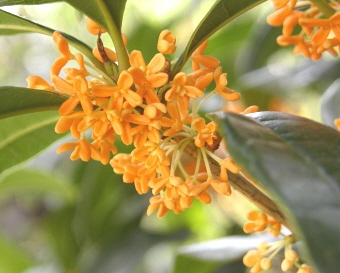
Kinmokusei(金木犀 :Osmanthus fragrans or Sweet Osmanthus) is in full bloom.
It has subdued blossoms but has a strong fragrance. At this time of year, we can smell the blossoms everywhere. I noted the presence of the blossoms while I was out walking my dog at night.
Teika-kazura(定家葛:Trachelospermum asiaticum) blossoms near my house also asserted their strong presence by scent. It comes into bloom in the middle of May.
Its name derives from the legend that Fujiwara no Teika(藤原定家, 1162-1241) couldn't get Shikishi Naishinnou (式子内親王 Princess Shikishi) out of his mind even after her death, and reincarnated Teika clung to her grave as Teika-kazura.
The blossom has five petals, but ceramic artist Kenkichi Tomimoto(富本憲吉,1886-1963)made a design of the blossom as a four-petal flower.
Kuchinashi(梔子、巵子、支子:Common gardenia, Gardenia jasminoides) is strongly scented in June and July.
The seed can be used as stock for making dye. Food colorings I'm using originates from this seed.
photos :「季節の花 300」 http://www.hana300.com/ (Japanese version only)
Monday, October 4, 2010
Sweet chestnut and Pacific saury
Sweet chestnut and Pacific saury(秋刀魚, sanma) come into season at this time of year. We eat Pacific sauries broiled with salt and rice cooked with chestnuts.
The Chinese characters "秋刀魚" literally means an autumn fish. Pacific sauries are cheap and better-tasting in autumn.
Japanese chestnut(or Castanea crenata) is delicious, but it is difficult to remove astringent skins from the chestnut. So we frequently buy peeled chestnuts. I peel raw chesnuts a once or twice a year and cook with them or preserve them in syrup.
Raw chestnuts slightly darken when cut or peeled, so food makers or confectionery makers turn them yellow with gardenia fruits or bleach them with hydrosulfite.
We make confections with chesnuts preserved in syrup.
There is also a confection using chesnuts with their astringent skins preserved in syrup.
Kuri-manju(栗饅頭)
Baked confection filled with sweet white bean paste and small pieces of preserved chesnuts.
Kuri-mushi-youkan(栗蒸し羊羹)
Neri-youkan(練り羊羹) consists of sweet bean paste, kanten solution and sugar. Mushi-youkan(蒸し羊羹) is a steamed mixture of flour and sweet adzuki bean paste. Kuri-mushi-youkan is a mushi-youkan containing chesnuts.
Youkan commonly means neri-youkan, but mushi-youkan has a longer history than neri-youkan. Neri-youkan keeps longer than mushi-youkan.
Kuri-kinton(栗金団) or Kuri-chakin(栗茶巾)
This confection is made by wrapping a mixture of sugar and mashed chesnuts in silk cloth and twisting the cloth.
Kuri-youkan(栗羊羹)
Kuri-youkan commonly means neri-youkan containing chesnuts, but this confection consists of mashed chesnuts, kanten solution and sugar.
練り切り,栗
Zeitaku youkan(ぜいたく羊羹)
This contains sweet mashed chesnuts.
Toyo no aki(豊の秋)
Tanbaji(丹波路)
Subscribe to:
Posts (Atom)