Events:
Cherry Blossom Forecast 2026
https://www.japan-guide.com/sakura/
https://n-kishou.com/corp/news-contents/sakura/?lang=en
https://sakura.weathermap.jp/ (Japanese version only)
https://tenki.jp/sakura/expectation/ (Japanese version only)
https://www.otenki.jp/sp/art/sakura/?pg=11 (Japanese version only)

when and where to see fall foliage(Japanese version only):
https://hanami.walkerplus.com/
https://sp.jorudan.co.jp/hanami/
Showing posts with label seasonal events. Show all posts

Thursday, March 26, 2026

Harmony is top priority- Prince Shotoku and his time(3)

 Imperial Rescript on the Worship of Shinto Deities

In 607, the "Imperial Rescript on the Worship of Shinto Deities" was issued (as recorded in the Nihon Shoki). Through this decree, the Imperial Court commanded the nation to revere Shinto deities and ensured that Shinto rituals were never neglected.

Shinto and Buddhism have long coexisted in Japan, as neither is a monotheistic religion. Shinto is polytheistic and animistic, finding the divine in all aspects of nature. Meanwhile, the Buddha embarked on an ascetic life to seek liberation from the four unavoidable sufferings—birth, aging, sickness, and death—attaining enlightenment by accepting these realities and letting go of worldly attachments. Buddhist monks continue to follow this path today.

Both religions share a deep respect for the environment, which has naturally led to the conservation of nature over the centuries: Tadasu no Mori is a primeval forest over 2,000 years old surrounding Shimogamo Shrine in Kyoto. Kasugayama Primeval Forest has been protected for over 1,000 years as a sacred area of Kasuga Grand Shrine, prohibiting hunting and logging.

 Until the end of the Edo period, Shinto shrines and Buddhist temples were often located on the same grounds. Even today, it is common to visit either a shrine or a temple at the beginning of the new year. When people ask, "Which one should I visit?" the typical answer is, "Whichever you prefer." For instance, I have often visited Tsurugaoka Hachiman-gu Shrine, and occasionally Kawasaki Daishi Heikenji Temple, to welcome the new year.


Japan’s International Debut

In 607, the diplomat Ono no Imoko was dispatched to the Sui Dynasty with a diplomatic message, as recorded in the Nihon Shoki (Chronicles of Japan). This marked a significant step in Japan’s official diplomatic relations with China. During this mission, Ono no Imoko presented a letter from Empress Suiko to Emperor Yang of Sui.

According to the Book of Sui (Suishu), the letter famously began: "From the Emperor of the Land of the Rising Sun to the Emperor of the Land of the Setting Sun." Emperor Yang was reportedly outraged by this opening. However, many researchers argue that the phrase "Land of the Setting Sun" was not intended as an insult. Instead, the tension arose because the letter implied that Japan held equal status with the Sui Dynasty—a direct challenge to the Sino-centric world order, in which the Chinese Emperor was believed to be the sole supreme ruler. Although the Emperor initially rejected the letter as expected, the envoys were not executed.

The Japanese court believed there was a strategic opportunity to establish relations with Sui. Following a conflict in Northeast China, the Sui Dynasty had launched an invasion of Goguryeo in 598. The Japanese delegation arrived during a period of ongoing tension between Sui and Goguryeo. Sui likely deemed it unwise to drive Japan into an alliance with their enemy, Goguryeo. Furthermore, Japan’s devotion to Buddhism and its developing legal system led the Sui Dynasty to recognize Japan as a civilized state.

In 608, the delegation returned to Japan accompanied by the Sui diplomat Pei Shiqing. Although Ono no Imoko reported that he had lost the Emperor’s reply, he was not punished. Some historians infer that the letter was intentionally "lost" or suppressed to save Japan’s face, as it may have contained content unfavorable or condescending to the Japanese court. Historically, diplomatic correspondence was sometimes altered or withheld to preserve the dignity of both parties. When Pei Shiqing eventually returned to China, he was accompanied by Ono no Imoko and a group of eight scholars—four students and four monks. These individuals remained in China for over 20 years, eventually returning to Japan to play a crucial role in the nation’s political reforms.


After the Death of Prince Shotoku

Prince Shotoku passed away at the age of 47 (or 48) in either 621 or 622. While the Nihon Shoki (Chronicles of Japan) records his death in 621, other sources such as the Jogu Shotoku Hoo Teisetsu (Biography of Prince Shotoku) suggest it was in 622.

Following his death, a conflict over imperial succession arose between Shotoku’s son, Prince Yamashiro (Yamashiro no Oe no Ou), and Soga no Emishi, the son of Umako. After the real power shifted from Emishi to his own son, Soga no Iruka, tensions between Yamashiro and Iruka escalated sharply. In 643, troops loyal to Iruka stormed Ikaruga-no-miya Palace, the residence of Prince Shotoku and Yamashiro. The palace was subsequently burned to the ground.

Prince Yamashiro, along with his family and a few retainers, managed to escape the palace and flee to Mount Ikoma. He reportedly chose to end his own life to prevent further bloodshed, honoring his father's teachings of harmony." They eventually returned to Ikaruga-dera Temple (the original Horyu-ji). There, the entire family—including the elderly and children—committed suicide. It is said that Soga no Emishi was outraged upon hearing that Iruka had driven Yamashiro to his death.

Ironically, this violence soon led to the Soga clan's own downfall; Iruka was assassinated and Emishi was killed in 645 (the Isshi Incident), as recorded in the Nihon Shoki. Historical accounts also suggest that other imperial family members, such as Prince Karu (the future Emperor Kotoku), may have participated in the initial attack on Prince Yamashiro. As a result of these bloody conflicts, the Soga clan ultimately lost its grip on power.


Traces of Horyu-ji

According to the Nihon Shoki, Prince Shotoku built Ikaruganomiya Palace in 601 and moved there in 605. He established the Ikaruga temple complex—including Horyu-ji, Chugu-ji, Horin-ji, and Hokki-ji—to the west of the palace.

The current Horyu-ji Temple consists of two main areas: the Sai-in (Western Precinct) and the To-in (Eastern Precinct). Ikaruganomiya Palace is believed to have been located on the site of the To-in, where archaeological excavations have uncovered pillar holes and the remains of a well. According to the Nihon Shoki (Chronicles of Japan), the original Horyu-ji buildings were entirely destroyed by a fire caused by lightning in 670. In 1939, archaeologists excavated an old ruin known as Wakakusa Garan, located southeast of the Sai-in. They discovered that these ruins were likely the remains of the original Horyu-ji temple that burned down in 670. Interestingly, the old and new temple complexes face in different directions. While the original temple was aligned more closely with the cardinal points, the reconstructed Sai-in is tilted slightly to the west.

The existing buildings of the Sai-in are thought to have been reconstructed in the late 7th century, making them some of the oldest wooden structures in the world. In 2004, the Nara National Research Institute for Cultural Properties announced that the wood used for the current Kondo (Main Hall), the Five-Story Pagoda, and the Middle Gate was felled between the late 650s and late 690s. Notably, some timber in the Kondo was cut between the late 650s and 669. This suggests that a plan to build the Sai-in may have existed before the fire of 670, or that the construction periods of the current Sai-in and the original Wakakusa Garan might have partially overlapped. Furthermore, the shinbashira (central pillar) of the Five-Story Pagoda was found to be from a tree cut in 594, leading some to believe that the old pillar was reused for the new pagoda.


The Mysteries of Horyu-ji

Did the original temple truly burn down in 670? Who was responsible for rebuilding the Sai-in? Why was the new precinct built on a different site and oriented in a different direction? Many mysteries still remain hidden within these ancient walls.


In Closing

It is widely believed that the compilers of the Nihon Shoki portrayed Prince Shotoku as a legendary hero to align with the political agendas of the ruling elite at the time, even as Soga no Umako remained at the helm of the government.

In the Nihon Shoki, in political matters, Prince Shotoku’s name appears only in connection with a few key events: the conflict between the pro-Buddhist and anti-Buddhist factions (the Teibi Rebellion) in 587, his appointment as regent in 593, and the promulgation of the Seventeen-Article Constitution in 604.

Furthermore, a significant distance of 20 km separated the political center of Asuka from Ikaruga-no-miya Palace, where the Prince resided. In an era without modern transportation, a daily commute would have been nearly impossible. For this reason, some people suggest that he chose to withdraw from central politics in 601, when construction on his palace began, and officially stepped down in 605.

Although Prince Shotoku held a high position in the government, there is a lack of contemporary evidence to confirm his specific achievements or his direct contribution to public policy. While he remains one of the most famous figures in Japanese history, his true character and lived experience remain shrouded in mystery. Nevertheless, the enduring beauty and cultural significance of Horyu-ji Temple continue to captivate all who visit, serving as a silent witness to a man who envisioned a peaceful and unified Japan.

(I had this blog post reviewed by AI. It not only corrects my grammar and vocabulary, but also corrects my writing into a polished literary style. However, a final check is necessary. There was a risk of being led in an unintended direction. I will continue to use AI, as it increases my writing speed.)


Tuesday, March 24, 2026

Harmony is top priority- Prince Shotoku and his time(2)

 The Seventeen-Article Constitution 

According to the Nihon Shoki, Prince Shotoku promulgated the Seventeen-Article Constitution in 604.

Although it is called a "constitution," it differs from modern legal frameworks; it is a set of moral codes and ethical guidelines for government officials and powerful clans. The constitution incorporates teachings from Buddhism, Confucianism, and Legalism.

Most researchers believe that the compilers of the Nihon Shoki embellished the text. Since it includes official titles that did not exist at the time of Prince Shotoku, some scholars argue it was significantly altered or even created in later eras. A researcher presumes that an original version was indeed drafted during the Suiko period in the 6th century.

The Seventeen-Article Constitution (Selected Summary)

I. Harmony is to be valued above all else.
Collaborate peacefully regardless of affiliation. Avoid letting hostility take control. Partisanship often causes us to lose sight of the big picture. If participants discuss matters harmoniously, any goal can be achieved.

II. Have deep faith in Buddhism.
Respect the Buddha, his teachings, and those who follow them. True villains are rare; most people can be guided by reason if they learn the teachings of Buddha.

III. Always follow the Emperor’s orders.

IV. Officials must act with courtesy.
Politeness is the foundation of good governance. It maintains social order and the hierarchy of officials. If superiors lack manners, social order breaks down and crime increases.

V. Put aside greed and ensure fair justice.
Do not work for personal gain. Trials must be fair. It is unacceptable for officials to favor the wealthy due to bribes while ignoring the pleas of the poor.

VI. Deal with things after discerning right and wrong. 
Spread news of people's good actions. If you witness a crime, encourage the offender to reform. Flatterers and deceivers are "sharp weapons" that ruin the state and destroy the people.

VII. Fulfill your own duties without interference.
Every person has a specific role.  While few are born wise, people can become wise through learning.  Assigning the right person to the right position ensures a nation's security. An ancient sage king sought the right person for a role, rather than creating a role for a person.

VIII. Officials should work hard from early morning until  late evening.
The workload is heavy, so officials must start early to be prepared for any emergencies.

IX. Do your job with complete honesty.
A lack of integrity leads to failure in everything.

X. Respect different opinions and control your anger.
Everyone has their own perspective. While everyone thinks they are right, most people are actually quite similar. If someone gets angry with you, reflect on whether you might be at fault. Listen to others' opinions even if you are sure you are right.

XI. Evaluate subordinates fairly when giving rewards or punishments.
Nowadays, officials often fail to reward achievements and sometimes punish innocent people. This must be handled justly.

XII. Local officials should not collect extra taxes for their own profit.
Avoid double taxation. A country cannot have two masters, and the people should not be burdened for an official’s personal gain.

XIII. Understand the work of your colleagues and superiors.
Sometimes you may be unable to work due to circumstances, so everyone should cooperate. Never say "this is not my business."

XIV. Do not hold grudges or feel envious.
 Envy knows no bounds. If you resent those with superior talent or knowledge, great leaders will never be discovered. This prevents the country from finding the right leaders.

XV. Focus on the public interest without letting personal feelings interfere.
Personal feelings disrupt work and have a negative impact on the performance of public agencies.

XVI. Employ the people's labor only at appropriate times.
Farmers should not be forced to do public work during the busy farming seasons.

XVII. Major decisions should not be made in isolation. 
Important matters must be discussed with others. Looking at things from multiple perspectives helps you avoid serious mistakes.


Commentary on Article 1
Today, many Japanese people misunderstand the meaning of Article 1. It is not about simply "going along with others." Shotoku lived in a violent age. While some argue that Article 1 is based on the Analects of Confucius, I believe that "Wa" (和,harmony) in this context specifically refers to "peace" (平和,heiwa) to end the cycle of violence.


Sunday, March 22, 2026

Harmony is top priority- Prince Shotoku and his time(1)

 According to the Chronicles of Japan (Nihon Shoki), Prince Shotoku passed away on the 22nd day of the second month of the lunisolar calendar. This date roughly corresponds to March in the Gregorian calendar. 

Annual memorial services for the Prince are held on March 22nd at the Horyu-ji Temple(法隆寺) and on April 22nd at the Shitenno-ji Temple(四天王寺). The service is known as O-e-shiki(御会式) at the Horyu-ji and Shoryo-e(聖霊会) at the Shitenno-ji. Both temples were founded by the Prince. While Horyu-ji holds the service annually, it conducts a special large-scale ceremony every ten years on April 22nd.

Prince Shotoku was born in 574.

Among Japanese temples, Horyu-ji is my favorite.

Every Sunday, NHK broadcasts a year-long historical drama series (known as the Taiga drama). A few years ago, a survey revealed that Prince Shotoku was the figure people most wanted to see featured in the lead role. He consistently ranks near the top of any poll regarding Japan’s favorite historical icons. Despite his popularity, much of his life remains shrouded in mystery, with some scholars even questioning his historical existence.

Buddhism vs. Shinto

Shinto is an indigenous religion centered on nature worship, while Buddhism was introduced to Japan from the Korean Peninsula in the 6th century. Following the death of Emperor Yomei, Prince Shotoku's father, in 587, the power struggle between the adherents of Shinto and Buddhism escalated into armed conflict.

At the time, the Soga clan—led by Soga no Umako—was gaining significant influence through its connections with immigrants from the Korean Peninsula, who brought advanced technology and Buddhist scriptures to Japan. Prince Shotoku strengthened this alliance by marrying Umako's daughter, joining the pro-Buddhist faction.

The conflict concluded with a victory for the Buddhist side. Although Emperor Sushun ascended as the 32nd Emperor, he soon clashed with Umako, who held the actual political power. This confrontation ultimately led to the Emperor's assassination.

Regent for Empress Suiko

According to the Nihon Shoki, the 19-year-old Prince Shotoku was appointed as Regent for Empress Suiko in 593.

Empress Suiko was the first officially recognized reigning empress of Japan. While the formal title of "Regent" (Sessho) did not technically exist in its later legal form at that time, he acted as a key figure in the administration. Although the Prince had a legitimate claim to the throne, his path to becoming Emperor was blocked. Soga no Umako sought a puppet ruler to maintain his own influence, while Empress Suiko remained firmly committed to passing the throne to her own biological son.

Imperial Rescript on the Promotion of Buddhism

According to the Nihon Shoki, an Imperial Rescript on the Promotion of Buddhism was issued in 594.

Prince Shotoku played a pivotal role in ensuring that Buddhism took root in Japan. In 593, he founded the Shitenno-ji emple in Osaka.  It is said that he invited three specialized carpenters including Kongo Shigemitsu from Baekje (an ancient kingdom in southwest Korea) to construct the temple in 578, but Prince Shotoku was born in 574.

Shigemitsu went on to found Kongo Gumi, the construction company responsible for building the Shitenno-ji in 593 and the Horyu-ji Temple in Nara in 607. Remarkably, Kongo Gumi remains in operation in Osaka today, holding the title of the world's oldest continuously operating company.

The Changing International Landscape

In 589, the Sui Dynasty reunified China, ending a period of over a century during which Japan had no formal diplomatic ties with the mainland. On the Korean Peninsula, the three kingdoms of Goguryeo, Silla, and Baekje were locked in a fierce struggle for supremacy. When Sui demanded tribute from Goguryeo, the latter resisted, leading to a tense and hostile relationship between the two nations.

Seeking to counterbalance Sui’s influence, Goguryeo sought closer ties with Japan. Through the Soga clan, the Japanese Imperial Court requested that Goguryeo send high-ranking Buddhist priests. In 595, these priests arrived, with one serving as a tutor and foreign policy adviser to Prince Shotoku. From him, the Prince learned of Sui’s advanced administrative systems—based on centralized law and bureaucracy—and the flourishing Buddhist art in its capital.

In 596, the Hoko-ji Temple (now known as Asuka-dera) was completed. The Imperial Court welcomed skilled artisans, including architects and carvers from Baekje, to aid in its construction. At that time, it is estimated that one-third of the population associated with the Imperial Court consisted of immigrants or their descendants.

The First Mission to the Sui Dynasty

In 600, the Japanese Imperial Court dispatched its first mission to the Sui Dynasty. At the time, China was a state governed by rule of law. Its founder, Emperor Wen, had revolutionized the administration by appointing officials based on merit rather than hereditary rank, utilizing the imperial examination system (Keju).

While Buddhism was a universal religion with structured doctrines, Shinto was—and remains—an indigenous Japanese faith without a specific founder or formal dogma. Consequently, the Sui Dynasty initially hesitated to recognize Japan as a civilized "nation," viewing its lack of a legal political system and its unfamiliar religious practices with skepticism. This diplomatic snub catalyzed Japanese leaders, including Prince Shotoku, to urgently modernize their national institutions.

The Twelve Level Cap and Rank System (冠位十二階, Kan-i Junikai)

According to the Nihon Shoki, the Twelve Level Cap and Rank System (Kan-i Junikai) was established in 603.

Modeled after the courtly rank systems of the Korean Peninsula, this new hierarchy used the color of a bureaucrat’s cap to signify their specific rank. This was a revolutionary step toward meritocracy, as it allowed individuals to be promoted based on their talent and loyalty rather than their hereditary lineage.

However, the system had its limitations. It was primarily applied to middle- and lower-level officials, while the top tier of the aristocracy remained dominated by powerful hereditary clans. In many ways, the system also served as a diplomatic gesture to demonstrate to the Sui Dynasty that Japan had modernized its administrative structure.


Saturday, February 10, 2024

Lunar New Year

 February 10 is Lunar New Year (or Chinese New Year.) New Year celebrations are also held in chinatowns in Japan.  We celebrate the New Year in solar calendar.

I was going to post blog content on this New Year's Day, but 2024 Noto earthquake occurred. 

This year is the Year of the Dragon according to the Chinese zodiac.  Each of the 12 Chinese zodiac signs is related to a characteristic animal. The dragon is the god of water in East and South Asia.

You can see paintings and other representations of dragons.


Kennin-ji Temple(建仁寺) in Kyoto
Photo by sanographix

Rulers of the Heavens: Celebrating the Year of the Dragon, Kyoto national Museum, January 2–February 12


Yasaka Shrine

It is said that the main hall of Yasaka Shrine stands on the pond where the blue dragon lives.  


Kyoto Winter Special Openings 2024 

Syokoku-ji temple(相国寺) in Kyoto has a ceiling painting of dragon by Kano Mitsunobu(1565-1608). You hear an echo when you clap your hands under the ceiling.  It is known as Nakiryu(鳴き龍) because it sounds like a call of dragon.

Sennyu-ji temple(泉涌寺) in Kyoto also has a ceiling painting of dragon by Kano Sansetsu(1590-1651) that is open to the public in the year of the dragon and special occasions .

New Year's card(formal)


New Year's card(unformal)


"辰" means a dragon.


Ready-made traditional New Year foods called Osechi Ryori are set in three-tiered boxes.

Omedeta-ryu(おめでた竜)
handicraft kits by Takagi-seni Co., Ltd.
designed by Runa Okuda


Saturday, September 23, 2023

The 70th Japan Traditional Kogei-Art Crafts- Exhibition

 The 70th Japan Traditional Kogei Exhibition(日本伝統工芸展) is taking place at Mitsukoshi department store in Tokyo from September 13 to 25. The exhibition requires the applicants to create sophisticated design based on high degree of professional skill in Japanese traditional techniques.

I took a silverwork class a few decades ago. Its class teacher sent her work such as a silver flower vessel to the exhibition every year, but she passed away last December. Her works were accepted for the exhibition 39 times in a row. Her previous work is being released in this exhibition.

See the Japan Kogei Association site for further information:
https://www.nihonkogeikai.or.jp/ (Japanese version only)

Japan Traditional Kogei Exhibition:
https://www.nihonkogeikai.or.jp/exhibition/honten/(Japanese version only)
The Exhibition will travel through the following venues:


Mitsukoshi Nihonbashi Main Store, Tokyo
(event hall, Main building 7F)
September 13-25, 2023
Mitsukoshi Nihonbashi Main Store:
https://www.mistore.jp/store/nihombashi.html


Furukawa Art Museum, Nagoya City, Aichi Prefecture
October 5-9, 2023
Furukawa Art Museum:
https://www.furukawa-museum.or.jp/


Kyoto City KYOCERA Museum of Art, Kyoto City, Kyoto Prefecture
October 11-15, 2023
Kyoto City KYOCERA Museum of Art:
https://kyotocity-kyocera.museum/


Takashimaya Osaka Store, Osaka Prefecture
October 18-23, 2023
Takashimaya Osaka Store:
https://www.takashimaya.co.jp/osaka/


Ishikawa Prefectural Museum of Art, Kanazawa City, Ishikawa Prefecure
October 27-November 15, 2023
Ishikawa Prefectural Museum of Art:
https://www.ishibi.pref.ishikawa.jp/e_home/


the Okayama Prefectural Museum of Art, Okayama City, Okayama Prefecture
November 16-December 3, 2023
The Okayama Prefectural Museum of Art:
https://okayama-kenbi.info/


Shimane Art Museum, Matsue City, Shimane Prefecture 
December 6-25, 2023
Shimane Art Museum:
https://www.shimane-art-museum.jp/en/


the Kagawa Museum, Takamatsu City, Kagawa Prefecture
January 2-21, 2024
The Kagawa Museum:
https://www.pref.kagawa.lg.jp/kmuseum/kmuseum/index.html


Mitsukoshi Sendai Store, Sendai City, Miyagi Prefecure
January 24-29, 2024
Mitsukoshi Sendai Store:
https://www.mitsukoshi.mistore.jp/sendai.html


Mitsukoshi Fukuoka Store, Fukuoka City, Fukuoka Prefecture
February 7-12, 2024
Mitsukoshi Fukuoka Store:
https://www.iwataya-mitsukoshi.mistore.jp/mitsukoshi.html

Saturday, September 24, 2022

The 69th Japan Traditional Kogei-Art Crafts- Exhibition

 The 69th Japan Traditional Kogei Exhibition(日本伝統工芸展) is taking place at Mitsukoshi department store in Tokyo from September 14 to 26. The exhibition will be hold from September 14, 2022 to March 14, 2023. The exhibition requires the applicants to create sophisticated design based on high degree of professional skill in Japanese traditional techniques.

See the Japan Kogei Association site for further information:
https://www.nihonkogeikai.or.jp/ (Japanese version only)


The Exhibition will travel through the following venues:

Mitsukoshi Nihonbashi Main Store, Tokyo
September 14-26, 2022
Mitsukoshi Nihonbashi Main Store:


Hoshigaoka Mitsukoshi, Nagoya City, Aichi Prefecture
September 28- October 2, 2022
Hoshigaoka Mitsukoshi:
https://www.mitsukoshi.mistore.jp/hoshigaoka.html 


Kyoto Sangyo Kaikan Hall, Kyoto Prefecture
October 12-14, 2022
Kyoto Sangyo Kaikan Hall:
http://www.ksk.or.jp/ (Japanese version only)


Sapporo Mitsukoshi, Sapporo City, Hokkaido Prefecture
October 18-23, 2022
Sapporo Mitsukoshi:
https://www.mitsukoshi.mistore.jp/sapporo.html


Ishikawa Prefectural Museum of Art, Kanazawa City, Ishikawa Prefecure
October 28-November 6, 2022
Ishikawa Prefectural Museum of Art:
https://www.ishibi.pref.ishikawa.jp/e_home/


The Okayama Prefectural Museum of Art, Okayama City, Okayama Prefecture
November 17-December 4, 2022
The Okayama Prefectural Museum of Art:
https://okayama-kenbi.info/


Shimane Art Museum, Matsue City, Shimane Prefecture 
December 7-25, 2022
Shimane Art Museum:
https://www.shimane-art-museum.jp/en/


The Kagawa Museum, Takamatsu City, Kagawa Prefecture
January 2-16, 2023
The Kagawa Museum:


Mitsukoshi Sendai Store, Sendai City, Miyagi Prefecure
January 20-25, 2023
Mitsukoshi Sendai Store:
https://www.mitsukoshi.mistore.jp/sendai.html


Mitsukoshi Fukuoka Store, Fukuoka City, Fukuoka Prefecture
February 1-6, 2023
Mitsukoshi Fukuoka Store:
  

Hiroshima Prefectural Art Museum, Hiroshima City, Hiroshima Prefecture
February 15-March 5, 2023
Hiroshima Prefectural Art Museum:


Takashimaya Osaka Store, Osaka Prefecture
March 9-14, 2023
Takashimaya Osaka Store:


Thursday, January 13, 2022

Kanchu-mimai(winter greeting card)

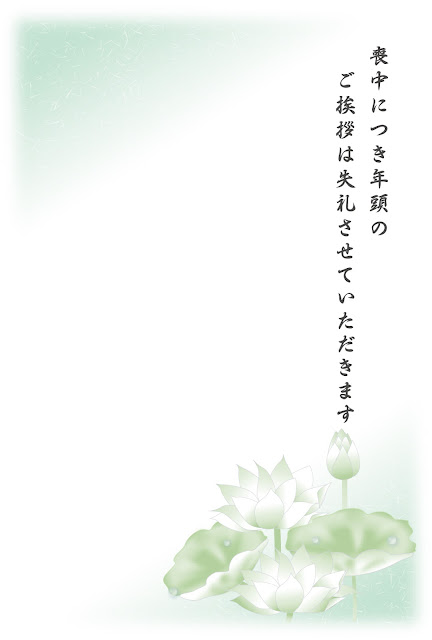
 The period of mourning after the death of a parent lasts one year. So I didn't observe the New Year's festival and didn't send New Year's cards.

It's a custom for people in mourning period to send a mourning postcard at the end of the year. In general, receivers of the postcard don't send a New Year's card to the sender.


mourning postcard
"Since I am in mourning, I am not sending New Year cards this year"


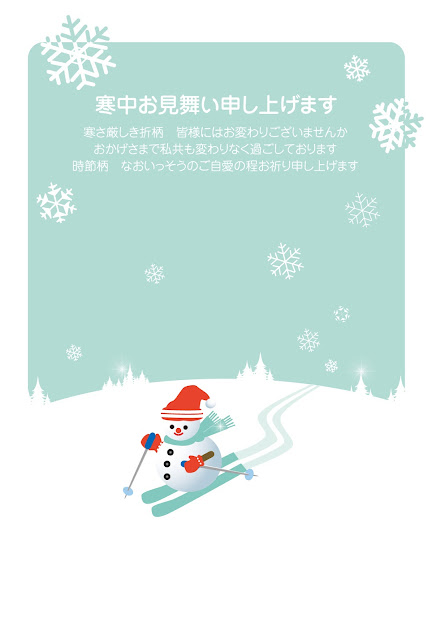
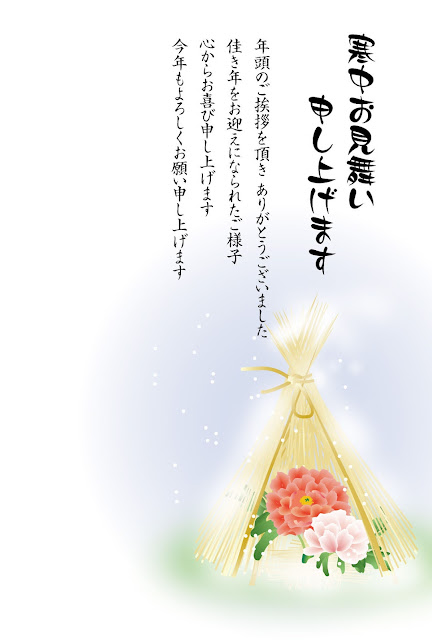
Kanchu-mimai(寒中見舞い, a mid-winter greeting card) is mailed from Shokan(小寒, minor cold or moderate cold), the 23rd in 24 Solar Terms to the day before Risshun(立春, Spring commences), the first in the terms. Shokan is around January 5, and Risshun is around February 4.

Kanchu-mimai card


Usually we mail New Year's cards until January 7. The greeting card is used as a reply to a New Year's card after January 7. 

Kanchu-mimai card
a reply to a New Year's card


We also use the card as a substitute for New Year's cards in mourning period.

Kanchu-mimai card
a substitute for New Year's cards in mourning period


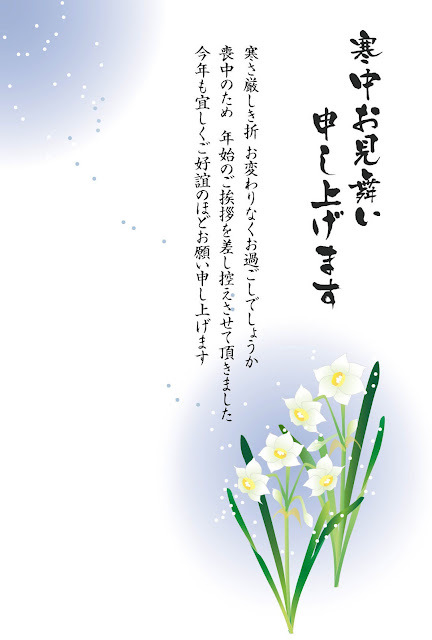
 For your information, Yokan-mimai(余寒見舞い) is mailed from Risshun to about the end of February in late winter. 

Yokan-mimai


Monday, September 13, 2021

The 68th Japan Traditional Kogei-Art Crafts- Exhibition

 The 68th Japan Traditional Kogei Exhibition(日本伝統工芸展) will take place from September 15, 2021 to March 6, 2022. The exhibition requires the applicants to create sophisticated design based on high degree of professional skill in Japanese traditional techniques.


See the Japan Kogei Association site for further information:

https://www.nihonkogeikai.or.jp/ (Japanese version only)

Japan Traditional Kogei Exhibition:

https://www.nihonkogeikai.or.jp/exhibition/honten/68 (Japanese version only)


The Exhibition will travel through the following venues:


Mitsukoshi Nihonbashi Main Store, Tokyo

(event hall, Main building 7F)

September 15-27, 2021

Mitsukoshi Nihonbashi Main Store:

https://www.mitsukoshi.mistore.jp/nihombashi.html


Mitsukoshi Nagoya Sakae Store, Nagoya City, Aichi Prefecture

(event hall, 7F)

September 29- October 4, 2021

Mitsukoshi Nagoya Sakae Store:

https://www.mitsukoshi.mistore.jp/nagoya.html


Takashimaya Osaka Store, Osaka Prefecture

October 15-20, 2021

Takashimaya Osaka Store:

https://www.takashimaya.co.jp/osaka/index.html


Ishikawa Prefectural Museum of Art, Kanazawa City, Ishikawa Prefecure

October 23-November 3, 2021

Ishikawa Prefectural Museum of Art:

http://www.ishibi.pref.ishikawa.jp/e_home/


Kyoto Sangyo Kaikan Hall, Kyoto Prefecture

(Kyoto Keizai Center 2F)

November 5-7, 2021

Kyoto Sangyo Kaikan Hall:

http://www.ksk.or.jp/ (Japanese version only)

Kyoto Keizai Center:

https://kyoto-kc.jp/ (Japanese version only)


the Okayama Prefectural Museum of Art, Okayama City, Okayama Prefecture

November 18-December 12, 2021

The Okayama Prefectural Museum of Art:

http://okayama-kenbi.info/en/


the Kagawa Museum, Takamatsu City, Kagawa Prefecture

January 2-16, 2022

The Kagawa Museum:

http://www.pref.kagawa.lg.jp/kmuseum/foreign/


Mitsukoshi Sendai Store, Sendai City, Miyagi Prefecture

(hall, Main building 7F)

January 20-25, 2022

Mitsukoshi Sendai Store:

https://mitsukoshi.mistore.jp/store/sendai/index.html


Mitsukoshi Fukuoka Store, Fukuoka City, Fukuoka Prefecture

(Mitsukoshi Gallery, 9F)

February 2-7, 2022

Mitsukoshi Fukuoka Store:

https://mitsukoshi.mistore.jp/store/fukuoka/index.html


Hiroshima Prefectural Art Museum, Hiroshima City, Hiroshima Prefecture

February 16-March 6, 2022

Hiroshima Prefectural Art Museum:

https://www.hpam.jp/museum/

Friday, January 1, 2021

new year 2021

 Wishing you and yours a safe, healthy, and prosperous new year! 


During the COVID-19 pandemic, my mother was hospitalized because of dehydration in February, because of pneumothorax and pneumonia in November. She remains largely stable now. She is not a COVID-19 patient, but meeting is restricted. In her hospital, we are permitted to visit a patient 10 minutes per week. 


2021 is the Year of the Ox according to the Chinese zodiac. Each of the 12 Chinese zodiac signs is related to a characteristic animal.


New Year's card(formal)


New Year's card(formal)

"丑" means an ox.


New Year's card(formal)
https://nengaprint.net/

Seven Deities of Good Fortune


New Year's card(formal)
https://nengaprint.net/

ema(絵馬)


New Year's card(formal/unformal)


New Year's card


New Year's card
https://nengaprint.net/


https://nengaprint.net/


New Year's card
https://nengaprint.net/
Amabie (アマビエ) is a Yokai(specter) in Japanese folklore, who emerged from the sea in Higo Province (Kumamoto Prefecture) and prophesied  abundant harvest for the next six years and an epidemic. The yokai instructed that people should draw an image of it and share it with as many people as possible in order to forestall the disease.
 The story was printed in the kawaraban(woodblock-printed bulletins) come out in 1846.


New Year's card
https://nengaprint.net/


Photograph courtesy of the Main Library, Kyoto University - Amabie
(kawaraban come out in 1846)


New Year's card(formal)
https://nengaprint.net/

Akabeko (red cow) is a traditional toy from the Aizu region in Fukushima Prefecture.
People believed that the red color could expel evil and that the toys could prevent children from contracting smallpox and other illnesses.


New Year's card(formal)
https://nengaprint.net/


New Year's card(unformal)
https://nengaprint.net/


New Year's card(unformal)
https://nengaprint.net/


New Year's card(unformal)
https://nengaprint.net/


Wednesday, January 1, 2020

New Year 2020

Happy New Year!

May the New Year bring many good things to you.

2020 is the Year of the Rat according to the Chinese zodiac.
Each of the 12 Chinese zodiac signs is related to a characteristic animal.
The rat has been seen as a symbol of wisdom, wealth and prosperity because they multiply rapidly and have been thought to be a messenger of Daikokuten (god of wealth).

New Year's cards

formal(to elders and betters)

謹賀新年(Kinga Shinnen)
恭賀新年(Kyoga Shinnen)
謹んで新春のご祝詞を申し上げます
謹んで初春(新春)のお慶びを申し上げます
あけましておめでとうございます


"子" means a rat.


Ornamental cabbages are often planted with violas and garden cyclamens.


New Year Holiday Arrangement with an ornamental cabbage


Ready-made traditional New Year foods called Osechi Ryori are set in three-tiered boxes.


Wednesday, September 18, 2019

The 66th Japan Traditional Kogei Exhibition Art Crafts

The 66th Japan Traditional Kogei Exhibition(日本伝統工芸展) is taking place at Mitsukoshi department store in Tokyo from September 18 to 30. The exhibition requires the applicants to create sophisticated design based on high degree of professional skill in Japanese traditional techniques.

Japan Traditional Kogei Exhibition:
https://www.nihonkogeikai.or.jp/exhibition (Japanese version only)


The Exhibition will travel through the following venues:

Mitsukoshi Nihonbashi Main Store, Tokyo
September 18-30, 2019
Mitsukoshi Nihonbashi Main Store:
https://www.mitsukoshi.mistore.jp/nihombashi.html


Mitsukoshi Nagoya Sakae Store, Nagoya City, Aichi Prefecture
October 2-7, 2019
Mitsukoshi Nagoya Sakae Store:
https://mitsukoshi.mistore.jp/store/nagoya/index.html


Takashimaya Kyoto Store, Kyoto Prefecture
October 9-14, 2019
Takashimaya Kyoto Store:
https://www.takashimaya.co.jp/kyoto/store_information/index.html


Ishikawa Prefectural Museum of Art, Kanazawa City, Ishikawa Prefecure
October 25-November 4, 2019
Ishikawa Prefectural Museum of Art:
http://www.ishibi.pref.ishikawa.jp/e_home/


Takashimaya Osaka Store, Osaka Prefecture
Novmber 6-11, 2019
Takashimaya Osaka Store:
https://www.takashimaya.co.jp/osaka/store_information/index.html


the Okayama Prefectural Museum of Art, Okayama City, Okayama Prefecture
November 14-December 1, 2019
The Okayama Prefectural Museum of Art:
http://okayama-kenbi.info/en/


Shimane Art Museum, Matsue City, Shimane Prefecture
December 4-25, 2019
Shimane Art Museum:
http://www.shimane-art-museum.jp/en/


the Kagawa Museum, Takamatsu City, Kagawa Prefecture
January 2-19, 2020
The Kagawa Museum:
http://www.pref.kagawa.lg.jp/kmuseum/foreign/


Mitsukoshi Sendai Store, Sendai City, Miyagi Prefecure
January 22-27, 2020
Mitsukoshi Sendai Store:
https://mitsukoshi.mistore.jp/store/sendai/index.html


Mitsukoshi Fukuoka Store, Fukuoka City, Fukuoka Prefecture
February 4-9, 2020
Mitsukoshi Fukuoka Store:
https://mitsukoshi.mistore.jp/store/fukuoka/index.html


Hiroshima Prefectural Art Museum, Hiroshima City, Hiroshima Prefecture
February 13-March 1, 2020
Hiroshima Prefectural Art Museum:
https://www.hpam.jp/museum/

Sunday, April 7, 2019

ceremonies for Imperial succession

The new imperial era will begin on May 1. Emperor Akihito will be called “emperor emeritus” and Empress Michiko “empress emerita” following his abdication in April.  Prince Akishino, Crown Prince Naruhito's younger brother, will be the next crown prince.

A series of the ceremonies for the Imperial succession started on March 12. Most of them are simple and are not open to the public.

Taiirei-Seiden-no-gi(the core abdication ceremony) beginning at 5:00 p.m. JST, April 30,
Kenji-to-Shokei-no-Gi(Inheritance Ceremony of Kenji and others)beginning at 10:30 p.m. JST, May 1,
Sokuigo Choken-no-gi (the new emperor's declaration of accession to the throne)beginning at 11:10 p.m. JST, May 1
will be broadcast live on NHK(Japan Broadcasting Corporation), NHK World(https://www3.nhk.or.jp/nhkworld/).

 In 2019 travelers should be careful about the holidays that will last from April 28(27) to May 6.


The abdication ceremonies of Emperor Akihito


12 March 
Kashikodokoro-ni-Taii-oyobisono-Kijitu-Hokoku-no-gi:
Koreiden-Shinden-ni-Taii-oyobisono-Kijitsu-Hokoku-no-gi:
 The Emperor wearing ancient attire for emperors reads out a script to report his abdication and its date at Kashikodokoro(賢所), Koreiden(皇霊殿) and Shinden(神殿) on Imperial Palace grounds.
Imperial ancestor Amaterasu-omikami(the sun goddess) is enshrined in Kashikodokoro(賢所). Successive emperors and members of the imperial family are enshrined in Koreiden(皇霊殿). Eight guardian gods of emperors and gods in heaven and earth are enshrined at Shinden(神殿).

Jingu-Jinmu-Tenno-Sanryooyobi-Showa-Tenno-izen-Yondai-no-Tenno-Sanryo-ni-Chokushi-Hakkenn-no-gi:

The Emperor sends Imperial envoys for reporting his abdication and its date, and making offerings to the Ise Grand Shrine and the Mausolea of Emperor Jinmu and the 4 recent Emperors up to Emperor Showa.
The Mausolea of Emperor Komei and Emperor Meiji are located in Kyoto City, Kyoto Prefecture.  Those of Emperor Taisho and Emperor Showa(Hirohito) are located in Hachioji City, Tokyo Prefecture.

15 March
Jingu-ni-Hohei-no-gi:
The Imperial envoy reports the abdication and its date, and made offerings at the Ise Grand Shrine.
Jinmu-Tenno-Sanryo-oyobi-Showa-Tenno-izen-Yondai-no-Tenno-Sanryo-ni-Hohei-no-gi:
The Imperial envoys report the abdication and its date, and made offerings at the Mausolea of Emperor Jinmu and the 4 recent Emperors up to Emperor Showa.

26 March
Jinmu-Tenno-Sanryo-ni-Shin'etsu-no-gi:
The Emperor pays reverence at the Mausoleum of Emperor Jinmu, Kashihara City, Nara Prefecture.

18 April
Jingu-ni-Shin'etsu-no-gi:
The Emperor pays reverence at the Ise Grand Shrine, Ise City, Mie Prefecture.
23 April
Showa-Tenno-Sanryo-ni-Shin'etsu-no-gi:
The Emperor pays reverence at the Mausoleum of Emperor Showa, Hachioji City, Tokyo.
30 April
Taiirei-Tojitsu-Kashikodokoro-Omae-no-gi,
Sokuirei-Tojitsu-Koreiden-Shinden-ni-Hokoku-no-gi:
 The Emperor reports the conduct of the Abdication Ceremony at Kashikodokoro, Koreiden and Shinden in Imperial Palace.

Taiirei-Seiden-no-gi(退位礼正殿の儀, the core abdication ceremony):
Attendants gather at the Matsu no Ma (main hall) of the Imperial Palace. At 5:00 pm, the imperial couple enter the hall. They are accompanied by the crown prince and the crown princess, imperial princes and princesses(their wives), imperial princesses, great-granddaughters of Emperor Taisho. Chamberlains place the sword and the jewel of the Three Imperial Regalia, the Great seal and the Imperial seal on a table in front of the emperor. Prime Minister Shinzo Abe gives a speech on behalf of the Japanese people. The emperor gives a farewell address.

About 338 attendants of the ceremony include the prime minister, cabinet ministers, speakers and vice‐speakers from both houses of the Diet, the chief justice of Supreme Court of Japan, prefectural governors. After the couple make their exit, the attendants make their exit. The ceremony lasts for 10 minutes from 5:00 pm.


三神器
sword, mirror, and magatama
PawełMM [Public domain], via Wikimedia Commons

The Three Imperial Regalia consist of the sword Kusanagi (草薙劍), the mirror Yata no Kagami (八咫鏡), and the jewel Yasakani no Magatama (八尺瓊勾玉). 

Magatama are curved, comma-shaped beads. The oldest  magatama were excavated from ruins of the Jomon Period(c.14,000- 300BCE). The beads were popular in the tumulus period(300-538).
Yata no Kagami is a bronze mirror with one side polished bright, to give a reflection, and the reverse side with designs.

It is thought that the three regalia became used to confer legitimacy on their owner as an emperor around 9th century. The real sacred mirror is enshrined as an object symbolizing the goddess Amaterasu Omikami at the Ise Grand Shrine, Ise City, Mie Prefecture. Its replica is enshrined at Kashikodokoro of Imperial Palace. The real Kusanagi sword is placed at Atsuta Jingu Shrine in Nagoya City, Aichi Prefecture. Its replica and the jewel (it's real) are stored in a room of Imperial palace.

The sword's replica was made during the reign of Emperor Sujin, who is said to have lived in the early 1st century, or the third or fourth century. In the Nihonshoki(Chronicles of Japan), the real Kusanagi was moved from the Imperial palace to the Ise Grand Shrine. Later it was transferred to the Atsuta Shrine.
Though the replica remained in the Imperial palace, it  sank to the sea floor in 1185 when the Taira clan were defeated by the Minamoto clan at the Battle of Dan-no-ura. The sword and the jewel sank with many Taira clan members including the eight year-old Emperor Antoku. The jewel was recovered, but the sword was lost. Another sword was sent from the Ise Grand Shrine to the Imperial palace, and the sword became the replica of Kusanagi sword.

However, no one (even emperor) can see the real regalia and the replicas.


the enthronement ceremonies of the new Emperor

1-3 May
Kashikodokoro-no-gi:
Ceremony to report  the accession to the throne at Kashikodokoro in Imperial Palace(ritual prayer by a proxy).
1 May
Koreiden-Shinden-ni-Hokokuno-gi:
Ceremony to report the accession to the throne at Koreiden and Shinden in Imperial Palace(ritual prayer by a proxy).

Sokui no rei(即位の礼, enthronement ceremony) :

 1. Kenji-to-Shokei-no-Gi(Inheritance Ceremony of Kenji(剣璽, the sword and the jewel) and others)
Attendants of the ceremony including cabinet ministers, the heads of the three branches of government  gather at the the Matsu-no-Ma hall of the Imperial Palace. At 10:30 am, the new emperor enters the hall. He is accompanied by the crown prince and adult imperial princes.  Chamberlains place the sword and the jewel of the Three Imperial Regalia, the Great seal and the Imperial seal on a table in front of the new emperor. The new emperor makes his exit. Chamberlains carry the regalia and the seals out of the hall. The attendants make their exit. The ceremony lasts for 10 minutes from 10:30 am.


2. Sokuigo Choken-no-gi (the new emperor's declaration of accession to the throne)
Attendants of the ceremony gather at the the Matsu-no-Ma hall of the Imperial Palace. At 11:10 am, the new imperial couple enter the hall. They are accompanied by the crown prince and the crown princess, imperial princes and princesses(their wives), imperial princesses, and great-granddaughters of Emperor Taisho. The new emperor make an address. Prime Minister Shinzo Abe gives a speech on behalf of the Japanese people. The new imperial couple make their exit. The attendants make their exit. The ceremony lasts for 10 minutes from 11:10 am.

4 May
Ippan-Sanga(Visit of the General Public to the Palace for celebrating the enthronement of the new emperor):
The new emperor receives congratulations from the general public after the Enthronement Ceremony at the Imperial Palace. No reservations are necessary, but visitors need to allow enough time to go through security check.

8 May
Kashikodokoro-ni-Kijitsu-Hokoku-no-Gi:
The new emperor reports the dates of the Enthronement Ceremony and Daijosai (Great Thanksgiving Ceremony) at Kashikodokoro in  Imperial Palace.
Koreiden-Shinden-ni-Kijitsu-Hokoku-no-Gi:
The new emperor reports the dates of the Enthronement Ceremony and Daijosai (Great Thanksgiving Ceremony) at Koreiden and Shinden in  Imperial Palace.
Jingu-Jinmu-Tenno-Sanryo-oyobi-Zen-Yondai-no-Tenno-Sanryo-ni-Chokushi-Hakken-no-Gi:
Ceremony to send Imperial envoys for reporting the dates of the Enthronement Ceremony and Daijosai (Great Thanksgiving Ceremony), and making offerings to the Ise Grand Shrine and the Mausolea of Emperor Jinmu and the 4 recent Emperors up to Emperor Showa.

10 May
Jingu-ni-Hohei-no-Gi:
The Imperial envoy reports the dates of the Enthronement Ceremony and Daijosai (GreatThanksgiving Ceremony), and makes offerings at the Ise Grand Shrine.
Jinmu-Tenno-Sanryo-oyobi-Showa-Tenno-izen-Yondai-no-Tenno-Sanryo-ni-Hohei-no-gi:
The Imperial envoys report the dates of the Enthronement Ceremony and Daijosai (GreatThanksgiving Ceremony), and make offerings at the Mausolea of Emperor Jinmu and the 4 recent Emperors up to Emperor Showa.

22 October
Sokuirei-Tojitsu-Kashikodokoro-Omae-no-gi:
The Emperor reports the conduct of the Enthronement Ceremony at Kashikodokoro.
Sokuirei-Tojitsu-Koreiden-Shinden-ni-Hokoku-no-gi:
The Emperor reports the conduct of the Enthronement Ceremony at Koreiden and Shinden.

Sokuirei-Seiden-no-Gi(即位礼正殿の儀, the core enthronement ceremony):
The new emperor proclaims his enthronement and receives felicitations of representatives from home and abroad. About 2,500 guests are invited to attend the ceremony, including heads of states and their spouses, congratulatory envoys and their spouses, ambassadors to Japan, representatives of Japanese descendants from 195 countries.

Shukuga-Onretsu-no-Gi(the coronation parade):
A celebration parade moves from the Imperial Palace to the Akasaka Imperial Residence. The imperial couple get in a convertible, the crown prince does in another car. About 110,000 people lined motorcade route to cheer at the last coronation parade in 1990.

22, 25, 29, 31 October
Kyoen-no-Gi(Imperial Court banquet):
Court banquet to celebrate the enthronement of the Emperor and for him to receive the congratulations of the guests in the Imperial Palace. Sit-down dinners are held on October 22 and 25, stand-up ones are done on October 29 and 31.
About 2,600 guests are invited to attend the banquet, including heads of states and their spouses, congratulatory envoys and their spouses, ambassadors to Japan and their spouses, representatives of Japanese descendants.

23 October
Formal dinner put on by the Prime Minister and his wife at the Hotel New Otani Tokyo:
About 900 guests are invited to attend the dinner, including heads of states and their spouses, congratulatory envoys and their spouses, two representatives of each country, representatives of Japanese descendants.

14-15 November
Daijosai(大嘗祭, GreatThanksgiving Ceremony)

Daijokyu-no-gi 
(Yukiden-Kyosen-no-gi,Sukiden-Kyosen-no-gi):
Daijosai is a Niinamesai that a new emperor holds for the first time after his enthronement. Annual Niinamesai is a harvest festival held at Shinkaden in Imperial Palace on November 23rd. The festival dates back at least to 677. 
Daijosai takes place at a temporary site. This year's site is East Gardens on Imperial Palace Grounds.
The new emperor dedicates newly harvested rice to imperial ancestors and gods in heaven and earth for the first time after his enthronement, and he partakes of the rice.
The rites related to Daijosai  are held on May 13, November 8, 12, 13,14,16, 18. The dates of five rites are to be determined.

TBD
Sokuirei-oyobi-Daijosai-go-Jingu-ni-Shin'etsu-no-Gi:
The Emperor pays reverence at  the inner and outer shrine of the Ise Grand Shrine after the Enthronement Ceremony and Daijosai (GreatThanksgiving Ceremony).
Sokuirei-oyobi-Daijosai-go-Jinmu-Tenno-Sanryo-oyobi-Zen-Yondai-no-Tenno- Sanryo-ni-Goshin'etsu-no-Gi:
The Emperor pays reverence at the Imperial mausoleums of Emperor Jinmu and the four most recent Emperors, after the Enthronement Ceremony and Daijosai (GreatThanksgiving Ceremony).
Sokuirei-oyobi-Daijosai-go-Kashikodokoro-ni-Shin'etsu-no-Gi:
The Emperor pays reverence at Kashikodokoro in the Imperial palace after the Enthronement Ceremony and Daijosai (GreatThanksgiving Ceremony).
Sokuirei-oyobi-Daijosai-go-Koreiden-Shinden-ni-Shin'etsu-no-Gi:
The Emperor pays reverence at the Koreiden and Shinden in the Imperial palace after the Enthronement Ceremony and Daijosai (GreatThanksgiving Ceremony).
Sokuirei-oyobi-Daijosai-go-Kashikodokoro-Mikagura-no-Gi:
A ceremonial performance of Mikagura (Japanese Court Music) at Kashikodokoro after the Enthronement Ceremony and Daijosai (GreatThanksgiving Ceremony)

19 April, 2020
Rikkoshi-no-Rei(立皇嗣の礼):

Ceremony for Proclamation of the new Crown Prince at the Imperial Palace