Events:
Cherry Blossom Forecast 2026
https://www.japan-guide.com/sakura/
https://n-kishou.com/corp/news-contents/sakura/?lang=en
https://sakura.weathermap.jp/ (Japanese version only)
https://tenki.jp/sakura/expectation/ (Japanese version only)
https://www.otenki.jp/sp/art/sakura/?pg=11 (Japanese version only)

when and where to see fall foliage(Japanese version only):
https://hanami.walkerplus.com/
https://sp.jorudan.co.jp/hanami/

Monday, May 16, 2011

Aoi Matsuri


Shimogamo Shrine
 The Aoi Matsuri (葵祭:Wild ginger festival) was held on May 15th in Kyoto.
(Refer to The Aoi Matsuri and Aoi Matsuri in Japanese literature for information about this festival.)


Kamigamo Shrine
A procession of people in historical costumes started at around 10:30 from the Imperial Palace, arrived at around 11:40 at Shimogamo Shrine(下鴨神社), started at 14:20 from the shrine and arrived at around 15:30 at Kamigamo Shrine(上賀茂神社).  Rituals were held at the Imperial Palace and the two shrines.

The procession consists of the following characters and others.

Real police officers on horseback head the procession.

Norijiri(乗尻) on horseback are six members of the Kamo family. They are the riders who galloped atop their horses at Kamigamo Shrine on May 5th.


 security officer called Kebiishi no Sakan(検非違使志)


chief security officer called Kebiishi no Jo(検非違使尉)

Ouma(御馬) are two horses to show gods. Norijiri ride these horses at the two shrines.


Gissha(牛車) is an oxcart decorated with wisteas. Oxen for Gissha are almost from Kyoto, but they include oxen from Okayama Prefecture in recent years.


Maiudo(舞人) is a military officer. He dances at this festival.


Chokushi(勅使) is an Imperial messenger, but a reliefer joins the procession now.
Actually, he is the main character at this festival. Chokushi is unspectacular but key appointment.

Huryukasa(風流傘) is a parasol decorated with artificial flowers such as peony flower and rabbit-ear iris.
Baiju(陪従) is a military officer. he sings a song and play musical instruments at this festival.


Saio-dai(斎王代) means a substitute for Saio(斎王). Saio was an unmarried female relative of the Japanese emperor and served gods. Now an ordinary woman associated with Kyoto is selected as Saio-dai.
Saio and ladies were added to the procession in 1956.
Myobu(命婦) and Nyoju(女嬬) are ladies-in-waiting to Saio.


Menowarawa(女童) is a girl who serves Saio.


Munenori-onna(駒女) is a shrine maiden on horseback.


Originally, Uneme(采女) was a lady-in-waiting who set the table for emperors and empresses. Uneme came to be selected from among ladies-in-waiting on special occasions.

Photo by KYOTOdesign(Japanese version only)

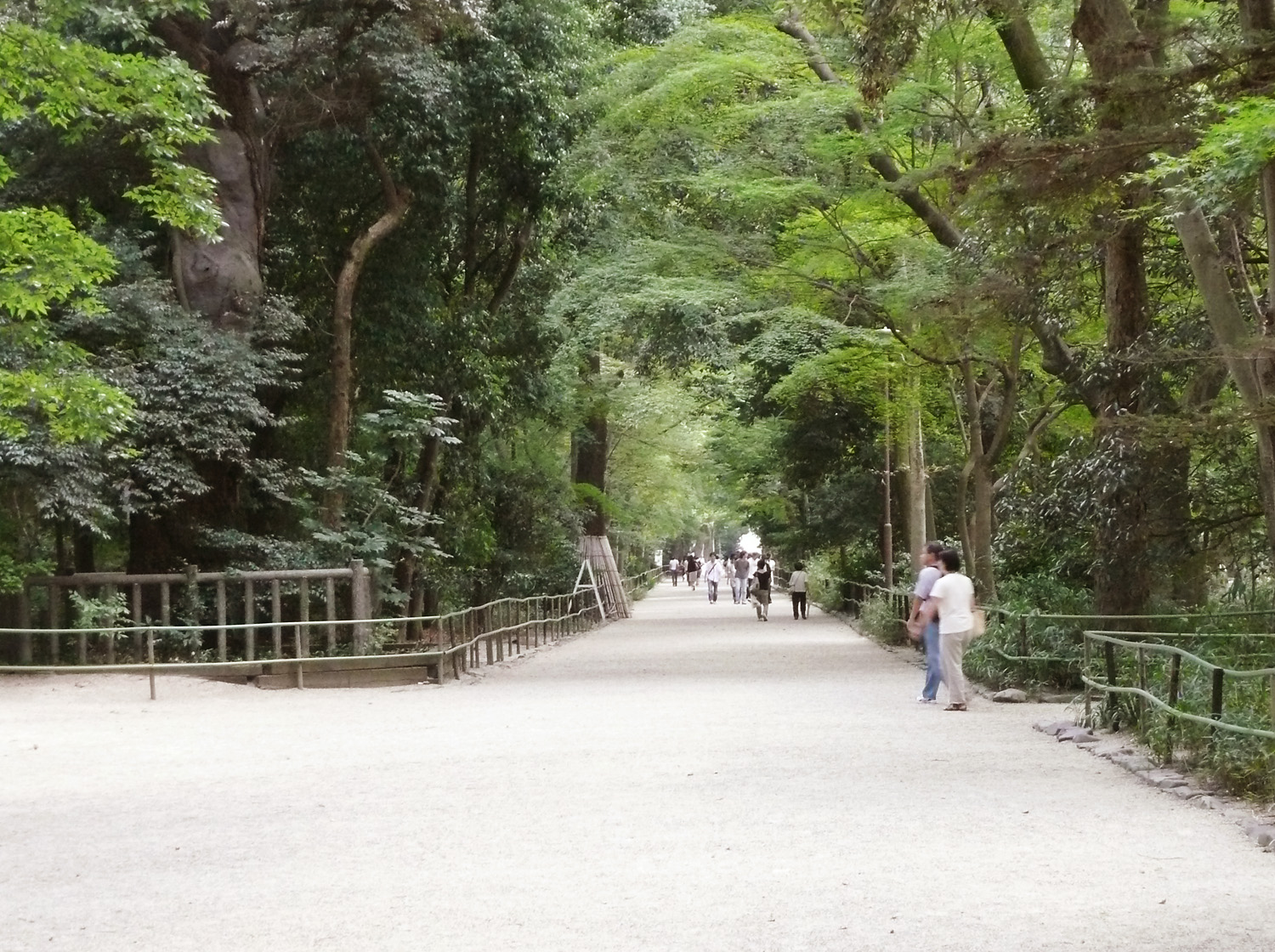
Shimogamo Shrine, the approach and
the surrounding virgin forest
called Tadasu no Mori (糺の森)
Yase(八瀬) is located in Kyoto. People living in Yase are called Yase-doji(八瀬童子). They claimed descent from oni(demons).

After they carried Emperor Godaigo on a palanquin in 1336, they gained an official position as palanquin bearers for emperors. So they had been exempt from taxation and exacted service until 1945.

Yase-doji carried Emperor Meiji and Emperor Taisho on a palanquin at their funerals, but they attended as an observer at Emperor Showa's funeral.
Even now, about 90 people including children in Yase take part in the Aoi Festival every year.

You can see Mikage Matsuri(御蔭祭) at Shimogamo Shrine on the blog "京都を歩くアルバム"(Japanese version only).

Monday, May 9, 2011

Mother's Day and Matsushima

Today is Mother's Day.

A carnation grower in one of the afflicted areas shipped tsunami-hit carnations. Although they became submerged in muddy water, they have produced masses of flowers after the water had receded.

In the afflicted areas, many people placed white carnations beside the remains of their houses, their mothers' remains in temples and their family graves.

Many people enjoy digging clams at the beach during Golden Week holidays every year, but less people went to the beaches along the Pacific Ocean in Kanto Region. In some area, a tidal range doesn't create the mudflats.
 
 
Matsushima(松島) in Miyagi Prefecture was crowded with many visitors during Golden Week holidays.

A pleasure boat restarted at the end of April. Marinepia Matsushima Aquarium repoened although some sea animals were killed by tsunami.

Matsushima has been long known as one of "the three most scenic spots in Japan(日本三景,nihonsankei)", along with Amanohashidate in Kyoto and Miyajima in Hiroshima.

 Photo by (c)Tomo.Yun

Matsuo Basho(松尾芭蕉) visited this spot in 1689, but there is no haiku poem featuring Matsushima in his famous travelogue "Oku no Hosomichi" (The Narrow Road to the Deep North).

However, he composed the following poem featuring Matsushima.

島々や 千々に砕きて 夏の海  (しまじまや ちぢにくだきて なつのうみ)
"A scattering of small islands break waves in the summer sea."

The town of Matsushima had relatively little damage. Coastal souvenir shops and restaurants had water above floor level and four people died or are missing. It is said that about 260 small islands in the Matsushima bay served as a buffer for tsunami.


Hondo

Zuigan-ji Temple(瑞巌寺) that is the family temple of Date clan is also attracting many visitors. Zuigan-ji Temple was reopened to the public on Aptil 10th.


Kuri

The temple was found in 828 and the first lord of the Semdai Domain, Date Masamune(伊達政宗) built several buildings including the main building(本堂, Hondo) and kitchen(庫裡, Kuri) in 1609.


These two buildings have been designated as national treasures. No damage was done to the main building, but Kuri developed some cracks in the wall.

The approach
 The approach to the temple was covered by mud.


Garyubai
It is said that Masamune himself planted Garyubai(臥龍梅), a variety of ume on the grounds of the temple. The ume trees reached full bloom on April 24th this year.

Visitors and residents in Matsushima took refuge in the temple after the quake and tsunami. About 300 people stayed in the building for trainee Zen monks. The monks prepared and served meals to the afflicted people. The disaster victims in the temple could sleep on futon. The monks also drew water to flush the toilet and worked to clear the rubble. Souvenir shops contributed foods to the temple.
A visitor helped the monks and residents with the cleaning in gratitude for them.

Saturday, May 7, 2011

wisteria and azalea

Wisterias(藤, fuji) and azaleas(躑躅, tsutsuji) are in full bloom.


Okanbara Azalea Garden(大桑原つつじ園, Okanbara Tsutsuji-en) in Fukushima Prefecture 

photo by 日本列島お国自慢


Nagaoka Tenmangu Shrine(長岡天満宮) in Kyoto 


Nishiyama Park(西山公園, Nishiyama Koen) in Fukui Prefecture 

Mount Ohira(大平山, Ohira-yama) in Okayama Prefecture

wild azaleas

Mount Yamato-katsuragi (大和葛城山, Yamato-katsuragi-san) in Nara Prefecture 

wild azaleas

Kasuga Taisha Shrine(春日大社) in Nara Prefecture 


Wake Wisteria Park(和気藤公園, Wake Fuji-koen) in Okayama Prefectur 


Byakugo-ji Temple(白毫寺) in Hyogo Prefecture 


Shirai-omachi Wisteria Park(白井大町藤公園, Shirai-omachi Fuji-koen) in Hyogo Prefecture 


photos by 高画質壁紙写真集無料壁紙


Wisteria Maiden(藤娘, Fuji Musume)

Wisteria Maiden is well known as a classical Japanese dance perfromance.
This is a confection called Makimono-gashi(蒔物菓子) that is handed to invited guests to Japanese dance or koto recital as a souvenir.

Thursday, May 5, 2011

carp streamers

In the Edo Period, samurai families with boys flew their family banners and commoners with boys hoisted carp streamers.
Recently, a troop of streamers are put up in many areas. Lesser people hoist standard-sized carp streamers and many streamers have sat in closets for a long time.

A village in Kochi prefecture started to gather those streamers and hoist them over the Shimanto River (四万十川) which is referred to as "the last clear stream of Japan".

past Hamamatsu Festival

Kite-flying was done as an event to celebrate Tango no Sekku(now the Boys' Festival) in some areas during the Edo Period.
past Hamamatsu Festival
Large kites fly in Zama in Kanagawa Prefecture and kites compete against other towns' ones in Hamamatsu in Shizuoka Prefecture. A kite tries to bring down another kite by cutting its string by friction. Kites competition is held as Hamamatsu Festival every year, but the festival was cancelled this year.

Wednesday, May 4, 2011

Hakata Dontaku

Tsuruga-jo Castle (鶴ヶ城)
The cherry blossoms are in full bloom at Hirosaki Park in Aomori Prefecture and at Tsuruga-jo Castle in Fukushima Prefecture.

Meanwhile, the rainy season started in Okinawa on April 30th.

We are on holidays called Golden Week that refers to the period from April 29th to May 5th including four national holidays.

The travel industry experienced a huge drop in business since the quake and tsunami. Especially, some areas such as Aizuwakamatsu City has been still suffering from the harmful rumor. The city is located in Fukushima Prefecture, but the city has not been affected by radioactivity.

Some tourist spots in Tohoku Region such as Hirosaki Park and Tsuruga-jo Castle are being crowded with tourists. Many people are traveling in Tohoku Region to support people in Tohoku.
It encouraged this trend that the entire portion of the Tohoku Shinkansen line reopened on April 29th.


Hakata Dontaku is an annual festival held on May 3rd and 4th in Hakata in Fukuoka Prefecture. The festival attracts more than 2 million tourists every year.

The name Dontaku comes from the Dutch word Zondag, meaning Sunday or holiday.

The festival dates back to the end of the 12th century. Originally, it was a performance to celebrate the New Year. men dressed up as the three gods of Good Luck, children in traditional attire and people called Torimon(通りもん) performed. Torimon march along the street, playing festival music with shamisen, flutes and drums. 


children in traditional attire


Daikokuten(大黒天) - one of the gods of Good Luck


Fukurokuju(福禄寿) - one of the gods of Good Luck


Ebisu(恵比須) - one of the gods of Good Luck

提供:福岡市

photo by Fukuoka Showcase(English version)

Thursday, April 28, 2011

the 49th day after death

In the affected areas, Buddhist memorial services were held on April 28th that marked the 49th day after death. 
It is thought that the souls of the dead alternate between the afterworld and this world during the seven weeks after death in most buddhist sects. The dead are judged by Yama(the King of Hell) every seven days and Yama decides whether the dead could go to the heaven(Amitabha's Pure Land) on the day.

Remains of the deceased pray that the dead can go to the heaven during the period. Bereaved families come to terms with their family member's death during the period. Most of them place the dead's ashes in their tombs on the day.

However, 11,432 people are still missing although the Japan Self-Defense Forces and others have been searching for them.


On April 26th, 25 years have passed since a large-scale radiation leak occurred at the Chernobyl nuclear plant in 1986.

On April 25th, an actress's funeral was held in Japan. She debuted as a member of an idol trio, retired five years later and made a comeback as an actress since then.

Her best knowm film is "Black Rain(黒い雨, Kuroi Ame) " directed by Shohei Imamura in 1989. He depicted the real nature of human beings in his films.

The film is based on the novel of Masuji Ibuse and the novel is based on the diaries of atomic bombing victims. It depects the horror of radioactive rain called black rain and residual radioactivity, a lack of understanding about atomic bomb disease and discrimination against atomic bombing victims.

It was shown at the Cannes International Film Festival. When I read a movie critic's review that the film emphasized that Japanese people were victims during the war and lack understanding of themselves as aggressors, I was stunned by the fact that he never thought that radiation exposure could be a problem for himself although only three years had passed since the nuclear meltdown at Chernobyl.

The actress left a message recorded on her sickbed for her farewell service. she condoled with the quake and tsunami victims at the beginning. She told that she wanted to be of service to the dead from the quake and tsunami if she went to the heaven, she had a very happy life but wanted to continue to act more and more and appreciated everybody.

She maintained a friendship with the other members of the idol trio. They knew that she had been fighting against breast cancer for nearly twenty years and didn't have that much time. They were in at the finish with her family and made the main speech at her funeral.

Monday, April 25, 2011

Hirosaki Cherry Blossom Festival


Hirosaki Cherry Blossom Festival is being held at the Hirosaki Park from April 23rd to May 5th. The cherry blossoms are late blooming this year, so its period will be extended for three days.

Hirosaki Park includes Hirosaki Castle constructed in 1611 and its grounds. Hirosaki belongs to Aomori Prefecture that includes some tsunami-hit regions such as Hachinohe City. Even so, Hirosaki decided to hold this festival.

I've been to the festival, but the blossoms have passed a peak.

These pictures were taken in 2008 and 2009.
photo by 「青い森の写真館」(Japanese version only)
In Aomori, cherry blossoms, ume and daffodils come into bloom all together.

I heard from the provider of these photos. An acquaintance of his,  a disaster victim said, "I want to soak in a bathtub and have a good night's sleep. Of course, I know, I'm asking too much."

Saturday, April 23, 2011

Shoryo-e (memorial service for Prince Shotoku)

Double cherry blossom(八重桜, yae-zakura), flowering dogwood(花水木, hanamizuki) and rhododendron(石楠花, shakunage) are blooming in my town.

I often hear a Japanese bush warbler singing.


According to Chronicles of Japan, the 22th day of 2nd month in the lunar calendar is the anniversary of the deatn of Prince Shotoku(聖徳太子, 574-622 or 629).

Shoryo-e(聖霊会) which is the annual memorial service for Prince Shotoku including a parade, Gagaku(雅楽, ancient court music and dance) were held on April 22th in Horyu-ji Temple(法隆寺) and Shitenno-ji Temple(四天王寺). Those temples were built by order of him.
Horyu-ji usually holds the service on March 22th and does it on April 22th once every ten years.


These are some costumes of the dances performed in Shitenno-ji. Dancers dressed in colorful costumes perform in groups of four or five each.


the dance named Soriko(蘇利古)


This dance expresses an enjoyable drinking party. Some people say the dance came from the custom that brewers held an event to commemorate the god of furnace and well in an ancient kingdom located in southwest Korea.


the dance named Manzairaku(万歳楽)

Some say this dance music was modeled on a song of a bird during the Sui or Tang dynasty in ancient China. This is performanced on celebratory occasions.


the dances named Garyobin(迦陵頻) and Kocho(胡蝶)

Garyobin is the dance of Garyobinga(迦陵頻伽) which is an imaginary creature in Buddhism, part human and part bird. It is believed that it lives in Sukhavati(Amitabha's Pure Land).

Kocho is butterfly dance. This dance and its music are said to be made in 906 in Japan.
Two groups dance together on each side of the stage. Garyobin is performanced on the left side of the stage and Kocho is done on its right side. Both of them are performed by boys (or women).
This illustration depicts dancers on pleasure boats with dragon head and imaginary bird head.


A score for Asian lute (Biwa called in Japan) is found on the reverse of a Buddhist scripture discovered in the Mogao Caves of Dunhuang(敦煌) in China in 1900. Gagaku was originally the Chinese ceremonial music, but it died out completely in China.

The discovered score is very similar to the biwa score that is in use nowadays in Japan. Its title is about the same. Some gagaku musicians restored the piece in the style of Japanese gagaku.

The Court musicians of the Imperial Household mastered the playing skills of western musical instruments through training in the Meiji Period and perform at events at the Imperial Palace.