Events:
Cherry Blossom Forecast 2026
https://www.japan-guide.com/sakura/
https://n-kishou.com/corp/news-contents/sakura/?lang=en
https://sakura.weathermap.jp/ (Japanese version only)
https://tenki.jp/sakura/expectation/ (Japanese version only)
https://www.otenki.jp/sp/art/sakura/?pg=11 (Japanese version only)

when and where to see fall foliage(Japanese version only):
https://hanami.walkerplus.com/
https://sp.jorudan.co.jp/hanami/

Wednesday, June 30, 2010

Nagoshi no Harae

The events to purify people from half-year's worth of sin had been held on the last days of the 6th month and the 12th month in the lunar calendar.

One of them, named Nagoshi no Harae(夏越祓), is held on June 30th in Kyoto now. At the event, Chinowa Kuguri(茅の輪くぐり) is held at many shrines. It is also held at the shrine near my house.
People purify them by going through a large loop made of Imperata cylindrica(cogongrass) or Miscanthus sinensis (Susuki grass).

Ice had been cut out in the northern part of Kyoto as a tribute to the Emperor and had been carried to the Imperial Palace on the 1st day of the 6th month in the lunar calendar. This event was called Himuro no Sekku(氷室の節句). Himuro literly means ice room.


On this day, people in Kyoto eat a confection named Minazuki(水無月), which is cut into a triangle to the semblance of ice chip and is topped with azuki beans to pray for good health.

Tuesday, June 29, 2010

At a night in the rainy season

Hot humid weather has lasted for days. It promotes the growth of fungus and often causes food poisoning. we are troubled by propagation of mold.

Meanwhile, it has encouraged fermentation technology, and we can eat fermented food such as miso, soy sauce, sake(Japanese liquor), natto which is made from soybeans fermented with Bacillus subtilis var. natto, original sushi and Japanese pickles.

Towards the end of the rainy season, some areas are hit by heavy rain every year. Warnings of heavy rains and local flooding are issued for Kyushu now.

At a night of the rainy season, some men including Hikaru Genji(光源氏) talk together a lot on the women of their dreams.
They relate their experiences with their old lovers such as a jealous woman, a shy woman, a highbrow woman and an unfaithful woman.

Although Genji is married to a minister's daughter, commuting relationships are common at that time and he has stayed at the security office in the Imperial court for many nights.

Hahakigi(帚木), the 2nd chapter of "The Tale of Genji" written by Murasaki Shikibu, includes this episode. Hahakigi is a legendary tree which can be seen not from up close but from a distance.

Monday, June 21, 2010

The Summer Solstice

Yesterday was Father's Day, but it's pale compared to Mother's Day.
Many people are very interested in the World Cup soccer games now.
Hanashoubu(花菖蒲:Japanese water iris) are now at their peak.

Warnings of heavy rains and local flooding are issued for Kyushu now.

五月雨を 集めてはやし 最上川(「奥の細道」松尾芭蕉)
"Gathering as much early summer rain as possible, the Mogami River comes rushing down in a torrent", written by Matsuo Bashou (松尾芭蕉,1644–1694) in "The Narrow Road to the Deep North".

Samidare(五月雨) literally means rain falling in the 5th month in the lunar calendar. Originally, it means rain falling in the rainy season.


The Summer Solstice occurs around June 21st each year.
It is marked by the longest day and shortest night of the year.

夏の夜は まだ宵ながら 明けぬるを 雲のいづこに 月やどるらむ(「古今集」清原深養父)
"Summer nights are short, so I felt that dawn succeeded night during the early evening. Where in clouds does the moon spend night?", written by Kiyohara no Fukayabu(清原深養父), Sei Shounagon's great-grandfather.


五月闇 短き夜半の うたたねに 花たちばなの 袖に涼しき(「新古今集」慈円)
"When I am dozing off at a short night in the rainy season, wind carries the smell of tachibana(橘:Citrus tachibana) and makes me feel the cool air through my sleeves", written by Jien(慈円,1155–1225), who was a Japanese poet, historian and Buddhist monk.

We have few sun exposure and rarely see the shining moon and stars in the rainy season. Satsuki-yami(五月闇) means moonless night or dark weather in the rainy season.


Seiryu(清流:limpid stream)
Sweetfishes are swimming in the limpid stream, and beans are used to resemble stones in the riverbed.

Wednesday, June 16, 2010

Japanese Confectionery Day

In 1979, Japan Wagashi Association declared June 16th "Japanese Confectionery Day" modeled after the event named Kajou(嘉祥).
The event had been held on the 16th day of the 6th month in the lunar calendar.

The origin of the event can not be traced, but it had been already held by samurai warriors and aristocrats in the Muromachi Period(1338-1573).
In the Edo Period, it became common among commoners to buy confections for the 16 ancient Chinese coins named kajou-tsuhou(嘉定通宝).

Another theory suggests that the event started because Emperor Ninmyou(仁明天皇, 810-850) created the new era named kajou(嘉祥) and offered confections to the gods to pray for aborting an epidemic and people's future health on the day in 848.
After the Meiji era, the event died out completely.

On the day, Sanno Kajou Festival(山王嘉祥祭) is held at Hie Shrine(日枝神社) in Tokyo. Japanese confectionery makers participate its ceremony. Japanese confections that a confectioner made during the ceremony and Toraya's confections named kajou-gashi(嘉祥菓子) that Toraya restored to its original state based on the old record are dedicated to the god.

We can buy kajou-gashi or kajou-manju(嘉祥饅頭),which is also a confection for the day, only at Toraya. But they will be available for a limited time only.

It is not known when Toraya(虎屋) was founded, but it's thought to be founded in the 1520s. Toraya had been a purveyor to the Imperial Household since the latter half of the 16th century and has the sample book written in 1695. It moved its headquarters from Kyoto to Tokyo when the emperor moved from Kyoto to Tokyo.
It has branches in New York and Paris and gave Japanese confectionery classes for beginners in Paris last year.

Kajou-gashi is a set of seven kinds of confections:
Miso-matsukaze(味噌松風); Musashino(武蔵野); Genjimase(源氏籬); Kikyou-mochi(桔梗餅); Toyooka-no-sato(豊岡の里); Asaji-ame(淺路飴); Iga-mochi(伊賀餅)
The number "16" is divided into "1" and "6", and one and six makes seven.


Miso-matsukaze(味噌松風):
steamed cake containing wheat flour, sugar and miso. Miso(味噌) is a fermented food that is made from soy beans mixed with salt and the fermentation agent called koji.

Matsukaze(松風) means the wind blowing through pine groves. people were desolated to hear the sound of the wind. The word "Ura-sabishii(うら寂しい)" can be read in two ways, "desolate" and "the reverse side is not decororated". The confection is topped with poppy seeds and only its upper side is browned.
Matsukaze is an autumn cofection.

Kameya Mutsu(亀屋陸奥), which is a Japanese confectionery shop and founded at Kyoto in 1421, created a confection named matsukaze(松風)
by Saint Kennyo(顕如上人) as a preserved food for The Ishiyama Hongan-ji Temple(石山本願寺). Because the temple faced a serious food shortage due to the 11-year battle with Oda Nobunaga(織田信長, 1534-1582), who was the initiator of the unification of Japan.
As an aside, Nobunari Oda(織田信成), who is a Japanese male figure skater and reached seventh place at the Vancouver Olympics in 2010, is the 17th direct descendant of Nobunaga.

There are various views on the origin of Miso-matsukaze. The recipes vary by store.

Musashino(武蔵野)and Genjimase(源氏籬) is a combination of kourai-mochi(高麗餅) and yokan(羊羹). Kourai-mochi is made by mixing sweet bean paste with rice flour, passing it through a coarse sieve, drying and steaming it. Yokan is a thick jellied confection made of azuki bean paste, kanten and sugar.

It is said that Kourai-mochi was brought to Japan by Korean captive potters when Toyotomi Hideyoshi invaded Korea. Kore-mochi known as a specialty of Kagoshima is close to the originals.


This is kourai-maki(高麗巻), which is a combination of kouraimochi and yokan. It's like a Swiss roll.

Tuesday, June 15, 2010

Ise-ondo Koi no Netaba

Ise-ondo Koi no Netaba(伊勢音頭恋寝刃)

On the 4th day of the 5th month in the lunar calendar (on June 9th in the Gregorian calendar), Nine people were killed or injured by a doctor at a brothel in Huruichi(古市) near Ise Jingu(or Ise Grand Shrine, 伊勢神宮). In two days, he committed suicide at his uncle's house.

Ise-ondo Koi no Netaba(伊勢音頭恋寝刃) was written by Chikamatsu Tokuzou(近松徳三) based on this incident. He added a family feud and investigation of a noted sword to the story. It was premiered as a kabuki play in late summer in 1796.

In kabuki, this play is a regular performance in summer.
It was made into a bunraku play in 1838. In bunraku, some parts of the play are performanced. The bunraku play produces a humorous visual effect by cutting a puppet's head completely in half.
It appeared as the indiscriminate mass killing to me.

The doctor's uncle was a onshi(御師).
Onshi(or oshi) belonged to temples or shrines, showed worshippers around them and arranged accommodations for worshippers like travel agencies.
Onshi belonging to Ise Jingu travelled all over the country and encouraged people to make a pilgrimage to the shrine.

Ise Jingu is the holiest site in Shinto. However, the war-torn era had caused a decrease in both worshippers and onshi's incomes. So they started promotional activities to attract more worshippers in the Edo Period(1603-1868).
Commoners were prohibited from moving freely across Japan in the Edo Period, but only going in pilgrimage was allowed.

They went on a sightseeing trip to Ise and other sacred places such as Todai-ji(東大寺) in Nara Prefecture, Kiyomizu-dera(清水寺) in Kyoto, Kotohiragu(金刀比羅宮) in Kagawa Prefecture, Zenkou-ji(善光寺) in Nagano Prefecture and Kumano-sanzan(熊野三山) in Wakayama Prefecture under color of religious pilgrimage.
In the 1830s, 4.8 million people, which accounted for a sixth part of the total population in Japan, made pilgrimages to Ise Jingu.

The cost of the pilgrimage was comparable with a farmer's annual income, so fellow pilgrims put aside some money on a regular basis for the pilgrimage and chose a delegate as a pilgrim to Ise by lot.

Japan in the Edo Period had good road connections. It was easy to find accommodation along the main roads. Travellers enjoyed local dishes. They were able to send their souvenirs to their houses by parcel delivery service when they went along the Tokaido (東海道) road. It was dangerous to carry large amounts of cash, so they were able to use draft for remittance.

Ise Jingu has two main shrines, Naiku (内宮) and Geku (外宮).
The Inner Shrine, Naiku is dedicated to the worship Amaterasu-omikami(天照大御神, the Goddess of the Sun) who is regarded as an imperial ancestor. The Outer Shrine, Geku is dedicated to Toyouke omikami(豊受大御神), the deity of agriculture and industry. Originally, the deity was enshrined to serve meals to Amaterasu-omikami in Ise Jingu.

First of all, onshi showed farmers around Geku. Farmers are so impressed to see that the deity of agriculture was enshrined in Ise Jingu.
Onshi dressed for welcoming worshippers. They served much-prized delicacies to worshippers with magnificent lacquer multitiered boxes. Although farmers usually used to sleep in pallets, onshi prepared silk futons(bed and comforter) for worshippers.

As an optional extra, onshi held kagura(ceremonial dances of Shintoism) as a dedication to the gods to make a wish to the gods in the onshi's house. Because commoners were prohibited from making personal wishes to the gods at Ise Jingu.
Onshi also took them to the brothels in Huruichi.

According to records, a group of 20 farmers from Sanuki(now Kagawa Prefecture) spent two million yen in five days and a group of 38 people spent more than 10 million yen in a current value.
It is said that farmers didn't feel ripped off. It was a once-in-a-lifetime experience for them, so the Journey must have left them with unforgettable memories that would last a lifetime.


People in groups took pilgrimages to Ise once 60 years. It's called Okage-mairi(お蔭参り). It was said that Okage-mairi started after Ise Jingu's talismans dropped out of the sky.
In the end of the Edo Period, people started to dance saying "Ee ja nai ka(ええじゃないか)" when talismans dropped out of the sky. Some people say the dance was reflected in political uncertainty at the time.
I have heard that "Ee ja nai ka" was similar to the Ghost Dance of 1890 in that people were concerned about what was happening in their coutries.
The profession as onshi was abolished in the Meiji Period.

Recently, Ise Jingu is attracting attention as the place where the people are bestowed with psychic powers. There is no science to it.

Ise-ondo(伊勢音頭) is a local folk song in Ise of Mie Prefecture.
Pilgrims to Ise Jingu brought the song back, so it got around throughout Japan.
「伊勢は津でもつ、津は伊勢でもつ、尾張名古屋は城でもつ」
"Tsu(津) is the mainstay of Ise, Ise is the mainstay of Tsu, Nagoya Castle is the mainstay of Nagoya(名古屋)"
Tsu(津) means main ports in Ise(now Mie Prefecture).

Monday, June 14, 2010

The rainy season has started

Hayabusa was burnt out after fulfilling his mission. The capsule with the rock samples was picked up this afternoon. It will be sent to Japan on the 18th.


The Japan Meteorological Agency announced that the rainy season has begun four to six days later than usual in the Kanto and Koshinetsu districts and the southern Tohoku. A gentle rain falls during the Japanese rainy season.


Ajisai(紫陽花:hydrangea)


Hydrangea macrophylla(Bigleaf Hydrangea) is a species of Hydrangea native to Japan.
Philipp Franz Balthasar von Siebold (1796–1866), who was a German physician and teach Western medicine in Japan, intorduced the scientific name of the hydrangea as "Hydrangea otakusa Siebold et Zuccarini" in his book. However, its scientific name was not adopted because it had already been named by another naturalist.

A Japanese botanist imagined that "otakusa" in its scientific name come from "Otaki-san(お滝さん)", which is the diminutive of a courtesan named Kusumoto Taki(楠本滝). Their daughter Kusumoto Ine (楠本イネ,1827-1903) became the first female doctor of Western medicine in Japan.


Anzu no Sato(杏の里):
Anzu(杏) means apricot. Apricots will be in season soon. This confection contains apricots.


Apricot Symphony:
Western-influenced Japanese confection.

Sunday, June 13, 2010

HAYABUSA returns

Asteroid Explorer "HAYABUSA"(MUSES-C) detached the capsule with the rock samples around 7:51 p.m. Japan time. The capsule will make its re-entry into the atmosphere around 10:51 p.m. Japan time and land in the Woomera desert in Australia around 11:00 p.m. Japan time.
Hayabusa will burn up after it enters the atmosphere.

Hayabusa was launched on a mission to collect and bring back rock samples from Asteroid Itokawa in May, 2003.
It arrived at Itokawa in September, 2005.
Fuel leakage from the auxiliary engine occurred as it performed the second touch down on Itokawa, and the leakage made trouble to its attitude control system. It lost communication with the earth. One and a half months later, it made a miraculous communication recovery and succeeded in resuming operation. However, the 4-year mission was extended by 3 years due to that trouble, and its extension caused another trouble.

All of four ion engines broke down in November, 2009.
Ion engines are less powerful but more energy-efficient than chemical propulsion engines. The mission also included testing the capability of the ion engine. The engines were past their estimated service life due to the extended mission.

Hayabusa resumed its journey to the earth by combining two partially working ion engines. A part in case of engine trouble worked for Hayabusa's return. Despite the two engines were ignited without prior testing with the part.

And now, Hayabusa is coming back to the earth. Hayabusa means a falcon in Japanese.
Hayabusa is treated like a boy, so it's called "Hayabusa-kun".
The Japan Aerospace Exploration Agency (JAXA) is providing information about him on its website. He often sent out his precise location to Twitter. The site has received a lot of messages cheering him. We can see his return on the Internet.

Welcome back, and good bye, Hayabusa-kun.

Wednesday, June 9, 2010

Yoshitsune and the Thousand Cherry Trees

From June 4th to 15th, the kabuki play titled "Yoshitsune Senbon Zakura (義経千本桜:Yoshitsune and the Thousand Cherry Trees) " is being performed at the Sadler’s Wells Theater in London. In the play, Ichikawa Ebizou(市川海老蔵) plays a fox disguised as a retainer of Minamotono Yoshitsune(源義経) named Sato Tadanobu(佐藤忠信).

Ichikawa Danjurou(市川團十郎), Ebizou's father, survived bouts with leukemia. Partly for that reason, he said he wanted to express parent-child attachment at the performance in London.

It's generally believed that this story doesn't appeal to the European people having a negative image of fox. Can it touch the hearts of the audience this time?
I heard that the exciting scene of the fox flying out over the audience using a technique called chunori appealed to the audience in London.


This play was written by Takeda Izumo Ⅱ(二代目竹田出雲), Miyoshi Syouraku(三好松洛)and Namiki Senryu(並木千柳). It was premiered as a bunraku play in 1747, as a kabuki play in 1748.

A tsuzumi drum(a hand drum used in traditional Japanese music) was made to do a ritual for rain. Its drumskins were made from a pair of 1000-year-old foxes which were parents of the fox in disguise. Its parent foxes were killed in its cubhood, so it couldn't be devoted to its parents. Although the fox had its wife and children, it was not giving up on seeing its parents.

Minamoto Yoritomo(源頼朝,1147—1199), the founder of the Kamakura Shogunate, is Yoshitsune's elder brother, but Yoritomo is driving Yoshitsune to his death.
Shizuka Gozen(静御前), Yoshitsune's mistress, goes to Yoshino where Yoshitsune escaped, being accompanied by the fox in disguise. The fox aims at the drum that she received from Yoshitsune.

When Shizuka and Yoshitsune meet again, the fox is exposed as an imposter. It reveals itself and confides feelings about its parents to them. When she taps the drum with her finger tips, the fox hears its parents' voice, "Don't afflict a loyal retainer by changing yourself into him. Go home early." The fox apologizes for deceiving them and shoves off.

They are deeply touched by its words and try to call it back by tapping the drum.
But the drum makes no sound.
Lingering farewell makes the drum lose its sound.

Yoshitsune is very impressed by their family love. Although he craved affection and acceptance from his brother, Yoritomo cast off Yoshitsune.
He give the drum to the fox that has come out of hiding. It hugs the drum for joy and flies out of sight. Then it shows its thanks by repeling an enemy.

Yoritomo, Yoshitsune and Shizuka were historical figures. They were hit with tragedies.
The Japanese audience laughs over its fox-like funny gesture, is impressed with its acrobatic movement and is moved to tears by its touching speech.

What does Yoshitsune have to do with the fox?
The fox is called "Genkurou-gitsune(源九郎狐)", and "Kitsune(or gitsune)" means fox. The Chinese characters "義経" for Yoshitsune can be read "gitsune" in Japanese.


tsuzumi(鼓)

Tuesday, June 8, 2010

Sanno Matsuri Festival

Sanno Matsuri Festival(山王祭) is being held at Hie Shrine(日枝神社) in Tokyo from June 7th to 17th.
In the Edo Period, most commoners in Edo(old Tokyo) were the parishioners of Sanno Shrine(山王神社, now Hie Shrine) or Kanda Myoujin(神田明神, formerly 神田神社 Kanda Shrine).
The natives of Edo got all excited about festivals, so both shrine parishioners outdid one another in size and extravagance. Finally, it was decided in 1615 to hold both festivals in alternate years in order to reduce the burden on the parishioners. (Now both shrines hold their festivals every year.)

Originally, Sanno Matsuri Festival had been held on the 15th day of the 6th month in the lunar calender(around mid-July in the Gregorian calendar). Kanda Myoujin Festival(神田明神祭) had been held on the 15th day of the 9th month (around mid-October), but is held from May 7th to 18th now.
Only the mikoshi(portable shrines) and floats of the two festivals were allowed into the Edo Castle grounds. It is said that shoguns saw them.

A branch shrine of Hie Shrine in Kawagoe was located to the site of Edo Castle by Ota Doukan (太田道灌,1432-1486) when the castle was built in 1457.
After Tokugawa Ieyasu who was the founder of the Edo Shogunate settled down in the castle, the shrine was relocated outside the castle. The Edo Shogunate had provided generous support to the shrine since its relocation.

Kanda Myoujin Shrine was founded in 730 to honor a Shinto deity. In 1309, the spirit of Taira no Masakado (平将門,?–940) was also enshrined in the shrine.

Taira no Masakado, who was a powerful landowner in the Kanto region, revolted against the government. It was stifled and he was executed in Kyoto.
People living in outlying Kanto region empathized with him because the government in Kyoto discriminated against people living in outlying regions. Taira no Masakado's head was burried by his followers near the shrine.
Extraordinary natural phenomenon occurred around there after its burial. It was believed that an evil spirit having extremely dreadful cursing power turned to the most powerful tutelary god by worshipping the spirit as a god.
After some steps were taken to console his spirit, the shrine started to worship his spirit as a god.

The Edo Shogunate located Kannei-ji Temple(寛永寺) and Kanda Myoujin in a northeasterly direction, and Zoujyou-ji Temple(増上寺) and Sanno Shrine in a southwesterly direction from Edo Castle.

According to Onmyoudou (陰陽道) based on Wu Xing(五行) in ancient China, evil spirits come from the northeast and go out toward northeast. The northeast and the southwest which is the opposite direction of northeast are viewed as anathema.
The Edo Shogunate drew on Masakado's dreadful power to contain evil spirits even though Masakado was regarded as an enemy of the court.

The mound where Tairano Masakado's head are buried is called Masakado-zuka(将門塚), which is loacated at Otemachi(大手町)traditional business district.
After The Great Kanto Earthquake in 1923 and world war Ⅱ, attempts to remove the mound ended in failure by a series of accidents.
The mound is still respected.

"Teito Monogatari (帝都物語,Tale of the Imperial Capital)" is a fantasy/historical fiction that deals with Masakado's spirit,
written by Hiroshi Aramata. It was also made into a movie.

There is no science to Masakado's dreadful power, but it is true that Edo had never been attacked for about 260 years. There was no war in Japan until Commodore Perry's arrival had heightened the country's political uncertainty.

In the Meiji Period, Kanda Myoujin stopped to worship Masakado's spirit and it was enshrined in another shrine. Because Masakado was an enemy of the court. In 1984, it became a god of Kanda Myoujin again.

Saturday, June 5, 2010

Japanese water iris


Hanashoubu(花菖蒲:Iris ensata var. ensata, Japanese iris, Japanese water iris)

The Japanese water irises are late in blooming this year. It is expected they will be at their best around June 10th in Tokyo.


The Japanese water iris
花しょうぶ

Haruko Kanezuka,Homemade Wagashi(Tokyo:BUNKA PUBLISHING BUREAU,1997),p.20
金塚晴子,ほーむめいど和菓子(東京:文化出版局,1997),p.20


"drawstring pouch in the shape of Japanese water iris" designed by Mitsuyo Naito
花しょうぶ袋 制作:内藤満代

Shigeyoshi Inoue(ed), Yasashiku-Tsukureru-Densyou-no-Chirmenzaiku (Tokyo:Fujin seikatsu-sha,1998),P.8.
井上重義監修,やさしく作れる伝承のちりめん細工(東京:婦人生活社,1998年),P.8.

Friday, June 4, 2010

sweetfish

Ayu(鮎:sweetfish)

The open season on sweetfish started on June 1st.
One of my former associates took off from work to go sweetfish-fishing this time of year. We can rarely eat wild sweetfishes.
We eat salt-broiled sweetfishes dipped in rice vinegar mixed with water pepper juice.


This is a sweetfish-shaped confection sold at the nearby Japanese confectionery store.


failed confections...these are not uniform in color!

Thursday, June 3, 2010

Rainy season


Tsuyu(梅雨:rainy season) is approaching.
It literally means "rain in the ume fruits season" and comes from Chinese(Chinese: 梅雨 méiyǔ). It's called tsuyu or baiu in Japan.


Hanging scroll with a painting of flashing fireflies and a vase of hydrangeas are placed in the alcove.

Hotaru-gari(蛍狩り) literally means "hunting for fireflies", but
actually means going out to see flashing fireflies. In the Edo period, Many people go out to see them when they began to appear at dusk. Now fireflies drastically have decreased in Japan because they can live only in clean rivers. So artificially-raised fireflies are released in many parts of Japan. However, it has become a problem in recent years because they are released into the places except their natural habitat.
The blink rate of fireflies is different in eastern and western Japan.
Its boudary happen to coincide with the Fossa Magna which is geological boundary of eastern and western Japan.


Ajisai(紫陽花:hydrangea) is native to Japan and is a representative blossom in the rainy season. Hakkyoi(白居易, Chinese: Bái Jūyì), who was a Chinese poet of the Tang dynasty, named never-seen-before blossoms the Chinese characters "紫陽花". He wrote a poem about them. A person that read the poem applied the Chinese characters "紫陽花" to the Japanese word "あじさい(ajisai)".


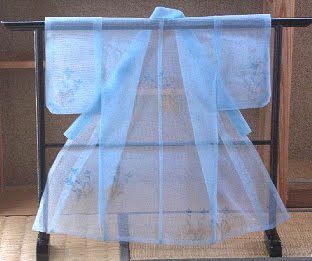
Kimono for summer is put on the hanging rack. This kimono is made from sheer fabric named ro(絽).
In the Heian Period, people in the Emperor's court updated their wardrobe on the 1st day of the 4th month and the 1st day of the 10th month in the lunar calender in imitation of a Chinese custom.
In the Edo Period, the Edo Shogunate institutionalized to change samurai warriors' clothes four times a year and commoners followed its custom.

Today, most school students change their uniforms on June 1st and October 1st, but kimono is changed four times a year.
Lined kimono is worn from October to May, unlined kimono in June and September, kimono made from thin fabric such as ro(絽) or sha(紗) in July and August.
They look like cool, but they are not so. Because it is necessary to wear an kimono-like garment under them. It is important to look like cool. The cotton yukata(浴衣) is an informal kimono in summer.


Teruteru-bouzu(照る照る坊主:"shiny-shiny Buddhist priest") is a doll to which Japanese children pray for fine weather. It is said that the doll have "bouzu(monk)" in its name because the doll's head looks like the shaven head of a Buddhist monk or monks prayed for rain. Its origin can be traced to a doll(掃晴娘:sǎoqíngniáng) in China.


There are an old sewing table, a clothes iron and an uncompleted wiping cloth on the tatami mats.


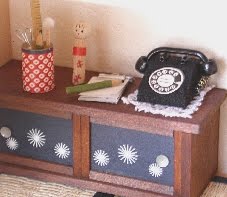
In the old days, all the telephones at home were black.
A Japanese bamboo ear pick with a down puff is in the pen stand.
Kokeshi, which is the traditional wooden doll made in the northeastern region of Japan, is next to the pen stand.

Monday, May 31, 2010

What did a dead wife ask her surviving husband?

The 21-year-old Yohei(与兵衛) and the 15-year-old Okame(お亀) committed suicide together on the 17th day of the 5th month in the lunar calender(in the end of June in the Gregorian calendar). The 17th day of every month is a day believed to have a special relation with Kannon. But Only Yohei survived.

Okame was a daughter of an antique shop owner. Yohei who was her cousin married into her family. But he was entrapped by her father's mistress, and they decided to commit suicide together.

"Uzuki no Iroage(卯月の潤色:Redyeing of Uzuki)" starts here.
Yohei, her surviving husband, became a monk about a year after her death. He still sees her in his mind's eye. Her image is as hazy as a half-remembered dream. (Chikamatsu often shows poetic images like a movie.)

When he dozes off remembering her, he hears her voice. "Do you have a Yohei residing with you?" he hears her voice approaching. He gives an answer for joy and steps out of his house. She looks just the way she used to and asks him excitedly, staying on a palanquin, "It's hot... can you get me a glass of water?"
"Where did you go on a palanquin?"
"Today is the 17th day of the 4th month, so I just visited 22 shrines and prayed that you get along with my father." She carries on a pleasant conversation with him.

"I came to you because I wanted to ask you something. My aunt heard that Yohei often seemed to spend the time at adult entertainment shops. This question has bothered me for a long time. Is it true?"
With a happy grin, he turn the stove on to put water on for tea.
However, fire strikes her weak point. She makes herself invisible in front of him.

Through spiritual mediums, she let him know she wanted for him to stay alive and become a monk. Survivors of love suicide supposed to be executed, but he wasn't. Because his parents and relatives desperately begged for his life.

However, he didn't spend years as a ascetic monk, so he is not able to let her rest peacefully in her grave. He realizes that he has her chained to this world as long as he lives.
And he kills himself on the 17th day of the 4th month in the lunar calender(in the end of May in the Gregorian calendar).

"Uzuki no Iroage(卯月の潤色:Redyeing of Uzuki)" is the sequel to "Uzuki no Momiji(卯月紅葉: Maple leaves in April)". This bunraku play was written by Chikamatsu Monzaemon(近松門左衛門). It's thought to be based on an actual but unidentified incident.

This play has never been performanced according to my best recollection, but it's one of my favorites.

Saturday, May 29, 2010

Woman-Killer in Oil Hell

"Onnagoroshi Abura no Jigoku(女殺油地獄:Woman-Killer in Oil Hell )" is a bunraku play, which was written by Chikamatsu Monzaemon(近松門左衛門). It's thought to be based on an actual incident that occurred on the 4th day of the 5th month in the lunar calendar (on May 29th in the Gregorian calender) in 1721. But it's not unidentified.

The 23-year-old Yohei(与兵衛) killed the 27-year-old Okichi(お吉) because she rejected his appeal to lend him approximately 200,000 yen in a current value.(It's the same as the average starting salary for university graduates in Japan.)

He says, "I was hell-bent on preventing my father from being accused of a crime. I couldn't care less about the others."

He is a prodigal son and borrows money in the parent's name.
His stepfather succeeded his deceased father, who was his boss, to become a shop owner and married his mother. His stepfather can't reproach Yohei with his misconduct. His mother is very strict with Yohei. Yohei's elder brother serves his apprenticeship in another shop. The family members except Yohei care for each other and refrain from speaking their minds.

Okichi's husband runs a shop selling oil for lamp. They married more than 10 years ago and have some children. Yohei and Okichi are neighbors across the street.
He feels comfortable talking with her but don't have a romantic relationship with her.

He portrays her as a woman like a candy fashioned in animal forms- it's good-looking but tastes bad. He is falling head over heels for a courtesan. So his parents asks her to reprove him for his misconduct and sometimes cares for him. When he becomes muddy while fighting together, she helps to remove traces of soil.

He understands his parents' feelings and decides to pay off his debt in order not to give them further trouble. He asks for a loan to her as his last hope, but she don't comply with his request for a loan.
The highlight of the play is the scene of trying to kill her on oil-slicked floor. Afer her death, he attends a funeral for her with a completely innocent face.

Other bunraku writers cast him as a nefarious villain, but Chikamatsu didn't so. Therefore, his play didn't become a hit. It is said that Yohei resembles today's younger generation who snaps and loses their temper quickly.

After the Meiji period, this play is considered to be his masterpiece and is frequently performanced. It has been made into movies several times. Recent movies focuses on a romantic relationship between Yohei and Okichi. Their relation is open to a variety of interpretation.

Friday, May 28, 2010

unripe ume and loquat

Unripe ume(Japanese apricots) and loquats are currently on the market.
Umeshu(ume liquor) is made from unripe ume, rock candy and distilled spirits called white liquor.
Unripe ume stewed in sugar are also used for these confections.


Meanwhile, ripe ume are used to make pickled ume called umeboshi(梅干し).

Ao-ume(青梅):
confection in the shape of unripe ume
Biwa(枇杷):
confection in the shape of loquat(or Japanese medlar)
Sasa-no-tsuyu(笹の露):
confection in the shape of a bamboo leaf

Sunday, May 23, 2010

Sonezaki Shinjuu

Sonezaki-shinjuu(曽根崎心中: Love Suicides at Sonezaki)

この上は徳様も死なねばならぬしななるが。死ぬる覚悟が聞きたいと、独言になぞらへて。足で問へば、うちうなづき。足首とつて、喉笛なで。自害すると知らせける。
"Toku-sama can only die. Is he prepared to die?" She confirms his willingness by poking him with her foot while pretending to talk to herself. He expresses his intent to die by holding her ankle against his windpipe.

どうで徳様、一所に死ぬる、わしも一所に死ぬるぞやいのと。足にて突けば、縁の下には涙を流し。足を取つて、おし戴き。膝に抱付き、焦れ泣き、女も色につつみかね。互いに物は言はねども。肝と胆とに応えつつ、しめり。
"I will die with Toku-sama no matter what." She conveys her decision to him by poking him with her foot. Under the porch floor, he sheds tears while enveloping her knees in his arms. She also weeps in sympathy. They communicate their feelings to each other without words.

"Sonezaki Shinjuu (曽根崎心中:The Love Suicides at Sonezaki)" is a bunraku play, which was written by Chikamatsu Monzaemon(近松門左衛門) based on an actual incident that Tokubei(徳兵衛), then a 25-year-old sales clerk, and Ohatsu(お初), then a 21-year-old courtesan, commited suicide together in the forest of Sonezaki.

It happened on the 7th day of the 4th month in the lunar calendar (May 22th in the Gregorian calendar) in 1703, and the play was premiered on the 7th day of the 5th month in the lunar calendar in the same year.


engawa(縁側):
A veranda-like(or wood deck-like) porch called engawa has the space under its floor. Ohatsu hides him under the porch floor.


He remains there while Kuheiji, who put Tokubei in the deep financial hole, is making advances to her sitting on the end of the floor.
"Toku-sama" is Tokubei's nickname.

In general female puppets have no legs, but it looks as if they have legs by foot puppeteer's handling.
Japanese women's legs were wrapped with kimono. So this play must have shocked audience with the scene he was holding her legs.

In the scene of the lovers' suicide trip, the following first sentence is proverbial one.
この世のなごり 夜もなごり 死にに行く身をたとふれば、
あだしが原の道の霜 一足づつに消えて行く 夢の夢こそあはれなれ
あれ数ふれば暁の 七つの時が六つ鳴りて 残る一つが今生の
鐘の響きの聞き納め 寂滅為楽と響くなり

In the forest of Sonezaki, Ohatsu is frightened to see will-o'-the-wisp. Tokubei tells her, "Two will-o'-the-wisp floating side by side are our souls." She says, "Then we've been already dead..."

Chikamatsu depicts gory details in his plays. I wondered why the killing scenes in his plays were so real.
Because there was a superstition that a person who die a painful death can get to heaven. I heard it in a study session. I guess the superstition partly comforted deceased family members.

Saturday, May 22, 2010

Roses

Roses are in full bloom.
It takes a lot of trouble with growing roses in the hot and humid climate of Japan. Rose fanciers have to use chemicals to control disease and pest about one to four times a month from spring to fall.


Bara(薔薇:Rose)
some autochthonous roses in Japan are wild ancestors of garden species in Europe.
In Japan, Koushin-bara(庚申薔薇:China rose, Monthly rose) or
Mokkou-bara(木香茨、木香薔薇: banksia rose), which are native plant species, were grown as an ornamental plant in the Edo period.
After the Meiji period, European garden species became popular among Japanese people.


Neighborhood house surrounded by roses. It's not easy to get roses this far in Japan.

Thursday, May 20, 2010

Shinjuu Yoigoushin

「百度千度去られても・・・」
"If you were forced to get divorced a hundred or a thousand times, …"

"Shinjuu Yoigoushin(心中宵庚申:love suicides on the night of the day of koushin-machi)" is a bunraku play, which was written by Chikamatsu Monzaemon(近松門左衛門) based on an actual incident that happened on the sixth day of the fourth month in the lunar calendar (May 20th in the Gregorian calendar) in 1722.

On the day, a greengrocery and his wife committed suicide together despite she was pregnant. Koushin-machi means Buddhist and Shinto ceremonies that people stay awake all through the night.

Surprisingly, the play was premiered on the 22nd day of the fourth month in the lunar calendar in the same year.
Bunraku writers of that time often dramatized actual incidents as they were happening live. The plays were premiered shortly after the incidents, like yellow papers.


Chiyo, this story's heroine, has bad luck with men.
Her first husband ruined himself and she lost her second husband. In additon, her mother-in-law forced her to get divorced during her third husband's absence, and she has been forced to come back to her parent's home.
Her marriages are arranged ones that were once common in rich families. Her father is a very wealthy farmer. People in those days regarded divorces as a shame of her family through no fault of her own.

He tells Chiyo, "If you were forced to get divorced a hundred or a thousand times..." He feels sorry for his daughter and complains of her third husband earnestly. Finally, He says,"I will marry you off to a much better husband than him."
His words should touch daughters' hearts.

We have an image of women in old times as weak victims, but most women in bunraku plays are pretty tough stuffs.
She is very meek compared to her noisy older sister who runs a family business well with her sister's husband. I guess her mother-in-law don't like her weakness and marital history.

Her third husband, Hanbei(半兵衛), was born into a samurai family but was adopted into a greengrocery's family. So he is not able to protest against his stepmother about being hard on her daughter-in-law. Meahwhile, he promises his wife's father not to leave his wife.
Finally, they decide to commit suicide together.

It is thought that the first act of the play was written to describe Hanbei's personality.
However, the content of the act is startling. The act is not performed at the present day, so few people know the content of this act.

He went to Hamamatsu to attend a Buddhist memorial service for his late father. He visits his brother who is a samurai warrior.
Some warriors try to have his brother's heart and their master encourages retainers to have a homosexual encounter!
Hanbei handles the romance with adeptness.

Actually, samurai warriors and monks were allowed to have a homosexual encounter in the Edo Period. It's a well-known fact that some famous samurai warriors were homosexual.
A Japanese film "Taboo (御法度, Gohatto)" directed by Nagisa Ōshima depects male homosexuality in the Edo Period. Recently, a kabuki play that deals with male homosexuality was performanced for the first time in 100 years.

Tuesday, May 18, 2010

Aoi Matsuri in Japanese literature

The first thing I come to mind when thinking of Aoi Matsuri in Japanese literature is "The Tale of Genji". Its 9th chapter named "Aoi no ue" depicts the incident occurred at Aoi Matsuri and its subsequent tragedy.

Hikaru Genji take part in the Aoi Matsuri's parade.
Lady Rokujou(六条御息所, Rokujyou no Miyasundokoro) and Lady Aoi(葵の上,Aoi no Ue) go and see the sights of the parade with their servants in cow-drawn carriages.
Lady Rokujou's carriage have already taken a good spot for the nice view, but Lady Aoi's servants push Lady Rokujou's carriage aside by force while knowing that it's her carriage.

Lady Aoi is Genji's wife.
Lady Rokujou was a daughter of a minister and the wife of former prince, but now is one of Genji’s mistresses.
Lady Rokujou has been wondering whether she left Kyoto with her daughter to eliminate a love-hate relationship with him. This minor incident blows her self-esteem, and she remains deep in the shock. She loses her control over herself.

Lady Aoi during pregnancy is often plagued by who-knows-what.
Meanwhile, Lady Rokujou often dreams that she hit Lady Aoi very violently.
Lady Rokujou have too much pride to retaliate on Lady Aoi, but her living spirit leaves her body and possesses Lady Aoi.
His visit to Lady Rokujou worrying about her illness and his wife's delivery ruffle her feelings.

Genji sees her living spirit and hears its voice.
Finally, Lady Aoi dies sometime after her delivery.
In fact, her living spirit has killed a mistress of his before.
She is stunned by herself for a deep hatred in the back of her mind. She resembled a person who has a split personality.

Although the leading character is Hikaru Genji, the novel describes the feelings of the women having relationships with him and their female servants carefully because a female novelist wrote it. She also depicts his outfit or stationery for love letters in considerable detail.

After his wife's death, people around him hope Lady Rokujou will become his second wife because she is very sophisticated and comes from distinguished ancestry.
Both of them adopt an awkward attitude to each other due to her living spirit.
At last, she decides to break up with him and leave Kyoto. He goes to see her to say goodbye just before her departure. By her face, he re-ignites romance and tries to persuade her to stay. Her determination is invincible. After that, she corresponds with him.

Years later, she entrusts him to her daughter's care because she feels the approach of death.
Athough she warns him never to fall in love with her daughter, he comes to love her daughter. She brushes off his advances because he is a fatherlike figure to her.

Hikaru Genji is an ideal man from a woman's perspective at the time.
He is good-looking, has a quick mind, is well-educated, is very good at dancing or playing instruments, has a sense of humor, is very gallant to ladies, puts his old girlfriends up in his house and financially supports them.

Even though he is a son of the former emperor, he is not acknowledged as a member of the imperial family. He sometimes says, "Every woman has her good points, but there is no ideal lover in the real world."

A noh play and Yukio Mishima's play were wrtten from this episode.


Mitarashi-dango(みたらし団子:stick of dumplings):

People in Kyoto eat this confection on the days of the Aoi Matsuri and the Mitarashi Matsuri(御手洗祭:Mitarashi festival).
Mitarashi festival is held on the day of the ox in midsummer(土用の丑の日) at Shimogamo Shrine. On this day, worshipers purify themselves by bathing their feet into Mitarashi-no-ike pond.

Mitarashi-dango originates from an offering to the deity which was made by shrine parishioners. It is said to have been made in the image of bubbles in the pond.

Sticks of five dumplings dipped in salty-sweet sauce are sold at Kamo Mitarashi jaya(加茂みたらし茶屋), a Japanese sweets shop near Shimogamo Shrine.
It's llike this.
●ー●●●●ー
It is said that five dumplings means the head, arms and legs. Most Mitarashi-dango on the market has four dumplings.
A Japanese song named "Dango Three Brothers" was a popular hit song in 1999.

Sunday, May 16, 2010

Sanja Matsuri


Sanja Matsuri(三社祭) is an annual festival held in the middle of May at Asakusa Shrine. "Sanja" comes from the three deities enshrined there.
Today is the last day of the three-day festival. Three mikoshi, which
are miniature mobile shrines for the three deities, are paraded through the city streets and back to the shrine.

The bad manner that some people ride on mikoshi has become a problem in recent years. Riding on the mikoshi is blasphemy against deities. In 2006, the poles on which people carry nikoshi were broken because some people rode on the poles. The following year, this sort of problem happened again. So the parade in 2008 was cancelled.
It seems that there was not a major problem with the this year's festival.

The festival have another troubles such as participating gangsters
(it cannot be broadcast on TV) or participants except shrine parishioners.