Haru-ichiban(春一番) blew in Kanto region including Tokyo and Yokohama on February 25th. Haru-ichiban is the first strong south winds of the year between Rissyun(立春:the first day of spring, Feb 4th this year) and Syunbun(春分:spring equinox, March 21th this year).
At the same time, the hay fever season has started again this year. Last summer was extremely hot, so a large amount of cedar pollen is predicted this year. It's terrible!
In Yokohama, high temperatures was 20.3 degrees centigrade, the same as in mid April.
Meanwhile, the day's high was about 10 degrees Celsius.
I wish the trapped survivors of the earthquake in Christchurch will be dug out. It seems very possible that more than 20 Japanese students are also being trapped under the wreckage.
A 2-year-old child was rescued 92 hours after the Mid Niigata Prefecture Earthquake in 2004. A 74-year-old woman was rescued 106 hours after the Great Hanshin earthquake in 1995.
Saturday, February 26, 2011


Sunday, February 20, 2011
Enburi Festival at Hachinohe

Enburi(えんぶり) is the folk performing art that dancers wearing hats in the shape of the horse head dance with a shake of the head to pray for a good harvest.

Enburi is held in five prefectures including Fukushima, Tamagata, Miyagi, Iwate and Aomori.
Children also perform several dances during the festival.


Saturday, February 19, 2011
Chushingura(2)
Kira's son Uesugi Tsunanori(上杉 綱憲) was the 4th lord of the Yonezawa Domain.
(Uesugi Kagekatsu who was Uesugi Kenshin's son was the first load of the domain. Shinshu Kawanakajima Gassen and Honcho Nijushi Kou)
Kira's adopted son Yoshimasa(義周) was one of Tsunanori's sons. Tsunanori urged Kira to move to Yonezawa and it is said the farewell tea ceremony was held on the 14th day.
On hearing about the the raid by the Ako warriors, Tsunanori tried to deliver reinforcements. However his relative held him back.
Eighteen-year-old Yoshimasa waged a brave war against the warriors, but he was seriously injured.
Later the shogunate extinguished Kira's family line and drove him into exile. He was born weak and died of disease at the age of 21 in the place of exile.
Two of his retainers who moved from the Yonezawa Domain to Kira's house with him battled fiercely. One of them was killed in battle and the other was badly injured. Later the surviving retainer accompanied Yoshimasa to the place of exile.
The warriors put out fires caused by the raid and put Kira's headless body to bed after Kira's death. Then, one of them went away. It's not known exactly why.
Forty-six warriors went to Sengaku-ji Temple and placed Kira's head in front of Asano's grave. Later the head was carried back to Kira's retainer by the monks of the temple.
They were entrusted to the cares of four feudal lords.
The shogunate was at a loss over how to cope with the raid.
Raids were punishable by death. Meanwhile, their loyalty to their lord won widespread praise.
On the 4th day of the 2nd month(March 20th), the shogunate ordered them to commit harakiri. They did it the same day and were buried in the graves on the grounds of Sengaku-ji.
Their sons aged 15 and over except monks were driven into exile, but they were pardoned by the next shogun. Asano's brother regained his position as a direct retainer of the shogun. One of Oishi's sons was employed by Asano's head family.
Meanwhile, Yoshimasa death put an end to the Kira Family.
The sons of the 46 warriors received an offer from many domains. However, most of the Ako warriors who didn't take part in the raid could not serve another feudal lord.
Kira gained an infamous reputation for the raid, but was he such a bad person?
Injuring someone by stabbing in Edo Castle was an capital felony. Kira was a victim. Asano should have been punished severely whatever the reason.
The worst of it is that the shogun and his henchmen didn't find out why Asano made a cut at Kira.
The shogunate left warriors although it knew their plot, and no one tried to prevent them from raiding Kira's house when they were heading for it.
Kanadehon in the title "Kanadehon Chushingura (仮名手本忠臣蔵)" means an old Japanese alphabet copybook. This alphabet is also a poem which consists of 47 different letters.
Kanadehon is a pun for the 47 warriors.
いろはにほへと ちりぬるを
わかよたれそ つねならむ
うゐのおくやま けふこえて
あさきゆめみし ゑひもせす
i-ro-ha-ni-ho-he-to chi-ri-nu-ru-wo
wa-ka-yo-ta-re-so tsu-ne-na-ra-mu
u-wi-no-o-ku-ya-ma ke-fu-ko-e-te
a-sa-ki-yu-me-mi-shi we-hi-mo-se-su
This poem have several possible meanings. One of them is as follows.
The petals fall after blooming.
Everything changes in this world.
I got over a steep mountain in my life today.
I don't want to dream an empty dream when being sober.
The present Imperial Palace was built on the site of Edo Castle.
People are not allowed to enter the palace, but the East Gardens of the Imperial Palace is open to people.
There isn't a trace of the corridor where the incident occurred, but the sign in the garden says that it used to be there.
(Uesugi Kagekatsu who was Uesugi Kenshin's son was the first load of the domain. Shinshu Kawanakajima Gassen and Honcho Nijushi Kou)
Kira's adopted son Yoshimasa(義周) was one of Tsunanori's sons. Tsunanori urged Kira to move to Yonezawa and it is said the farewell tea ceremony was held on the 14th day.
On hearing about the the raid by the Ako warriors, Tsunanori tried to deliver reinforcements. However his relative held him back.
Eighteen-year-old Yoshimasa waged a brave war against the warriors, but he was seriously injured.
Later the shogunate extinguished Kira's family line and drove him into exile. He was born weak and died of disease at the age of 21 in the place of exile.
Two of his retainers who moved from the Yonezawa Domain to Kira's house with him battled fiercely. One of them was killed in battle and the other was badly injured. Later the surviving retainer accompanied Yoshimasa to the place of exile.
The warriors put out fires caused by the raid and put Kira's headless body to bed after Kira's death. Then, one of them went away. It's not known exactly why.
Forty-six warriors went to Sengaku-ji Temple and placed Kira's head in front of Asano's grave. Later the head was carried back to Kira's retainer by the monks of the temple.
They were entrusted to the cares of four feudal lords.
The shogunate was at a loss over how to cope with the raid.
Raids were punishable by death. Meanwhile, their loyalty to their lord won widespread praise.
On the 4th day of the 2nd month(March 20th), the shogunate ordered them to commit harakiri. They did it the same day and were buried in the graves on the grounds of Sengaku-ji.
Their sons aged 15 and over except monks were driven into exile, but they were pardoned by the next shogun. Asano's brother regained his position as a direct retainer of the shogun. One of Oishi's sons was employed by Asano's head family.
Meanwhile, Yoshimasa death put an end to the Kira Family.
The sons of the 46 warriors received an offer from many domains. However, most of the Ako warriors who didn't take part in the raid could not serve another feudal lord.
Kira gained an infamous reputation for the raid, but was he such a bad person?
Injuring someone by stabbing in Edo Castle was an capital felony. Kira was a victim. Asano should have been punished severely whatever the reason.
The worst of it is that the shogun and his henchmen didn't find out why Asano made a cut at Kira.
The shogunate left warriors although it knew their plot, and no one tried to prevent them from raiding Kira's house when they were heading for it.
Kanadehon in the title "Kanadehon Chushingura (仮名手本忠臣蔵)" means an old Japanese alphabet copybook. This alphabet is also a poem which consists of 47 different letters.
Kanadehon is a pun for the 47 warriors.
いろはにほへと ちりぬるを
わかよたれそ つねならむ
うゐのおくやま けふこえて
あさきゆめみし ゑひもせす
i-ro-ha-ni-ho-he-to chi-ri-nu-ru-wo
wa-ka-yo-ta-re-so tsu-ne-na-ra-mu
u-wi-no-o-ku-ya-ma ke-fu-ko-e-te
a-sa-ki-yu-me-mi-shi we-hi-mo-se-su
This poem have several possible meanings. One of them is as follows.
The petals fall after blooming.
Everything changes in this world.
I got over a steep mountain in my life today.
I don't want to dream an empty dream when being sober.
 |
| East Gardens (the ruins of the palace) |
The present Imperial Palace was built on the site of Edo Castle.
People are not allowed to enter the palace, but the East Gardens of the Imperial Palace is open to people.
There isn't a trace of the corridor where the incident occurred, but the sign in the garden says that it used to be there.
 |
| East Gardens (the terraced walls of the castle) |
Wednesday, February 16, 2011
Kamakura Festival
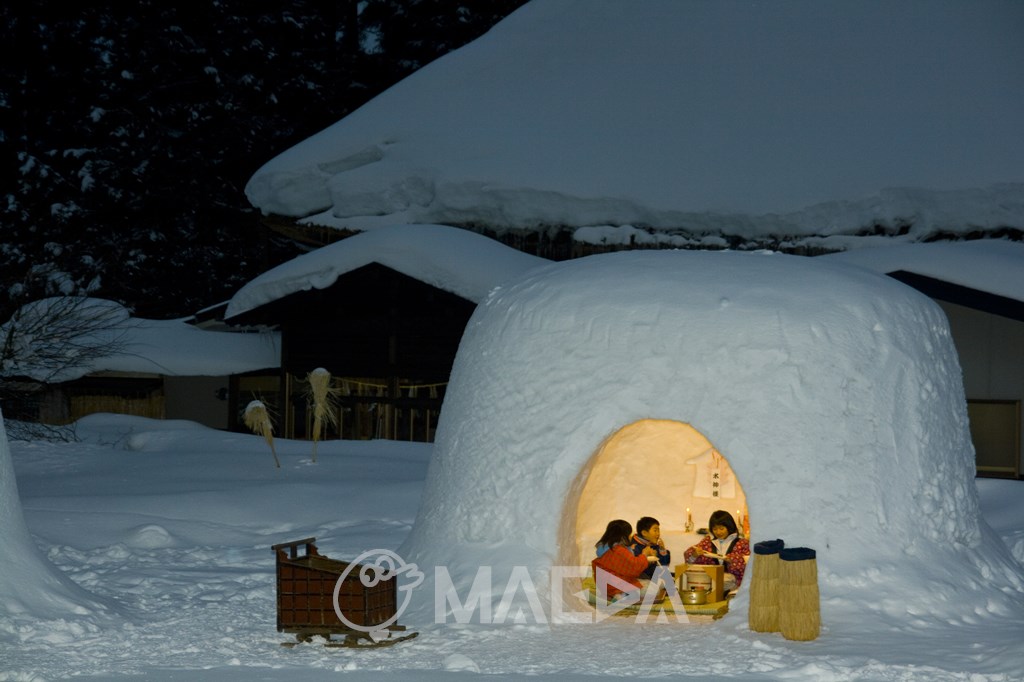
Kamakura Festival at Yokote in Akita Prefecture was held on February 15th and 16th. It is one of the New Year holiday events and used to be held on the 15th day of the 1st month in the lunar calendar. The festival dates back 400 years.
A snow house called Kamakura has a household altar dedicated to the god of water to wish for the safety of their families, success in business and agricultural fertility.
In the house, children invite passersby inside and offer them sweet alcoholic amazake and rice cakes.
German architect Bruno Taut(1880-1938) visited Yokote in 1936 and described his impressive experience at the festival in his book "A Rediscovery of Japan".
About 100 kamakura stand in Yokote City during the festival. Many miniature kamakura are also built.
Powered by 36arts.com

photo:日本列島お国自慢(Japanese version only)
A snow house called Kamakura has a household altar dedicated to the god of water to wish for the safety of their families, success in business and agricultural fertility.
In the house, children invite passersby inside and offer them sweet alcoholic amazake and rice cakes.
German architect Bruno Taut(1880-1938) visited Yokote in 1936 and described his impressive experience at the festival in his book "A Rediscovery of Japan".
About 100 kamakura stand in Yokote City during the festival. Many miniature kamakura are also built.
Powered by 36arts.com

photo:日本列島お国自慢(Japanese version only)
Monday, February 14, 2011
Chushingura (1)
A little snow pile up on the road yesterday. In recent years we have little snow here.
Late on the 14th day of the 12th month in the lunar calendar (January 31st in 1703 according to the Gregorian calendar), forty-seven Ako(赤穂) warriors raided the house of Kira Kozukenosuke(吉良上野介) and killed him around 4 a.m. on the 15th day.
We think of the scene that the warriors are headed for Kira's house in the snow. The memorial event for Ako warriors are held at Sengaku-ji Temple on December 14th, but the snow doesn't piled up at this time of year. In fact, it is said that it was a clear and frigid night with a full moon.
Kanadehon Chushingura (仮名手本忠臣蔵) based on this incident was written by Takeda Izumo Ⅱ(二代目竹田出雲), Miyoshi Syouraku(三好松洛), Namiki Senryu(並木千柳) premiered as a bunraku play in 1748, as a kabuki play in 1749.
he story has been featured in films and TV dramas many times in Japan.
In 2012, this story will be adapted into a 3D film called "47 Ronin" that starred Keanu Reeves. He will play an imagined character for the film. Ronin means a masterless samurai.
It all starts with the incident that Asano Takumi no Kami (浅野内匠頭), the lord of the Ako Domain made a cut at Kira Kozukenosuke with a sword in the corridor of Edo Castle on the 14th day of the 3rd month(on April 21st) in 1701. The Edo Shogunate was due to perform a very important ceremony after welcoming Imperial messengers at Edo Castle.
The 5th Shogun Tsunayoshi was outraged by the incident. Asano committed suicide(harakiri) on the order of Tsunayoshi on the day of the incident without a detailed investigation in the face of opposition, and that he was sentenced to death by committing harakiri on the garden. Generally a feudal lord committed harakiri in the house.
It was unprecedented for a lord of domain to be ordered to commit suicide on the day of an incident.
Asano said that he had something against Kira, but it's not known exactly why he did so. The shogun extinguished the Ako Domain. Kira was not punished because he didn't fight back at all.
At night on the 14th day, Asano's retainers received his body and held a funeral in obscurity at Sengaku-ji Temple(泉岳寺). At midnight, Asano's wife was taken along to a house belonging to her father.
The Edo Shogunate decided to punish Asano's brother and cousins on the 15th day. The domain's residences were handed over to another domains on the 17th and 18th day after the members of the Ako Domain working in Edo (now Tokyo) left there.
In the early morning of the 19th day, the members of the domain in Ako(now a part of Hyogo Prefecture) got the initial report of the incident.
The domain used to pay with local paper money issued in Ako. Chief retainer Oishi Kuranosuke(大石内蔵助) decided to change local paper money into national currency at a 40% discount. At that time another domains paid at more discount rate.
The members in Ako split over what to do about the incident. One group advocated holding out against the government barricading themselves inside Ako castle and the other group advocated reviving the domain after surrendering their castle to the government.
The members in Edo strongly advocated avenging their lord's death. Oishi Kuranosuke distributed more surplus funds to low-class warriors, but Oishi himself didn't get a share of the funds.
He led the members to accept the surrender of the castle to ask for reviving the domain by following their master to the grave. Advocates for his plan made an oath to commit harakiri by submitting a written pledge sealed with blood.
On the 19th day of the 4th month, Oishi surrendered Ako castle without blood. Some members including him attended to their backlog of the domain's government. Asano's tomb was raised at Koyasan.
In the 8th month, the shogunate ordered Kira to move home and ordered Kira's brother, Kira's close companion and the person who made Asano commit suicide in a demeaning manner to give up their posts. In the 12th month, Kira transferred responsibility for the family to his adopted child(his biological grandchild) and his wife came back to her parents.
In the 1st month in 1702, Kayano Sanpei(萱野三平), one of the advocates committed suicide at the age of 28 because he was torn between loyalty to his lord and his father who offered to serve another lord. Hayano Kanpei(早野勘平) in Chushingura was modeled on him. Another advocate committed suicide with a courtesan.
Oishi lobbied powerful persons for reviving the domain, but their hopes were dashed on the 18th day of the 7th month in 1702. Oishi also decided to aim exclusively at avenging their lord's death.
Then Oishi provided an opportunity for the advocates to withdraw from the alliance by returning their written pledges. Because the advocates included the supporters of reviving the domain.
On the 5th day of the 11th month, members including Oishi reached Edo. It's not true that Oishi visited Asano's wife to say farewell after reacing Edo.
Oishi learned from a Japanese classical scholar that a tea ceremony was held at Kira's house. The scholar was one of Oishi's friends and was often invited to Kira's house.
Otaka Gengo(大高源五), one of the advocates, was also well known as a haiku poet and apprenticed himself to a famous tea master to found out the dates of the tea ceremony. Otaka published a collection of haiku poems before going to Edo.
Late on the 14th day of the 12th month (on January 31st in 1703), forty-seven warriors raided the house of Kira.
Late on the 14th day of the 12th month in the lunar calendar (January 31st in 1703 according to the Gregorian calendar), forty-seven Ako(赤穂) warriors raided the house of Kira Kozukenosuke(吉良上野介) and killed him around 4 a.m. on the 15th day.
We think of the scene that the warriors are headed for Kira's house in the snow. The memorial event for Ako warriors are held at Sengaku-ji Temple on December 14th, but the snow doesn't piled up at this time of year. In fact, it is said that it was a clear and frigid night with a full moon.
Kanadehon Chushingura (仮名手本忠臣蔵) based on this incident was written by Takeda Izumo Ⅱ(二代目竹田出雲), Miyoshi Syouraku(三好松洛), Namiki Senryu(並木千柳) premiered as a bunraku play in 1748, as a kabuki play in 1749.
he story has been featured in films and TV dramas many times in Japan.
In 2012, this story will be adapted into a 3D film called "47 Ronin" that starred Keanu Reeves. He will play an imagined character for the film. Ronin means a masterless samurai.
It all starts with the incident that Asano Takumi no Kami (浅野内匠頭), the lord of the Ako Domain made a cut at Kira Kozukenosuke with a sword in the corridor of Edo Castle on the 14th day of the 3rd month(on April 21st) in 1701. The Edo Shogunate was due to perform a very important ceremony after welcoming Imperial messengers at Edo Castle.
The 5th Shogun Tsunayoshi was outraged by the incident. Asano committed suicide(harakiri) on the order of Tsunayoshi on the day of the incident without a detailed investigation in the face of opposition, and that he was sentenced to death by committing harakiri on the garden. Generally a feudal lord committed harakiri in the house.
It was unprecedented for a lord of domain to be ordered to commit suicide on the day of an incident.
Asano said that he had something against Kira, but it's not known exactly why he did so. The shogun extinguished the Ako Domain. Kira was not punished because he didn't fight back at all.
At night on the 14th day, Asano's retainers received his body and held a funeral in obscurity at Sengaku-ji Temple(泉岳寺). At midnight, Asano's wife was taken along to a house belonging to her father.
The Edo Shogunate decided to punish Asano's brother and cousins on the 15th day. The domain's residences were handed over to another domains on the 17th and 18th day after the members of the Ako Domain working in Edo (now Tokyo) left there.
In the early morning of the 19th day, the members of the domain in Ako(now a part of Hyogo Prefecture) got the initial report of the incident.
The domain used to pay with local paper money issued in Ako. Chief retainer Oishi Kuranosuke(大石内蔵助) decided to change local paper money into national currency at a 40% discount. At that time another domains paid at more discount rate.
The members in Ako split over what to do about the incident. One group advocated holding out against the government barricading themselves inside Ako castle and the other group advocated reviving the domain after surrendering their castle to the government.
The members in Edo strongly advocated avenging their lord's death. Oishi Kuranosuke distributed more surplus funds to low-class warriors, but Oishi himself didn't get a share of the funds.
He led the members to accept the surrender of the castle to ask for reviving the domain by following their master to the grave. Advocates for his plan made an oath to commit harakiri by submitting a written pledge sealed with blood.
On the 19th day of the 4th month, Oishi surrendered Ako castle without blood. Some members including him attended to their backlog of the domain's government. Asano's tomb was raised at Koyasan.
In the 8th month, the shogunate ordered Kira to move home and ordered Kira's brother, Kira's close companion and the person who made Asano commit suicide in a demeaning manner to give up their posts. In the 12th month, Kira transferred responsibility for the family to his adopted child(his biological grandchild) and his wife came back to her parents.
In the 1st month in 1702, Kayano Sanpei(萱野三平), one of the advocates committed suicide at the age of 28 because he was torn between loyalty to his lord and his father who offered to serve another lord. Hayano Kanpei(早野勘平) in Chushingura was modeled on him. Another advocate committed suicide with a courtesan.
Oishi lobbied powerful persons for reviving the domain, but their hopes were dashed on the 18th day of the 7th month in 1702. Oishi also decided to aim exclusively at avenging their lord's death.
Then Oishi provided an opportunity for the advocates to withdraw from the alliance by returning their written pledges. Because the advocates included the supporters of reviving the domain.
On the 5th day of the 11th month, members including Oishi reached Edo. It's not true that Oishi visited Asano's wife to say farewell after reacing Edo.
Oishi learned from a Japanese classical scholar that a tea ceremony was held at Kira's house. The scholar was one of Oishi's friends and was often invited to Kira's house.
Otaka Gengo(大高源五), one of the advocates, was also well known as a haiku poet and apprenticed himself to a famous tea master to found out the dates of the tea ceremony. Otaka published a collection of haiku poems before going to Edo.
Late on the 14th day of the 12th month (on January 31st in 1703), forty-seven warriors raided the house of Kira.
Wednesday, February 9, 2011
the first horse's day of February (Hatsuuma)

A torii is a symbolic Shinto shrine gate which marks the entrance to a sacred area. It literally means "a perch for birds," but its exact origin is unclear.

Inari(稲荷) is the god grain, agriculture, trade and manufacture. Followers of Inari have a custom of donating a wooden torii to Inari. It is said that the custom started from the Edo Period. As a result, 10,000 torii has lined up.

photos: 高画質壁紙写真集無料壁紙(Japanese version only)


Monday, February 7, 2011
Sapporo Snow Festival
The 62nd Sapporo Snow Festival is being held from February 7th to 13th. (LIVE camera)


photos: 北海道無料写真素材集 Do Photo (Japanese version only)
Shinmoe-dake (新燃岳) in Kyushu is still erupting. The shock waves generated by its eruption broke the school windows 11 kilometers from the valcano.
The Japan Sumo Association has decided to cancel the March Grand Sumo Tournament in Osaka. This is the first time a sumo tournament will not be held since delayed renovation work of the Kokugikan Hall prevented the tournament from being held.
Sumo is facing a serious crisis with the match-fixing allegation again. There also have been rumors of match-fixing. Some evidence has surfaced that would support the allegation.
Saturday, February 5, 2011
Syunsetsu
February 3rd was New Year's Day according to the lunar calendar called Syunsetsu(春節) this year. In Yokohama's Chinatown, New Year celebrations are being held from February 3rd to 17th.
(the pictures of the last year's celebrations : Four Seasons of Yokohama Kamakura,横浜鎌倉の四季)
There are more than 500 shops on the site of about 0.2 square meters. After the opening of the Port of Yokohama in 1859, many Chinese merchants migrated to the foreign settlement.
There is a Kantei-byo(関帝廟) in the town. It's a temple of Guan Yu(関羽, ?-219) who was an ancient Chinese warlord and is enshrined as the god of commerce because he kept faith.
Most restaurants in the town served Cantonese cuisine.
Heichinrou(聘珍樓) was founded in Yokohama in 1884 and was introduced as one of famous Cantonese restaurants in a book published in 1909. It has been in business for 120 years.
The town experienced two Sino-Japanese wars and was burned down by The Great Kanto Earthquake in 1923 and World War II.
Now we associate the town with Chinese restaurants.
When I was a child, I looked forward very much to an annual lunch with my family at the town.
Many Japanese housewives cooked Chinese cuisine that adjusted their fare to suit Japanese tastes. The ingredients in chinese cooking were less commonly available and it was difficult to make real Chinese cooking at home.
Small family-run restaurants used to fill the town, but such restaurants are disappearing now. A new breed of Chinese shopkeepers is coming to the forefront.
(the pictures of the last year's celebrations : Four Seasons of Yokohama Kamakura,横浜鎌倉の四季)
There are more than 500 shops on the site of about 0.2 square meters. After the opening of the Port of Yokohama in 1859, many Chinese merchants migrated to the foreign settlement.
There is a Kantei-byo(関帝廟) in the town. It's a temple of Guan Yu(関羽, ?-219) who was an ancient Chinese warlord and is enshrined as the god of commerce because he kept faith.
Most restaurants in the town served Cantonese cuisine.
Heichinrou(聘珍樓) was founded in Yokohama in 1884 and was introduced as one of famous Cantonese restaurants in a book published in 1909. It has been in business for 120 years.
The town experienced two Sino-Japanese wars and was burned down by The Great Kanto Earthquake in 1923 and World War II.
Now we associate the town with Chinese restaurants.
When I was a child, I looked forward very much to an annual lunch with my family at the town.
Many Japanese housewives cooked Chinese cuisine that adjusted their fare to suit Japanese tastes. The ingredients in chinese cooking were less commonly available and it was difficult to make real Chinese cooking at home.
Small family-run restaurants used to fill the town, but such restaurants are disappearing now. A new breed of Chinese shopkeepers is coming to the forefront.
Sunday, January 30, 2011
eruption, snow and bird flu
A volcano named Shinmoe-dake (新燃岳) in Kyushu is erupting and volcanic ash is falling on a widespread area. There are many volcanoes in Japan and some of them often erupt. An old friend of mine who lived in Kagoshima of Kyushu said that volcanic ash of Sakura-jima(桜島) fell on Kagoshima City in summer.
Many areas in Japan is experiencing heavy snowfall this winter.
Houses can't bear the weight of a heavy layer of snow if people get the snow off them. There have been more accidents during snow removal.
H5N1 avian flu outbreak has been confirmed in several areas in Japan. It's thought that the wild birds are carrying the virus.
The infected birds include Hooded cranes(鍋鶴, nabe-zuru), White-naped cranes(真鶴, mana-zuru) and Whooper swans.
Nearly 90 percent of Hooded cranes and nearly 50 percent of White-naped cranes overwinter at Izumi in Kyusu of Japan. Both of them are designated as an endangered species, so there is concern about decreasing populations of them.
 tulip(green) Mizu-asobi(水遊び)
tulip(pink) Tsuru(鶴, crane)
This is a Red-crowned crane(丹頂鶴, tancho-zuru) that is known as a symbol of luck and longevity. A flock of them is resident in Hokkaido.
These tulips are like cabbage..
These confections contain steamed and mashed lily bulbs.
Japan's national team won the Asian Cup soccer tournament.
This is the only upbeat topic.
Many areas in Japan is experiencing heavy snowfall this winter.
Houses can't bear the weight of a heavy layer of snow if people get the snow off them. There have been more accidents during snow removal.
H5N1 avian flu outbreak has been confirmed in several areas in Japan. It's thought that the wild birds are carrying the virus.
The infected birds include Hooded cranes(鍋鶴, nabe-zuru), White-naped cranes(真鶴, mana-zuru) and Whooper swans.
Nearly 90 percent of Hooded cranes and nearly 50 percent of White-naped cranes overwinter at Izumi in Kyusu of Japan. Both of them are designated as an endangered species, so there is concern about decreasing populations of them.
tulip(pink) Tsuru(鶴, crane)
This is a Red-crowned crane(丹頂鶴, tancho-zuru) that is known as a symbol of luck and longevity. A flock of them is resident in Hokkaido.
These tulips are like cabbage..
These confections contain steamed and mashed lily bulbs.
Japan's national team won the Asian Cup soccer tournament.
This is the only upbeat topic.
Saturday, January 29, 2011
the numbers of visiting shrines and temples
Many Japanese people visit a Shinto shrine or Buddhist temple at the beginning of January.
Although The National Police Agency used to release its estimates for people visiting shrines and temples between January 1st and 3rd around this time of the year, it announced that it would not release the estimates due to its inexactness last year.
The Shinto shrines and Buddhist temples that were ranked in the top ten in 2010 are as follows.
1. Meiji Jingu Shrine(明治神宮) 3.2 million visitors
2. Narita-san Shinsho-ji Temple(成田山新勝寺) 2.98 million
3. Kawasaki Daishi Heikenji Temple(川崎大師平間寺) 2.96 million
4. Fushimi Inari Taisha Shrine(伏見稲荷大社) 2.7 million
5. Sumiyoshi Grand Shrine (住吉大社, Sumiyoshi-taisha) 2.6 million
6. Senso-ji Temple(浅草寺) in Asakusa(7位) 2.54 million
7. Tsurugaoka Hachiman-gu Shrine(鶴岡八幡宮) 2.5 million
8. Atsuta-jingu Shrine (熱田神宮) 2.35 million
9. Omiya Hikawa Jinja Shrine(大宮氷川神社) 2.05 million
10. Dazaifu Tenman-gu Srinne(大宰府天満宮) 2 million
Meiji Jingu Shrine was built in 1920 to honor Emperor Meiji(1852-1912) and Empress Shoken(1849-1914).
Groves are attached to shrines. An artificial grove was created for the shrine. Plant scientists took potential natural vegetation into consideration for everlasting grove. They decided to plant evergreen broadleaf trees such as chinquapin trees, oak trees so that the grove of the shrine would become close to the wild condition in 100 years.
Although the prime minister at that time insisted on planting Japanese cedars like the avenue of cedars at Nikko Toshogu, they convinced him that the cedars didn't thrive around the shrine.
The grove has thriven naturally in the shrine's climate.
About 100,000 trees of 365 different kinds were planted, and 170,000 trees of 246 different kinds are firmly rooted in the grove now.
Recently, an old well called Kiyomasa no Ido(清正井) on the site of the shrine is famous as an energy spot or a sacred place. However, we are not allowed to get some water from the well. People only use its image as their cellular phone wallpaper.
Narita-san Shinsho-ji has a profound connection with the Ichikawa family in kabuki.
Refer to Fushimi Inari Taisha for information about hatsu-uma.
Tree Peonies are now at their peak at a garden in Tsurugaoka Hachiman-gu. It requires an entrance fee.
Dazaifu Tenman-gu was built in 919 to honor Sugawara Michizane.
Refer to Michizane for information about Ume-Matsuri and Why did Sugawara Michizane become a god?
Although The National Police Agency used to release its estimates for people visiting shrines and temples between January 1st and 3rd around this time of the year, it announced that it would not release the estimates due to its inexactness last year.
The Shinto shrines and Buddhist temples that were ranked in the top ten in 2010 are as follows.
1. Meiji Jingu Shrine(明治神宮) 3.2 million visitors
2. Narita-san Shinsho-ji Temple(成田山新勝寺) 2.98 million
3. Kawasaki Daishi Heikenji Temple(川崎大師平間寺) 2.96 million
4. Fushimi Inari Taisha Shrine(伏見稲荷大社) 2.7 million
5. Sumiyoshi Grand Shrine (住吉大社, Sumiyoshi-taisha) 2.6 million
6. Senso-ji Temple(浅草寺) in Asakusa(7位) 2.54 million
7. Tsurugaoka Hachiman-gu Shrine(鶴岡八幡宮) 2.5 million
8. Atsuta-jingu Shrine (熱田神宮) 2.35 million
9. Omiya Hikawa Jinja Shrine(大宮氷川神社) 2.05 million
10. Dazaifu Tenman-gu Srinne(大宰府天満宮) 2 million
Meiji Jingu Shrine was built in 1920 to honor Emperor Meiji(1852-1912) and Empress Shoken(1849-1914).
Groves are attached to shrines. An artificial grove was created for the shrine. Plant scientists took potential natural vegetation into consideration for everlasting grove. They decided to plant evergreen broadleaf trees such as chinquapin trees, oak trees so that the grove of the shrine would become close to the wild condition in 100 years.
Although the prime minister at that time insisted on planting Japanese cedars like the avenue of cedars at Nikko Toshogu, they convinced him that the cedars didn't thrive around the shrine.
The grove has thriven naturally in the shrine's climate.
About 100,000 trees of 365 different kinds were planted, and 170,000 trees of 246 different kinds are firmly rooted in the grove now.
Recently, an old well called Kiyomasa no Ido(清正井) on the site of the shrine is famous as an energy spot or a sacred place. However, we are not allowed to get some water from the well. People only use its image as their cellular phone wallpaper.
Narita-san Shinsho-ji has a profound connection with the Ichikawa family in kabuki.
Refer to Fushimi Inari Taisha for information about hatsu-uma.
Tree Peonies are now at their peak at a garden in Tsurugaoka Hachiman-gu. It requires an entrance fee.
Dazaifu Tenman-gu was built in 919 to honor Sugawara Michizane.
Refer to Michizane for information about Ume-Matsuri and Why did Sugawara Michizane become a god?
Sunday, January 23, 2011
The mountain-burning event
The mountain-burning event at Mount Wakakusa (若草山, Wakakusa-yama) in Nara Prefecture was held yesterday. The event attracts many visitors. It's held annually on the 4th Saturday in January now.
Various events and a prayer for safety are held before its prescribed burn that starts around 18:00 and ends around 19:00.
However its exact origin is unclear. The montain was already covered with turf by 1255.
Various events and a prayer for safety are held before its prescribed burn that starts around 18:00 and ends around 19:00.
However its exact origin is unclear. The montain was already covered with turf by 1255.
Thursday, January 20, 2011
Daikan
Abashiri Local Meteorological Observatory observed the drift ice in the Sea of Okhotsk yesterday. A staff of Shiretoko Nature Center said that ice like sherbet was casting ashore and it led to the onset of a full-fledged winter.
The 20th day of the 1st month is called Hatsuka-shogatsu(二十日正月). On this day, all of the events related to Shogatsu finish. In the old days it was thought that the god of the New Year came back to the sky, and Kagami-Biraki(鏡開き: eating New Year's rice cakes) used to be held on this day.
According to system of 24 seasonal divides that originated in ancient China, today is the coldest day in winter called Daikan(大寒). It's very cold about this time of the year.
The second coldest day called Shokan(小寒) was January 6th. We can send a midwinter greeting card (寒中見舞い, Kanchu-mimai ) during the period from Shokan to Rissyun(立春:the first day of spring, February 4th).
The ninth day from Shokan is called Kanku(寒九). Coldness and drying keep away bacteria from developing during this period, so sake brewers used to draw water on this day. Even now a brewer draws mountain water on the day of Kanku.
Body trainings such as midwinter training and midwinter swimming are held during the period.
The 20th day of the 1st month is called Hatsuka-shogatsu(二十日正月). On this day, all of the events related to Shogatsu finish. In the old days it was thought that the god of the New Year came back to the sky, and Kagami-Biraki(鏡開き: eating New Year's rice cakes) used to be held on this day.
According to system of 24 seasonal divides that originated in ancient China, today is the coldest day in winter called Daikan(大寒). It's very cold about this time of the year.
The second coldest day called Shokan(小寒) was January 6th. We can send a midwinter greeting card (寒中見舞い, Kanchu-mimai ) during the period from Shokan to Rissyun(立春:the first day of spring, February 4th).
The ninth day from Shokan is called Kanku(寒九). Coldness and drying keep away bacteria from developing during this period, so sake brewers used to draw water on this day. Even now a brewer draws mountain water on the day of Kanku.
Body trainings such as midwinter training and midwinter swimming are held during the period.
Monday, January 17, 2011
the 16th anniversary of the Great Hanshin Awaji Earthquake
Sixteen years have passed since the Great Hanshin Awaji earthquake occurred on January 17.
A TV drama derived from the earthquake is now showing at some theaters in Japan.
The leading characters are a man and a woman who experienced the earthquake in their childhood. They walk through the town of Kobe.
His father who worked with housing-related materials made massive profits after the Hanshin Awaji Earthquake. However, he didn't feel like staying. He tells his stories.
After one of her friends was killed by the quake, the friend's father became mentally unbalanced. She couldn't bear to see him living in Kobe, but she takes the plunge and sees him.
Finally, they attend a memorial ceremony held in Kobe at 5:46 JST on January 17.
The two actors playing the lead in the drama actually experienced the earthquake.
The ceremony is held annually on January 17 at Higashi Yuenchi Park to mourn the victims and pass on stories of the disaster. This drama was shot at the park in the early morning of January 17th.
The town of Kobe also plays the leading part.
A TV drama derived from the earthquake is now showing at some theaters in Japan.
The leading characters are a man and a woman who experienced the earthquake in their childhood. They walk through the town of Kobe.
His father who worked with housing-related materials made massive profits after the Hanshin Awaji Earthquake. However, he didn't feel like staying. He tells his stories.
After one of her friends was killed by the quake, the friend's father became mentally unbalanced. She couldn't bear to see him living in Kobe, but she takes the plunge and sees him.
Finally, they attend a memorial ceremony held in Kobe at 5:46 JST on January 17.
The two actors playing the lead in the drama actually experienced the earthquake.
The ceremony is held annually on January 17 at Higashi Yuenchi Park to mourn the victims and pass on stories of the disaster. This drama was shot at the park in the early morning of January 17th.
The town of Kobe also plays the leading part.
Sunday, January 16, 2011
Yabuiri
The 16th day of the 1st month was called Yabuiri(藪入り).
Yama(閻魔大王, Enma Daiou) is the lord of death and give sentence on the dead. Yama and devils working in hell take time off on the 16th day of the 1st month and the 16th day of the 7th month when the lid of hell's caldron is taken off. So hell is closed on the two days.
Merchants' apprentices took a leave of absence on these days. Their masters gave them seasonable clothes and their allowance. They visited Enma-do(閻魔堂: Yama hall) and entertainment spots such as Ueno, Asakusa and a playhouse.
Married women could go home to see their parents on these days.
In the Edo Period, merchants and artisans ordinarily had 1st, 15th and 28th of each month off. In addition, they had many regular holidays under the arrangement with their peers and holidays associated with various events.
According to a public agreement issued in Osaka in 1794, artisans worked from 8 am to 6 pm, had a thirty-minute break at 10 am and 2 pm and had an hour lunch break (two-hour break from the 8th day of the 4th month to the 1st day of the 8th month).
Their holidays included 1st and 15th days of each month, five festival days, New Year's holidays from the 25th day of the 12th month to the 9th day of the 1st month and Bon holidays from the 11th day of the 7th month to 20th.
Yama(閻魔大王, Enma Daiou) is the lord of death and give sentence on the dead. Yama and devils working in hell take time off on the 16th day of the 1st month and the 16th day of the 7th month when the lid of hell's caldron is taken off. So hell is closed on the two days.
Merchants' apprentices took a leave of absence on these days. Their masters gave them seasonable clothes and their allowance. They visited Enma-do(閻魔堂: Yama hall) and entertainment spots such as Ueno, Asakusa and a playhouse.
Married women could go home to see their parents on these days.
In the Edo Period, merchants and artisans ordinarily had 1st, 15th and 28th of each month off. In addition, they had many regular holidays under the arrangement with their peers and holidays associated with various events.
According to a public agreement issued in Osaka in 1794, artisans worked from 8 am to 6 pm, had a thirty-minute break at 10 am and 2 pm and had an hour lunch break (two-hour break from the 8th day of the 4th month to the 1st day of the 8th month).
Their holidays included 1st and 15th days of each month, five festival days, New Year's holidays from the 25th day of the 12th month to the 9th day of the 1st month and Bon holidays from the 11th day of the 7th month to 20th.
Saturday, January 15, 2011
Ko-shogatsu
The annual National Center Test for University Admissions is conducted throughout Japan on January 15th and 16th, but it's snowing in many areas. The test serves as the preliminary hurdle for those seeking entrance to public universities. Recently, more private schools have adopted the test.
The first three days of the new year are called sanga nichi or Shogatsu(正月). The 15th day of the 1st month has been called Ko-shogatsu(小正月) which literally means minor shogatsu.
Housewives used to be busy for reception to visitors or relatives for the three days, but they took a rest on January 15th. So it is said New Year holidays for women. Originally the period called matsu-no-uchi(松の内)last until January 15th.
Ancient people had the custom of eating rice gruel with sweet adzuki beans on this day.
The events of Ko-shogatsu include Sagicho(左義長), Torioi(鳥追い: driving off birds) and Tsunahiki(綱引き: tug of war).
Sagicho is an event to burn New Year's decorations or calligraphy works written on January 2nd. It's also called Dondo-yaki(どんど焼き). The event is thought to be held to pray for good harvests, good health and the safety of families or to send the god of the New Year back to the sky by burning things related to Shogatsu. This event is held across the country.
Torioi is thought to be held to pray for protecting rice paddies from birds. Children parade through the town singing a song.
Tsunahiki is a tug-of-war between two neighboring villages or areas to tell whether crops would be good or not.
These events are still held in areas such as Tohoku and Shinetsu.
The first three days of the new year are called sanga nichi or Shogatsu(正月). The 15th day of the 1st month has been called Ko-shogatsu(小正月) which literally means minor shogatsu.
Housewives used to be busy for reception to visitors or relatives for the three days, but they took a rest on January 15th. So it is said New Year holidays for women. Originally the period called matsu-no-uchi(松の内)last until January 15th.
Ancient people had the custom of eating rice gruel with sweet adzuki beans on this day.
The events of Ko-shogatsu include Sagicho(左義長), Torioi(鳥追い: driving off birds) and Tsunahiki(綱引き: tug of war).
Sagicho is an event to burn New Year's decorations or calligraphy works written on January 2nd. It's also called Dondo-yaki(どんど焼き). The event is thought to be held to pray for good harvests, good health and the safety of families or to send the god of the New Year back to the sky by burning things related to Shogatsu. This event is held across the country.
Torioi is thought to be held to pray for protecting rice paddies from birds. Children parade through the town singing a song.
Tsunahiki is a tug-of-war between two neighboring villages or areas to tell whether crops would be good or not.
These events are still held in areas such as Tohoku and Shinetsu.
Friday, January 14, 2011
Utakai Hajime
Utakai Hajime (Imperial New Year's Poetry Reading) was held at the Imperial Palace in Tokyo on January 14. The reading of traditional tanka poetry is convened by the Emperor.
This year's theme was "葉(ha: the leaf)" and next year's theme is "岸(kishi: the shore)".
Ceremony of the Utakai Hajime(The Imperial Household Agency)
 Gyodai(odai)-gashi(御題菓子:confection associated with this year's theme)
This confection is named Oimatu(老松: old pine). Pines have been reagarded as a sacred tree and a symbol of longevity in Japan since ancient times. Old pines are stately.
This year's theme was "葉(ha: the leaf)" and next year's theme is "岸(kishi: the shore)".
Ceremony of the Utakai Hajime(The Imperial Household Agency)
This confection is named Oimatu(老松: old pine). Pines have been reagarded as a sacred tree and a symbol of longevity in Japan since ancient times. Old pines are stately.
Monday, January 10, 2011
Coming-of-Age Day and Lucky Men

 |
| re-enactment of the race |
Nishinomiya Jinja Shrine(西宮神社) in Nishinomiya City of Hyogo Prefecture is the head shrine that is dedicated to Ebisu. Its main gate is opened at six in the morning of January 10th and many men rush into the main hall to win laurels as "Lucky Men".
Top three men can get alcoholic drinks, a bag of rice and a statue of Ebisu.
写真提供:神戸観光壁紙写真集
photo: http://kobe-mari.maxs.jp/
Sunday, January 9, 2011
Toka-Ebisu

These pictures were taken in 2010.
Toka-Ebisu(十日えびす) is being held at Imamiya Ebisu Jinja Shrine(今宮戎神社) in Osaka from anuary 9th to 11th. It's a festival to pray for the prosperity of business.
(Refer to Ebisu-kou and Bettara fair for information on Ebisu-kou)

The objects are modeled after eboshi(烏帽子), fan(末広,suehiro), moneybag(銭袋,zenibukuro), oval gold coin(小判,koban), sea bream, mortar(臼,usu), lucky mallet(打出の小槌,uchide-no-kozuchi), account book(大福帳,daifukucho), masu(升:a square wooden box used to measure rice), bags of rice(米俵,kome-dawara), awabi-noshi(鮑熨斗:dried and stretched abalone), weight(分銅, fundo) and chogin(丁銀:oval silver coin in the Edo Period).

Bamboo branches and talismans are provided gratis, but other objects cost 1,500 yen each.

National Bunraku Theatre is near the shrine.
Fuku-musume is wearing eboshi.


Tuesday, January 4, 2011
the first working day of the year
In Japan, January 4th is the first working day of the year for most public servants and companies.
The stock exchanges in Japan held the first session of the new year called daihakkai(大発会). Female employees wearing long-sleeved kimono ring the opening bell at Tokyo Stock Exchange every year. They are able to choose whether or not to wear kimono, so they spend their own money for dressing and hairdressing.
The stock exchanges in Japan held the first session of the new year called daihakkai(大発会). Female employees wearing long-sleeved kimono ring the opening bell at Tokyo Stock Exchange every year. They are able to choose whether or not to wear kimono, so they spend their own money for dressing and hairdressing.
Sunday, January 2, 2011
first things of the year
Return rush has started. Expressways, bullet trains and flights were crowded.
About 77,000 people went to the Imperial Palace and offer their congratulations to the Emperor. The Emperor and the imperial family wave to the people standing on a balcony five times. People are allowed to enter the palace only on January 2nd and the Emperor's birthday.
People do the various first things of the year on January 2nd.
Hatsuyume(初夢) means the first dream of the new year. It refers to the dream seen on the night of January 1st or 2nd.
People have believed their fortunes are told in the dream, so they slept after placing a picture of a ship full of treasures called takarabune(宝船) under their pillows to have a good dream.
Kakizome(書き初め) is the first calligraphy writing of the New Year held on January 2nd of each year.
The day is also the first day of work for fishermen, farmers, woodcutters and merchants.
Most department stores around Japan reopened for business and began selling lucky bags called fukubukuro(福袋) on January 2nd.
Most major supermarkets came to be open on January 1st since the mid-1990s, but some of them are closed on the day recently.
A lucky bag used to be a set of various mystery articles, but now many shops announce a bag's contents in advance. Queues of people formed in front of department stores.
Lucky bags include clothes, edible goods and various other items. There are also lucky bags containing a 500-thousand-yen wedding package, a 18-million-yen vacation package, a 10-million-yen set of a piano and a cameo accessory, a 10-million-yen kimono and a 200-million-yen diamond accessories.
About 77,000 people went to the Imperial Palace and offer their congratulations to the Emperor. The Emperor and the imperial family wave to the people standing on a balcony five times. People are allowed to enter the palace only on January 2nd and the Emperor's birthday.
People do the various first things of the year on January 2nd.
Hatsuyume(初夢) means the first dream of the new year. It refers to the dream seen on the night of January 1st or 2nd.
People have believed their fortunes are told in the dream, so they slept after placing a picture of a ship full of treasures called takarabune(宝船) under their pillows to have a good dream.
Kakizome(書き初め) is the first calligraphy writing of the New Year held on January 2nd of each year.
The day is also the first day of work for fishermen, farmers, woodcutters and merchants.
Most department stores around Japan reopened for business and began selling lucky bags called fukubukuro(福袋) on January 2nd.
Most major supermarkets came to be open on January 1st since the mid-1990s, but some of them are closed on the day recently.
A lucky bag used to be a set of various mystery articles, but now many shops announce a bag's contents in advance. Queues of people formed in front of department stores.
Lucky bags include clothes, edible goods and various other items. There are also lucky bags containing a 500-thousand-yen wedding package, a 18-million-yen vacation package, a 10-million-yen set of a piano and a cameo accessory, a 10-million-yen kimono and a 200-million-yen diamond accessories.
Subscribe to:
Posts (Atom)