Events:
Cherry Blossom Forecast 2026
https://www.japan-guide.com/sakura/
https://n-kishou.com/corp/news-contents/sakura/?lang=en
https://sakura.weathermap.jp/ (Japanese version only)
https://tenki.jp/sakura/expectation/ (Japanese version only)
https://www.otenki.jp/sp/art/sakura/?pg=11 (Japanese version only)

when and where to see fall foliage(Japanese version only):
https://hanami.walkerplus.com/
https://sp.jorudan.co.jp/hanami/

Thursday, July 28, 2011

Heron dance


two dancers dressed as a male and female heron

The heron dance(鷺舞, Sagimai) is a shrine ritual held as part of the Gion Festival at Yasaka Jinja Shrine(弥栄神社) in Tsuwano(津和野) on July 20th and 27th.

The lord of the Tsuwano domain started a heron dance on the model of the heron dance at the Gion Festival in Yamaguchi in 1542.  The heron dance in Yamaguchi was modeled after the Kyoto Gion Festival. People living in Kyoto didn't know about european magpie(鵲, kasasagi), so they created a egret(sagi) in a woven hat(kasa). Now european magpies also live in the Kyushu region.
After temporary interruption, two members of the domain was sent to Kyoto to master the dance in 1643.


Kosagi no mai

This dance is based on a Chinese legend that a pair of lovers separated by the Milky Way can see each other once a year on the 7th day of the 7th month and an european magpie with spread out wings works as a bridge for them.

 
I've been to Tsuwano.
Tsuwano is a little and relaxing castle town and is referred to as the "small Kyoto in San'in Region." Old samurai residences line up and many colored carps swim in the roadside canals along the plaster walls there.
Otome Pass(乙女峠) in Tsuwano is a Catholic holy site because 36 Christians were martyred for their faith there. The town is also the birthplace of Mori Ogai(森鴎外), one of Japan's great novelists.


Fringed orchids or white egret flowers (鷺草, sagiso) have started to bloom.  Sagiso(鷺草) literally means heron plant. It is named because the shape of its flower looks like an egret with its wings spread out.

In Japan, this orchid is very popular and many cultivated ones are sold. However, they almost die in two to three years because of plant viruses. Fringed orchids which grows wild in Japan are in danger of extinction.

2 photos by 季節の花 300


"White Egret Castle(白鷺城, Hakuro-jo or Shirasagi-jo)" is the nickname of Himeji Castle (姫路城, Himeji-jo). Most parts of the castle that we see today were remodeled by Ikeda Terumasa(池田輝政) between 1601 and 1609.


The castle met an ironic fate. It was built as a strong fortress. Despite that, the castle has never had a severe attack and never received heavy damage.


Ikeda Mochimasa(池田茂政), the lord of the Okayama domain, attacked the castle under the order from the new government in 1868. One of the gates of the castle was destroyed. Ironically, Mochimasa was a descendant of Ikeda Terumasa.

When the central part of Himeji City was burned down during World War II, a junior high school on the site of the castle was also burned down. Although some incendiary bombs were dropped on the site, the castle was not touched.


It is said targets  included castles. Nagoya Castle was burned down by air raids. Most of the existing castles in Japan were rebuilt with iron and concrete in the postwar period.


3 photos by 列島宝物館

Wednesday, July 27, 2011

The Tenjin Festival

The Tenjin Festival was held at Osaka Temmangu Shrine on July 24th and the 25th. Some  rituals were held at the shrine from late June to July 25th.


This festival is said to be one of the three major festivals in Japan , along with the Gion Festival in Kyoto and the Kanda Festival in Tokyo. The Gion Festival attracts many visitors from all over Japan, but I think other two festivals are of not much interest to visitors except local people.
The Kanda Festival in May was cancelled due to the Great East Japan Earthquake this year.


The shrine worships Sugawara no Michizane(菅原道真) who is known as Tenjin.
The festival is said to date from 951 when the shrine priests performed ritual ablutions at a ceremony site where hoko(鉾) drifted after being thrown into the Okawa River in 951.
Hokonagashi-shinji(鉾流神事) and Funatogyo(船渡御) come from this ritual. Hokonagashi-shinji is a ritual that hoko is thrown into Dojima River(堂島川) on 24th.
Funatogyo is said to have originated as part of the ritual that shrine parishioners went to the ceremony cite by ship to welcome the god.


Funatogyo

The main events of this festival are Funatogyo and Rikutogyo(陸渡御) on 25th. The sprit of Michizane is moved from the shrine to a palanquin named horen(鳳輦).

People in historical costumes carrying the palanquin walk through the town to the boat pier. It's called Rikutogyo.

About deccorated 100 boats that they get on sail up and down the Okawa River. It's called Funatogyo.


Gyaru Mikoshi(ギャル神輿)

Carriers of this portable shrine are limited to young women.


Tuesday, July 26, 2011

The Gion Festival(1)

It's getting hotter. The Women's World Cup excited us. It was one of the very few good news. Winning the Women's World Cup by the Japan women's national football team called Nadeshiko Japan (なでしこジャパン) gathered more than 17,000 people at a game of the women's soccer league "the Nadeshiko League" although a game of the league before the world cup gathered only 448 people.


The Gion Festival(祇園祭) is being held at Yasaka Shrine (八坂神社) in Kyoto from July 1st to the 31st. The Kyoto summer is extremely muggy, but people in Kyoto certainly look forward to the festival and realize that summer has come by it.

Although the festival's highlight Yamaboko-junko or Yamahoko-junko(山鉾巡行) was over, I hope this information helps future visitors to the festival.
Various events are being held until 31st. I heard that little people living in Kyoto saw all events of the festival.

The festival was originally started to counteract the epidemic spreading across Japan in 869.  The Imperial Court aimed to throw evil spirits with hoko(鉾) into the fountain of Shinsen-en temple(神泉苑) after leading evil spirits to possess stainding 66 hoko. Hoko is an older form of Japanese spear like a double-edged sword with a long handle. It is said the festival has been held every year since 970.

Each town came to elaborate decorated floats by the hands of residents including wealthy merchants and craftsmen. The festival was suspended by the Onin War (応仁の乱, 1467–1477), but it was revived in 1500.

The power of the day didn't like yamahoko(yamaboko) floats that got more extravagant year by year and banned parading the floats in 1533.  Town people went ahead with parading the floats not as a shrine ritual but as a festival for town people. At that time their floats cut a sacred rope that was stretched across a road to block their progression. So the Gion Festival is not only a shrine ritual but also a festival for town people.


Tsuki-hoko
 
Yamahoko floats consist of 23 Yama floats and 9 Hoko(Boko) floats. The floats were created based on scenes from historical events, legends and folktales in Japan and China.
.Hoko stands on the roof of hoko floats, but three of them don't have hoko.

Fune-boko

 Fune-boko(船鉾) has the shape of a ship.

Ayagasa-boko

Ayagasa-boko(綾傘鉾) and Shijokasa-boko(四条傘鉾) have a parasol. People pull hoko floats.

 
Shijokasa-boko


Kita-kannon-yama and Minami-kannon-yama


Three of 23 yama floats resemble a hoko float in appearance, but a pine tree in place of hoko stands on their roofs.

Other yama floats have pine or cedar tree. People used to carry them on their shoulders, but they have wheels now.


Iwato-yama

Hachiman-yama

The sections of the Yamahoko floats are all put together only with straw ropes, without using nails, during five days starting from 10th.


Tsuki-hoko
 They are drawn as a trial during three days startingfrom 12th. Ordinary citizens including women can take part in this trial.


Kanko-boko
 You can take a good look at the floats from the outside during and after construction. Some of them are open to the public, but Naginata-boko(長刀鉾) and Hoka-boko(放下鉾) are barred to women.


chimaki

Chimaki(粽) and goods such as lucky charms, folding fans and tenugui(a piece of dyed cotton cloth) unique to each float are sold at local meeting places around the floats.
People hang chimaki near their front doors as a charm against bad luck. Usually chimaki means a cake made with rice flour wrapped in bamboo leaves, but this chimaki's body is hollow.

musicians on Naginata-boko

From 14th to 16th, the floats are lit up with paper lanterns in the evening. You can hear festive music here and there.
Stands of food and drink are on sale. The streets in Kyoto are heavily packed with visitors at this time.


Kanko-boko

This festival was broadcast on TV on the night of the 16th this year. The streets were extremely crowded


Kikusui-boko
 

Niwatori-boko

On the sidelines of the festival, 16 private homes and companies show their art works including folding screens to the public from 14th to 16th. It's called Byobu-Matsuri(屏風祭) which literally means "folding screen festival".

photos by KYOTOdesign


Sunday, July 24, 2011

The Soma Nomaoi

The Soma Nomaoi(相馬野馬追) is a festival and shrine ritual held in the Soma area in Fukushima Prefecture from July 23rd to 25th.
Although the festival is not very well known in the country, it went on an expedition to foreign countries including the United States, the UK, Russia and Brazil.

It is said the festival originated from a military training from Taira no Masakado(平将門, ?-940). He used wild horses in place of enemies and trained soldiers for battle. Then he offered captured horses to a shrine.
It has been designated a significant intangible folk cultural asset of the country.

Three shrines and five villages in the Soma area take part in the festival. Samurai cavaliers dressed as if from a period of provincial wars head for a rendezvous point through a national road and rice fields.

The Soma area was damaged by the earthquake and tsunami on March 11th and includes the nuclear evacuation zone.  Many of horseback riders lost their family members, houses and horses. About 200 of 370 horses which had been kept for this festival in the area were left dead or missing by the tsunami.  Many people doubted whether the festival could be held and the organizers discussed carefully whether to hold it. However, local people have strong feelings for the festival.

Although about 500 riders with their horses participated in this festival each year, participants in this year's festival are only 80 of them.
The festival is being conducted at a reduced scale. The highlight of this festival, armor horse race(甲冑競馬, Kacchu-keiba) and competition for sacred flag(神旗争奪戦, Sinki-sodatsusen), are held on the second day of the festival, but they are cancelled this year.

Wild horse chasing(野馬懸, Nomagake) is a Shinto ritual that comes from offering captured wild horses. Usually the chasing is held at the Soma Kodaka Shrine(相馬小高神社) on the third day, but the shrine is located in the exclusion zone. So this event is held at Taka Shrine(多珂神社) on 25th.

On the second and third day, events will be held within a 30-kilometer radius of the nuclear plant. The organizers say it's unadvisable for visitors to go there.


I saw a dragonfly yesterday. The dragonfly was esteemed as an insect of victory by members of the samurai class because the insect goes only forward and never goes back. Dragonfly patterns are seen on outfit for battle such as armors, sword guards and battle surcoats. The patterns can still be seen on outfit for kendo(Japanese fencing).

Thursday, July 21, 2011

the day of the ox

We suffered from the summer heat a few days ago. It was very muggy while this season's sixth typhoon named Ma-on was moving slowly along Japan's Pacific Ocean coastline.
The temperature fell rapidly last night. We could sleep well after a long interval. It's very cool today.
Most schools has broken for the summer vacation.

Today is the day of the ox(丑の日) during the period called Doyo(土用). The last 18 days of each season are referred to as Doyo.
People eat grilled eel on the day of the ox in mid-summer to recover from fatigue. In Kanto Region, filleted eels are char-grilled after being steamed. In Kansai Region, filleted eels are only char-grilled. There is a style of eating eels called Hitsumabushi in Nagoya.

The price of the Japanese eel has been rising sharply. Their young larvae are caught and raised in eel farms. A poor catch of them has increased its price. Populations of the Japanese eel have declined drastically in recent years.

Little was known of the mode of life of the Japanese eel. Spawning grounds and eggs of the Japanese eel have been recently discovered around the Mariana Trench. In 2010, Fisheries Research Agency has succeeded in artificially hatching the eggs that artificially hatched eel laid.  It opened the way for fully cultured eel.

Basket clams(freshwater clam) are in season in summer and winter. They are called Doyo-shijimi(土用蜆) in summer. We often make basket cram miso soup.

A wind-bells bazaar is being held at Kawasaki Daishi(川崎大師), whose formal name is Heikenji Temple(平間寺), from July 17th to the 21st.


ceramic wind-bells


glass wind-bell


wind-bells of Nanbu ironware(南部鉄器, Nanbu-tekki) which is made in Morioka City in Iwate Prefecture.


Sunday, July 17, 2011

summer festivals

Temperatures have been above 35 degrees in some areas in Kanto Region. We are struggling to balance saving on electricity with preventing the onset of heat exhaustion.


Kushida Shrine

Hakata Gion Yamakasa(博多祇園山笠)is the festival held by Kushida Shrine(櫛田神社) in Fukuoka City in the Fukuoka Prefecture from July 1st to 15th.


 Yamakasa at Kushida Shrine

photos by ふくおか検索隊


The climax comes on July 15, when nearly-naked men swiftly draw eight decorated floats. It's called Oiyama(追い山).
According to one popular theory, the festival started in 1241 when Buddhist monk Enni(円爾,1202-1280) who studied in China poured sanctified water around town while praying for an end to diseases.
His posthumous name was Shoichi Kokushi(聖一国師).
In 1687, an accident occurred in which one float left behind another one during break time. The two floats chased each other back and forth. That match race went down with people. So decorated floats came to rush through street.


photos by Fukuoka City


A festival called Tohoku Rokkon-sai(東北六魂祭) is being held in Sendai on July 16th and 17th. The festival is held to liven up Tohoku Region and encourage people to come and see six major festivals in Tohoku Region including the Aomori Nebuta Festival(青森ねぶた祭), the Akita Kanto Festival(秋田竿燈まつり), The Sendai Tanabata Festival(仙台七夕まつり), the Yamagata Hanagasa Festival(山形花笠まつり), the Morioka Sansa Odori Festival(盛岡さんさ踊り) and the Fukushima Waraji Matsuri Festival(福島わらじまつり).

You can see these festivals at once. Visitors poured in to enjoy the festival from all over the country, so the Aomori Nebuta Festival and the Akita Kanto Festival were cancelled for the safety of visitors today.

There are so many festivals in Tohoku Region and many of them are held in August. These six festivals will be held as usual this year.
(1) The Morioka Sansa Odori Festival in Morioka City, Iwate Prefecture from August 1st to 4th
(2) The Aomori Nebuta Festival in Aomori City, Aomori Prefecture from August 2nd to 7th
(3) The Akita Kanto Festival in Akita City, Akita Prefecture from August 3rd to 6th
(4) The Yamagata Hanagasa Festival in Yamagata City, Yamagata Prefecture from August 5th to 7th
(5) The Sendai Tanabata Festival in Sendai City, Miyagi Prefecture from August 6th to 8th
(6) The Fukushima Waraji Matsuri Festival in Fukushima City, Fukushima Prefecture on August 6th

Tuesday, July 12, 2011

Moshioyaki-shinji

Four months have passed since the quake and tsunami in Tohoku Region. Memorial services were held in the afflicted areas.
Many people are still searching for their family members. As of July 10, 15,547 people died, 5,344 are missing and about 36,000 are living in evacuation centers such as schools. Sixty percent of the whole amount of rubbles in Iwate, Miyagi and Fukushima Prefectures still remains in the areas. The nuclear accident in Fukushima is not over yet.

The rainy season ended in Tohoku Region today. As an aside, Hokkaido area doesn't have the rainy season.

Moshioyaki-shinji(藻塩焼神事) is a religious service held from July 4th to 6th at Okama Jinja Shrine(御釜神社) which is a subordinate shrine of Shiogama Jinja Shrine (鹽竈神社). According to legend, a god named Shiotsuchi-no-ojinokami(鹽土老翁神) who is enshrined at Okama Jinja introduced a method for making salt to people.
Moshio(藻塩) means seaweed salt. A seaweed named hondawara(Sargassum fulvellum) is used here.

Okama Jinja has four sacred cauldrons said to have been used by the god to make salt. It was said the color of water in the cauldrons changes when something extraordinary happens, so their color change was reported to the Domain during the Edo Period.
A live-in caretaker said she saw subtle color change in the two of the four cauldrons on March 11th this year.

●On July 4th, hondawara is harvested in the offing of Hanabuchi harbour. (The harbour was hit by tsunami this March.)
The salt contains rich dietary minerals such as iodine, calcium, kalium and magnesium extracted from hondawara, and it has low level of salt. Some people use hondawara as food for abalone and its strained lees are used as fertilizer. 

●On July 5th, the water of four sacred cauldrons is replaced with tidewater taken at high tide in Matsushima Bay once a year.

●On July 6th, Moshio is made by putting an shallow cauldron on a hearth, puting one tier bamboo shelf over a shallow cauldron, spreading hondawara on the shelf, pouring tidewater over hondawara into the cauldron and boiling down tidewater in the cauldron.
Salt made at this event is offered to Shiogama Jinja Shrine at its annual celebration on July 10th.


Shiogama(しおがま)
Tabrokuen(丹六園) established in 1720 is near Shiogama Jinja and sells a confection named Shiogama(志ほがま) modeled after Moshio. The shop has been making and selling it since the middle of the Edo Period.

Shiogama(しおがま) is a confection which is made by molding a mixture of rice flour, sugar, salt and red shiso (Perilla frutescens). Now this confection is made in various areas. Red shiso represents hondawara.

Moshio was made in various areas around Japan and often appears in classical literature. The following waka poem is quoted in "Suma(須磨)", chapter 12 of "The Tale of Genji".

わくらばに 問ふ人あらば 須磨の浦に 藻塩たれつつ わぶと答へよ
(Wa-ku-ra-ba-ni To-u-hi-to-a-ra-ba Su-ma-no-u-ra-ni Mo-shi-o-ta-re-tsu-tsu Wa-bu-to-ko-ta-e-yo)

"If someone happens to ask for me, tell him that I'm making salt by pouring tidewater over hondawara at Suma beach(shedding tears) and leading a lonely life ," by Ariwara no Narihira(在原業平, 825-880).

Making salt by pouring tidewater over hondawara means shedding tears. Narihira got involved in an incident and was forced to leave Kyoto for Suma. This poem is renowned as a poem that expressed wreckage of his hopes.

Hote-matsuri(帆手祭) is a festival held at  Shiogama Jinja  to pray for fire prevention originally, dating back to 1682. On March 10th, 16 young men go down the steep flight of 202 steps holding one ton of mikoshi(portable shrine) on their shoulders, parade along the street and go up the flight.
The festival was held as usual this year. However, the next day, that earthquake and tsunami attacked Tohoku Region. In Shiogama City, 45 people were killed.

Saturday, July 9, 2011

Chinese lantern plant Fair

In Kanto Region including Tokyo and Yokohama, the rainy season ended 12 days earlier than usual. Hot humid weather will continue from now on.


The Tanabata festival in Shonan Hiratsuka is being held from July 8th to 10th. July 7th is the day of Tanabata(七夕) or the Star Festival, but the festivals in many areas such as Sendai are held in August according to the lunar calendar.
(See more information about  The Star Festival)

Many people write their wishes on strips of colorful paper and hang them from bamboo branches.


Chinese lantern plant Fair is being held on the grounds of Sensou-ji temple(浅草寺) at Taito City in Tokyo on July 9th and 10th.
(See more information about  Chinese lantern plant Fair)


Chinese lantern(鬼灯 or 酸漿, hozuki) in a pot comes bundled with a wind-bell.


wind-bells


Tuesday, July 5, 2011

Hiraizumi

On July 1st, we started to save our electricity use by up to 15 percent. Businesses that violate the law will face penalties. Working days and hours vary from company to company now.

Air conditioners use too much electricity, so sales of electric fans have exploded. Various items to beat the heat including folding fans, paper fans, bamboo blinds and water pillows are selling well. The green wall(green facade) is also popular. wind-bells actually don't cool a room, but they make us feel cool. So they are also selling well.

Chuson-ji Hondo(main hall)

Hiraizumi(平泉) including Chuson-ji Temple (中尊寺) and Motsu-ji Temple (毛越寺) in Iwate Prefecture was registered as a World Heritage site by UNESCO on June 28th.

On the 13th day of the 5th month in the lunar calendar(on June 29th in the Gregorian calendar) in 1689, haiku poet Matsuo Basho(松尾芭蕉) visited Hiraizumi during the rainy season and composed the following poems.

Gikeido (Yoshitsune Hall) in Takadachi

 夏草や兵どもが夢の跡
(Na-tsu-ku-sa-ya  Tsu-wa-mo-no-do-mo-ga  Yu-me-no-a-to)
"A long time ago powerful warriors fought with dreams of supremacy here, but a whole field of summer grass spread out in front of me now," written by Matsuo Basho.

Basho wrote this poem at Takadachi, the deathplace of Minamoto no Yoshitsune(源義経, 1159-1189), located to in the southeast of Chuson-ji Temple.

Chuson-ji Tsukimizaka

Yoshitsune was a tragic hero whose brother Minamoto no Yoritomo(源頼朝) was the founder of the Kamakura Shogunate. Although Yoshitsune craved affection and acceptance from his brother, Yoritomo cast off Yoshitsune. He escaped to Hiraizumi counting on the Fujiwara family because he was put under the protection of Fujiwara no Hidehira(藤原秀衡) for a period of time.

Chuson-ji

Hidehira welcomed him, but Hidehira's son
Yasuhira (泰衡) drove Yoshitsune to his death to keep peace of Hiraizumi after Hidehira's death. However, the family was destroyed by Yoritomo in 1189 after Yoshitsune's death .

Yoshitsune was very popular in Japan, so he appears in many legends and stories such as "Yoshitsune and the Thousand Cherry Trees(義経千本桜, Yoshitsune Senbon-zakura)".


current saya-do housing Konjiki-do
 
五月雨のふり残してや光堂
(Sa-mi-da-re-no  Fu-ri-no-ko-shi-te-ya  Hi-ka-ri-do-u)
"Surrounding buildings have fallen into decay, but only Hikari-do is as resplendent as it was ever. As if early summer rain skirted around it," written by Matsuo Basho.

Konjiki-do(Pictures prohibited in here)
  Hikari-do refers to Konjiki-do of Chuson-ji Temple. Now a reinforced concrete building with glass case has housed the hall since 1965. It is incongruous for the temple.


Chuson-ji  Benkei-do

Some people say "the land of gold" called jipangu in the Book of Marco Polo (1299) referred to Konjiki-do of Chuson-ji Temple that the Northan Fujiwara family built. The family took advantage of alluvial gold and horses which were specialties of Tohoku to reign over Tohoku region virtually for three generations including Kiyohira(清衡), Motohira(元衡) and Hidehira(秀衡).
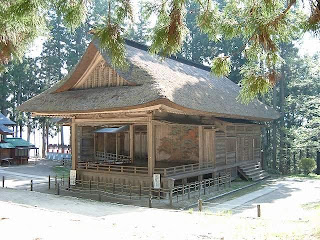

Chuson-ji  Noh stage
 Although the temple was placed under the protection of the Kamakura Shogunate after the destruction of the Fujiwara family, it decayed gradually. Most buildings in the temple disappeared due to wars and fires.

Konjiki-do (金色堂) built in 1124 literally means "Golden Hall". The mummified remains of Kiyohira, Motohira and Hidehira and Yasuhira's head are placed in the hall. In 1950, several seeds of lotus were found in the wooden container in which Yasuhira's head was enshrined. Some of them put forth buds in 1993 and came into bloom in 1998.

former wooden saya-do
 Some buildings housing the hall were built to protect the hall from wind and rain within decades after the construction of the hall.
Wooden saya-do(覆堂) housing the hall is thought to have been built in the 15th century and was moved near the hall. This saya-do is now designated as an Important Cultural Property of Japan. the Date family, the lords of the Sendai Domain supported the temple in the Edo Period. Basho saw the hall housed in this wooden saya-do.
The Japanese government has preserved the temple since the Meiji Period. In 1962, the hall was dismantled to restore.

I've been to Hiraizumi including Chuson-ji and Motsu-ji.  I was impressed because I could imagine the past glory of Chuson-ji Temple from the current state of the temple, Basho's haiku poems and the tragedy of Yoshitsune. I wonder if visitors who are not emotionally attached to them will be touched by the temple.

Motsu-ji  Jodo Garden
 Fujiwara no Motohira and Hidehira contributed to the prosperity of Motsu-ji Temple. All buildings of the temple were destroyed by fires after the destruction of the Fujiwara family. During the Edo Period, the Date Domain supported the temple.

Motsu-ji  Jodo Garden
Motsu-ji Temple is famous for its Jodo(浄土) garden built by in the early 12th century.
The garden represented Sukhavati (Amitabha's Pure Land). Even in Kyoto, there are very few Jodo gardens. It is said that only Motsu-ji's garden still retains the original form of Jodo garden.
Motsu-ji  Jodo Garden in autumn
  
The garden differs from most gardens in Japanese temples, so it left a fresh impression on me. The garden had a relaxed atmosphere. I thought the garden appeared similar to Chinese garden.


photos by  日本列島お国自慢
                 列島宝物館(平泉)