http://www.jreast.co.jp/tabidoki/winter/index.html (Japanese version only)
Izumo Grand Shrine(出雲大社) in Shimane Prefecture and Ise Jingu Shrine carried out Sengu(遷宮, transferring deities to new or restored shrine buildings) last year. Izumo Shrine transfers its deity(大国主大神, Okuninushi-no-okami) to its restored building once a every 60 years. At the shrine, the transfer used to be done at irregular intervals. The shrine building was rebuilt after its collapse due to aging. The transfer has been held once a every 60 or 70 years after 1609. The current main sanctuary was built in 1744 and has been designated as a national treasure.
I've been to Izumo Taisha Shrine decades ago. I took the Taisha Line. The shrine was located in a quiet neighborhood surrounded by rice paddies. Though it was regarded as the second highest ranking Shinto shrine in Japan, it had a relaxed and sunny atmosphere. Now the shrine and its approach are bustling with many young women.
Sightseeing Navigation in Shimane:
 |
| R0010339 by dishhh /flickr |
haiden(worship hall)
 |
| R0010335 by dishhh /flickr |
 |
| 出雲大社 Izumo Oyashiro shrine by puffyjet /flickr |
Visitors can't enter the honden(main sanctuary) of Izumo Shrine.
 |
| P8130097 by No Boring Stories /flickr |
restored honden from an anterior view
 |
| P8130131 by No Boring Stories /flickr |
old honden from a lateral view
 |
| photo by 列島宝物館 |
 |
| P8130109 by No Boring Stories /flickr |
 |
| P8130117 by No Boring Stories /flickr |
restored honden from a behind view
 |
| P8130123 by No Boring Stories /flickr |
 |
| photo by Shimane Prefectural Tourism Federaion |
On January 3, a banner flag called Kitcho-san(吉兆さん) parade down the street and 42 year-old men with devil masks called Bannai(番内) hold a ceremony to drive away evil spirits at every door. Forty-two is said to be a critical age for a man.
The 10th month in the lunar calendar(corresponding to November in the solar calendar) was named Kanna-zuki(神無月), when all of Shinto deities gather at Izumo Grand Shrine(出雲大社, Izumo Oyashiro or Izumo Taisha) in Shimane Prefecture. Now many harvest festivals are held in October.
It is said that the Shinto deities other than Ebisu gather at Izumo Grand Shrine(出雲大社, Izumo Oyashiro or Izumo Taisha) in Shimane Prefecture in the 10th month in the lunar calendar (corresponding to November in the solar calendar) because they have a meeting to build ties among people. So the month was called "God presence month" in Izumo area, and "God absence month" in other areas.
 |
Inasanohama Beach(稲佐の浜)
photo by Shimane Prefectural Tourism Federaion
(This pine tree died and was cut down.)
|
Visitors can attend "Enmusubi-taisai"(matchmaking festival) on the 15th, 17th days of the 10th month in the lunar calendar. Advance reservations are required. General participants write wishes on ema (a votive horse tablet). The priest recites a Shinto prayer. Court dance and music called kagura is dedicated to the shrine. The representatives of 47 prefectures dedicate ema tablets to the shrine. General participants dedicate ema after the ritual.
The shrine is popular with young women because Okuninushi is popularly known as a matchmaking deity. Many people from far away visit the shrine. It's not clear since when the shrine has been said to bring romance. It was famous for the shrine of matchmaking in the mid-Edo Period.
They send the deities off on the 17th day of the 10th month in the lunar calendar(corresponding to November 19 last year).
 |
| Izumo zenzai photo by Shimane Prefectural Tourism Federaion |
According to a theory, "zenzai"(rice cakes and boiled sweet adzuki beans) comes from "Jinzai-mochi"(神在餅) offered to the deities during their stay in Izumo.
People eat zoni(雑煮) containing rice cakes and sweetened adzuki beans in some areas of Tottori and Shimane prefectures. Zoni is a soup containing rice cakes, vegetables, some kind of meat. It is served on New Year's Day. However, it's cooked in various ways according to regional custom.
 |
| photo by Shimane Prefectural Tourism Federaion |
For your information, Izumo soba (the buckwheat noodles of Izumo Province) tastes good.
Incidentally, Ebisu looks after people during the deities' absence. Ebisu(夷、戎、胡、蛭子、恵比須、恵比寿、恵美須) is an ancient Japanese deity and came to be regarded as the deity who brings people success in business and the safety of their families. Many shrines across Japan hold Ebisu-kou(えびす講) on November 19 and 20.
On an unrelated topic, rare phenomena were observed in Izumo area on October 18, 2013. A sundog, a 22° halo, and a circumzenithal arc appeared together.
Izumo Taisha is officially known as Izumo Oyashiro. "Oyashiro(大社)" literally means "big shrine" in Japanese. Oyashiro used to mean Izumo Oyashiro. For your information, "Jingu" means Ise Jingu Shrine.
Records show that its main sanctuary was 96 meters tall in remote antiquity, 48 meters in the 10th century, and they were so tall that they repeatedly fell down. The exsiting main sanctuary is 24 meters tall. People doubted that such tall buildings existed.
reconstructed models of ancient Izumo Shrine
 |
| P7104619 by yuen yan /flickr |
In 2000, three 1.35-meter diameter timbers were unearthed from the grounds of the shrine.
They were bundled together to form one huge post. Another two posts were unearthed in the same year. It is estimated that the timbers were the posts of a sanctuary built in the 13th century.
Ancient writings include stories about the origin of Izumo Taisha Shrine.
According to Kojiki (古事記, Record of Ancient Matters), Amaterasu pressed Okuninushi to cede control over Izumo to her. Okuninushi had two sons. One of them agreed with her without any argument. The other fought against Amaterasu troops, but he lost the fight. Okuninushi requested her to build his grand shrine in return for the handover of his territory.
According to Nihon Shoki (日本書紀, Chronicles of Japan), Amaterasu requested Okuninushi to hand over his territory. He refused it. As an exchange condition, she proposed that Okuninushi would become the deity of the underworld and would have his shrine. He accepted the condition.
According to Izumo-no-kuni Fudoki (出雲国風土記), Okuninushi declared his resolve to turn over the sovereignty of his territories other than Izumo Province to Amaterasu, but he wanted to govern Izumo on his own.
The Yamato kingdom is a coalition government of powerful clans in Yamato(current Nara Prefecture) and Kawachi(a part of Osaka Prefecture). It is thought that the kingdom was established by the late third century. Headmen of the kingdom are regarded as the ancestors of the present-day Imperial Family.
Amaterasu is the female deity of the sun. Emperor Tenmu (天武天皇, 631-686) won the battle after praying to her. It is said that this led the deity to become the ancestor of Imperial Family.
The Naiku of Ise Jingu Shrine is dedicated to Amaterasu. There is a theory that his wife, Empress Jito (持統天皇, 645-703), started Shikinen Sengu of Ise Shrine to justify her succession to the imperial throne by identifying herself with Amaterasu.
Kojiki and Nihon Shoki are old extant chronicles. The preface of Kojiki mentioned that this chronicle was reported to the Emperor in 712. The book is thought to have been written to justify the imperial rule. Nihon Shoki was finished in 720. It is assumed that some inconvenient records for the Yamato kingdom were altered or deleted.
Izumo-no-kuni Fudoki is a fudoki (Description of regional climate, culture, etc.) of the Izumo Province. In 713, Emperor Genmyo ordered to each provision to edit Fudoki. It is said that the book was finished in 733. The fudoki includes many myths about Izumo, and its description differs from the other two chronicles. Though most fudoki books were written by provincial governors dispatched from the central government, a local official wrote this book. He was a member of a powerful local clan in Izumo. It isn't clear why the Yamato kingdom didn't request changes in the contents of Izumo fudoki.
Myths describe could some actual historical events.
Many people think that the Yamato kingdom destroyed the Izumo kingdom. According a theory, the Yamato kingdom built Izumo Shrine for Okuninushi because people feared him who caused disasters and other misfortunes. Some people say that the Izumo kingdom accepted a compromise proposal that Izumo became the center of religion and Yamato became that of politics.
Emperor Sujin (崇神天皇) was the tenth emperor of Japan according to Chronicles of Japan, but most historians consider him as the first emperor who lived from the third century to the beginning of the fourth century. The following careers of Emperor Sujin are mostly based on Chronicles of Japan.
Five years after his accession, many people died of the plague. Amaterasu and Okunitamano-kami(a local deity or Okuninushi) were enshrined in his palace. He thought that Amaterasu caused disasters because she was inherently incompatible with the deity. He moved them out of his palace to end its epidemic. Amaterasu was enshrined in Ise Jingu Shrine during the reign of his son, Emperor Suinin(垂仁天皇).
He enshrined Omononushi-no-okami(Okuninushi) in Omiwa Jinja Shrine(大神神社) in current Nara Prefecture and appointed a descendant of Omononushi as the chief priest of the shrine. The shrine is one of the oldest shrines in Japan. He appointed the chief priest of the shrine enshrining Okunitamano-kami. And then, the plague ended and an abundant harvest ensued.
In 2009, two building remains were discovered at the Makimuku ruins in Sakurai City, Nara Prefecture. An architectural historian said that one had the same style of building as Ise Jingu Shrine and the other had the same style of building as Izumo Taisha Shrine.
He advocates that Makimuku was the capital of the Yamato kingdom which was governed by Emperor Sujin and the two buildings were original forms of Ise and Izumo shrines. However, some people say that Himiko, the queen of the Yamatai-Koku kingdom, governed Makimuku.
Shinto shrines has two types. Most of "Jingu" shrines such as Ise Jingu, Atsuta Jingu have enshrined emperors or the deities deemed to be the ancestors of Imperial Family. There are few Jingu shrines. "Jinja" shrines have enshrined local deities. It is said that Jinja shrines account for 60-70 % of Shinto shrines across the nation.
The Yamato kingdom claimed that many local deities were related to Amaterasu instead of denying the existence of them. Susanoo was the younger brother of Amaterasu, but he was reagrded as not an ancestor of Imperial Family but as a local deity. Those in power often took advantage of deities who cursed people such as Sugawara Michizane, Taira no Masakado.
Now young women visit Izumo Taisha Shrine to make a good match, test takers pray to Sugawara Michizane for passing an entrance exam.
Ise Jingu Shrine has 125 shrines centered on the Naiku(内宮, the inner shrine) dedicated to Amaterasu-omikami(天照大神) and the Geku(外宮, the outer shrine) dedicated to Toyouke-no-omikami(豊受大神). As a matter of fact, some deities including Toyouke-no-omikami enshrined in Ise Shrine are local deities in Ise area.
A myth of Izanagi and Izanami in Izumo is remarkably similar to that of Orpheus and Eurydice.
 |
| Yomotsu Hirasaka
photo by Shimane Prefectural Tourism Federaion
|
Yomotsu Hirasaka(黄泉比良坂) is said to be at the entrance to the underworld.
Izanami (The Female Who Invites) made Yomotsu-shikome chase Izanagi (The Male Who Invites) in desire to catch him because he had run away from her. Izanagi run away after seeing his wife Izanami who was dead and cold, breaking his promise.
 |
| Yomotsu Hirasaka photo by Shimane Prefectural Tourism Federaion |
Izanami chased and caught up with him at the Yomotsu Hirasaka. Izanami said she would kill 1000 people a day. Izanagi replied he would have 1500 babies born each day. Izanagi blocked the road with rocks at the Yomotsu Hirasaka which is the slope that forms the border between the underground and this world.
 |
| Yomotsu Hirasaka photo by Shimane Prefectural Tourism Federaion |
Legend has it that Izanagi blocked the road with these rocks.
Izanagi is the father of Amaterasu, Tsukuyomi, Susanoo. In Izumo,
Susanoo met Kushinada-hime who was nearly sacrificed to Yamata no Orochi (eight-headed giant snake). After wiping out the snake, he married Kushinada.
 |
| Sada Shinno photo by Shimane Prefectural Tourism Federaion |
Susanoo-no-mikoto(素盞鳴尊) in Sada Shinno(佐陀神能)
Sada Shinno(佐陀神能) is a kagura (Shinto music and dancing) with a history of over 400 years and is dedicated to the Sada Shrine(佐太神社) in Matsue City, Shimane Prefecture. The shrine appears in Izumo-no-kuni Fudoki(733). The performance has been registered as an Intangible Cultural Heritage by UNESCO.
 |
| Sada Shinno photo by Shimane Prefectural Tourism Federaion |
 |
| Sada Shinno photo by Shimane Prefectural Tourism Federaion |
 |
| Sada Shinno photo by Shimane Prefectural Tourism Federaion |
Yamatahime-no-mikoto(倭姫命)
Kirime-no-mikoto(切女命)
 |
| photo by Shimane Prefectural Tourism Federaion |
Sada Shrine
(佐太神社)
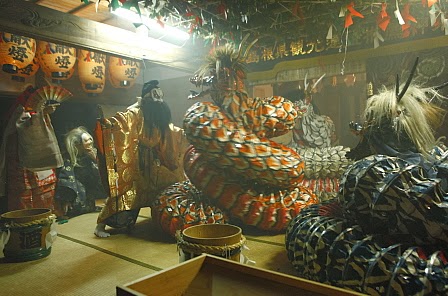
Iwami Kagura(石見神楽) consists of more than 30 programs. It is famous for its dynamic dances. "Orochi" based on Yamata no Orochi is a very popular program. The snakes coil up, flash their eyes, breathe out fire and smoke. The masks and snakes are made of washi paper.
 |
| orochi in Iwami Kagura photo by Shimane Prefectural Tourism Federaion |
 |
| orochi in Iwami Kagura photo by Shimane Prefectural Tourism Federaion |
 |
| orochi in Iwami Kagura photo by Shimane Prefectural Tourism Federaion |
 |
| orochi in Iwami Kagura photo by Shimane Prefectural Tourism Federaion |
 |
| photo by Shimane Prefectural Tourism FederaionOrochi at Iwami |
Iwami Kagura competition
Izumo Kagura(出雲神楽) is unspectacular and has a low profile compared to Iwami Kagura.
However, Some say that Izumo Kagura keeps the flavor of the time when common people started to play kagura that had been dedicated to deities.
 |
| Izumo Kagura photo by Shimane Prefectural Tourism Federaion |
Okuninushi fell in love with Susanoo's daughter. Susanoo took Okuninushi through a series of trials. Okuninushi married Susanoo's daughter, and built his magnificent palace on the advice of Susanoo.
A hare tricked some wani(shark or crocodile) into forming a line and tried to go over their backs. One of wani skinned the hare in angry. Okuninushi's elder brothers intentionally offered treatment advice to worsen the condition of the hare. Okuninushi offered an appropriate treatment, and the hare made a recovery.
In Izumo Taisha Shrine, there are the statues of Okuninushi and the hare.
 |
| 出雲大社 Izumo Oyashiro shrine by puffyjet /flickr |
There are a lot of other shrines related to Izumo myths.
Susa Shrine(須佐神社) appears in Izumo-no-kuni Fudoki. Susanoo is enshrined in the shrine.
It it said that the current main sanctuary was built in 1554.
The main sanctuary of Kamosu Shrine(神魂神社) has been designated as a national treasure.
It is said that the current main sanctuary was built in 1583.
 |
| main sanctuary of Kamosu Shrine photo by Shimane Prefectural Tourism Federaion |
 |
| Iya Shrine photo by Shimane Prefectural Tourism Federaion |
Iya Shrine(揖夜神社) is located near Yomotsu Hirasaka. The shrine is said to be closely connected to the underworld. A mirror is placed in fromt of its main sanctuary.
 |
| Iya Shrine photo by Shimane Prefectural Tourism Federaion A mirror is placed in fromt of its main sanctuary |
 |
| Iya Shrine |
 |
| Hinomisaki Shrine photo by Shimane Prefectural Tourism Federaion |
Hinomisaki Shrine(日御碕神社) has two shrines. Its lower shrine called Hishizumi-no-miya(日沈の宮) was built by order of Emperor Shomu to defend Japan during the night while Ise Shrine defended Japan during the day. The shrine was moved to its present location by order of Emperor Murakami in 947.
 |
| Yaegaki Shrine photo by Shimane Prefectural Tourism Federaion |
Yaegaki Shrine(八重垣神社) is popular as the shrine of matchmaking because the shrine is located where Susanoo and Inada-hime(Kushinada) set up a new home. Many young women visit here.
 |
| Yaegaki Shrine photo by Shimane Prefectural Tourism Federaion |
Love fortune-telling is popular with them. One buys a fortune-telling paper, puts a coin on the paper, and sets it adrift on the pond. The sooner the paper sinks in the pond, the better. The closer the location of the sunken paper is to him/her, he/she will marry the person closer to him/her. A message emerges on the paper when it gets wet.
 |
| photo by Shimane Prefectural Tourism Federaion |
Kumamo Taisha Shrine
(熊野大社)
 |
| photo by Shimane Prefectural Tourism Federaion |
Nagahama Shrine
(長浜神社)


