The kabuki actor Bando Mitsugoro VIII(八代目 坂東 三津五郎) died at age 68 due to poisoning from tiger puffer fish liver on January 16th in 1975. A chef served the liver at his earnest request.
Chefs have to be especially licensed to prepare puffer fish. It is prohibited to serve internal organs of puffer fish at restaurants. However, tiger puffer fish liver was widely known to gourmets including Mitsugoro as a mouth-watering ingredient.
It is required by law to keep toxic parts of puffer fishes under lock and key and to ask specialized waste disposers to deal with the parts. It is prohibited to sell puffer fishes without removing toxic parts of them to ordinary customers.
Puffer fish has been regarded as a delicacy in the old days. Ancient people risked their lives to eat the fish.
五十にて 鰒の味を 知る夜かな
I-so-ji-ni-te fu-gu-no-a-ji-wo shi-ru-yo-ka-na
"At the age of 50, I ate puffer fish for the first time in my life, I never knew how delicious it was," by Kobayashi Issa(小林一茶, 1763-1828)
ふぐ食わぬ奴にはみせな 富士の山
Fu-gu-ku-wa-nu ya-tsu-ni-wa-mi-se-na fu-ji-no-ya-ma
"A person without the courage to eat puffer fish is not qualified to see Mt. Fuji." by Kobayashi Issa
河豚汁や 鯛もあるのに 無分別
Fu-gu-ji-ru-ya ta-i-mo-a-ru-no-ni mu-fu-n-be-tsu
"Sea breams are safe to eat and delicious. So why some people risk thier lives to eat puffer fishes?" by Matsuo Basho(松尾芭蕉, 1644-1694)
あら何ともなや きのふは過ぎて ふくと汁
A-ra-na-n-to-mo-na-ya ki-no-u-wa-su-gi-te fu-ku-to-ji-ru
"I had a pufferfish pot dish yesterday. I was afraid of what would happen, but I'm very much alive. " by Matsuo Basho
Puffer fishes are in season from November to February.
Shimonoseki is famous for its puffer fishes. The first puffer fish auction of the year is held in Shimonoseki on January 4th. They use a unique bidding process. Bidders make a bid by signalling a bid price with fingers to an auctioneer in a tube-shaped cloth like kimono sleeve.
Some of cultured puffer fishes are nonpoisonous.
Oysters are also in season.
Hiroshima Prefecture ranks first in oyster production in Japan, and Miyagi Prefecture ranked second. Miyagi ranked first in seed oyster production. Because of the tsunami, the number of cultured oysters in Miyagi was down about 90% from the previous year. I haven't seen oysters from Miyagi at shops this season.
A oyster grower stewed a few hundred of oysters that he could not ship due to the tsunami. He was eating strongly flavored stewed oysters for two weeks. In spite of food shortage, he searched for missing persons and wiped away the rubble.
Ironically, it is said that oysters grow more rapidly after the tsunami. On January 19th, 160 kilograms of cultured oysters were shipped from Kesennuma in Miyagi. The shipment of the oysters had originally been scheduled for this autumn.
Mulot company, PlanetFinance, business operators related to the oyster farming industry and government agencies in France are currently promoting a joint project "France-Okaeshi Project" to revive Japanese oyster farming. "France-Okaeshi" means "France returning a present".
LOUIS VUITTON is also supporting oyster growers.
The Pacific oyster, Japanese oyster or Miyagi oyster (Crassostrea gigas), was introduced from Japan to France in the 1970s and 1990 because a virus has decimated oysters in France. About 90% of cultured oysters in France are descended from Miyagi's oysters.
However, a herpes virus was first detected in 2008 among breeding Pacific oysters in France and the virus spread. In March in 2011, 5000 Japanese seed oysters were expected to be introduced on a trial basis to Ifremer(French Research Institute for Exploitation of the Sea.) The quake and tsunami occurred a few days before the scheduled shipping. The introduction of Japanese seed oysters was shelved.
The joint project provides financial and material support to oyster producers in tsunami-hit areas. However, Japanese way of oyster farming is completely different from French. It was difficult to get materials for Japanese oyster farming in France.
In Japan, a fisheries entrepreneur found ways to cultivate oysters and started large-scale cultivation in 1927. Incidentally, his daughter is a famous journalist who specializes in cooking and was one of the judges on the original Iron Chef television program.
We appreciate that French oyster farmers facing tough times are helping to revive Japanese oyster farming.
Showing posts with label POEM_haiku. Show all posts
Showing posts with label POEM_haiku. Show all posts
Monday, January 30, 2012


Friday, September 16, 2011
Moon Viewing
Hot humid weather has lasted. I've got tired because of the summer heat. Many people have been rushed to hospitals with heat stroke.
September 12th corresponds to the 15th day of the 8th month in the lunar calendar this year. Moon Viewing is held on this day. It derives from the Chinese Mid-Autumn Festival.
We see a rabbit pounding steamed rice on the moon surface.
 座り兎の巾着袋ーデザイン/内林泰子
"drawstring bag in the shape of a sitting rabbit" designed by Yasuko Uchibayashi
It's like a rakugo storyteller who kneels on a cushion with a folding fan in its hand.
Mie Kuwabara, Chirimen-de-Tsukuru-Saikumono-to-Oshie,(Tokyo:Ondori-sha,1999),P.24.
桑原実絵・浜肇子・要海三枝子著,ちりめんで作る細工ものと押し絵(東京:雄鶏社,1999年),p24.
There is a custom called Tsukimi-dorobo(月見泥棒) like Trick-or-treating on Halloween in some areas.
The moon on this day is also called Imo-meigetsu (芋名月). Imo refers to tubers. Moon viewing is thought to have been also a celebration for the first taro harvest.
On this day, people used to be allowed to eat taros out in their neighbors' fields in many areas. But there was a limit to the amount of them.
In some areas, children used to be allowed to sneak rice dumplings out of the neighbors' houses. But the dumpling was limited to one per child. It was a thrill-seeking behavior for children. Adults considered that the moon ate the dumplings. The community as a whole watched children grow up.
In another areas, they visit their neighbors and ask for sweets, saying "Give me Otsukimi(sweets)!" They say "Thank you" when leaving.
Recently, people leave a basket of sweets around the entrance. Some children don't give thanks to them, take all of sweets, make a scene when seeing empty basket and come from different towns. For some children, it's only an oppotunity to get sweets for free.
秋風に たなびく雲の 絶え間より
もれ出づる月の 影のさやけさ
A-ki-ka-ze-ni Ta-na-bi-ku-ku-mo-no Ta-e-ma-yo-ri
Mo-re-i-zu-ru-tsu-ki-no Ka-ge-no-sa-ya-ke-sa
"Moonlight breaks through the clouds flowing in the autumn breeze, it's so bright and clear," written by Sakyo no Daibu Akisuke(左京大夫顕輔, 1090~1155)
This accessible waka poem is included in "one hundred waka poems," a famous poetry anthology selected by Fujiwarano Teika in the Heian period.
名月や 池をめぐりて 夜もすがら
Me-i-ge-tsu-ya I-ke-wo-me-gu-ri-te Yo-mo-su-ga-ra
"The harvest moon, while pacing around the pond, I saw the dawn break," written by Matsuo Basho(松尾芭蕉) on the 15th day of the 8th month in the lunar calendar(corresponding to October 2nd in the Gregorian calendar) in 1686.
He held a Moon-viewing party with haiku poets at his hermitage in Fukagawa, Tokyo. They enjoyed the harvest moon on a boat in the Sumida River.
He moved to Fukagawa and became a monk in 1680. Besides composing haiku poems, he got coaching from a Zen monk.
ひとつ家に 遊女も寝たり 萩と月
Hi-to-tsu-ya-ni Yu-u-jo-mo-ne-ta-ri Ha-gi-to-tsu-ki
"At the same inn, a prostitute also stays, bush clover and the moon," written by Matsuo Basho at an inn in Niigata on the 12th day of the 7th month in the lunar calendar(corresponding to August 26th in the Gregorian calendar) in 1689.
Basho wearing monk's stole and a colorful prostitute stay at the same inn. In its yard, bush clovers are blooming beautifully in the moonlight. A combination of bush clovers and the moon is something akin to that of monk and prostitute.
September 12th corresponds to the 15th day of the 8th month in the lunar calendar this year. Moon Viewing is held on this day. It derives from the Chinese Mid-Autumn Festival.
We see a rabbit pounding steamed rice on the moon surface.
"drawstring bag in the shape of a sitting rabbit" designed by Yasuko Uchibayashi
It's like a rakugo storyteller who kneels on a cushion with a folding fan in its hand.
Mie Kuwabara, Chirimen-de-Tsukuru-Saikumono-to-Oshie,(Tokyo:Ondori-sha,1999),P.24.
桑原実絵・浜肇子・要海三枝子著,ちりめんで作る細工ものと押し絵(東京:雄鶏社,1999年),p24.
There is a custom called Tsukimi-dorobo(月見泥棒) like Trick-or-treating on Halloween in some areas.
The moon on this day is also called Imo-meigetsu (芋名月). Imo refers to tubers. Moon viewing is thought to have been also a celebration for the first taro harvest.
On this day, people used to be allowed to eat taros out in their neighbors' fields in many areas. But there was a limit to the amount of them.
In some areas, children used to be allowed to sneak rice dumplings out of the neighbors' houses. But the dumpling was limited to one per child. It was a thrill-seeking behavior for children. Adults considered that the moon ate the dumplings. The community as a whole watched children grow up.
In another areas, they visit their neighbors and ask for sweets, saying "Give me Otsukimi(sweets)!" They say "Thank you" when leaving.
Recently, people leave a basket of sweets around the entrance. Some children don't give thanks to them, take all of sweets, make a scene when seeing empty basket and come from different towns. For some children, it's only an oppotunity to get sweets for free.
 |
| full moon on September 12th |
秋風に たなびく雲の 絶え間より
もれ出づる月の 影のさやけさ
A-ki-ka-ze-ni Ta-na-bi-ku-ku-mo-no Ta-e-ma-yo-ri
Mo-re-i-zu-ru-tsu-ki-no Ka-ge-no-sa-ya-ke-sa
"Moonlight breaks through the clouds flowing in the autumn breeze, it's so bright and clear," written by Sakyo no Daibu Akisuke(左京大夫顕輔, 1090~1155)
This accessible waka poem is included in "one hundred waka poems," a famous poetry anthology selected by Fujiwarano Teika in the Heian period.
名月や 池をめぐりて 夜もすがら
Me-i-ge-tsu-ya I-ke-wo-me-gu-ri-te Yo-mo-su-ga-ra
"The harvest moon, while pacing around the pond, I saw the dawn break," written by Matsuo Basho(松尾芭蕉) on the 15th day of the 8th month in the lunar calendar(corresponding to October 2nd in the Gregorian calendar) in 1686.
He held a Moon-viewing party with haiku poets at his hermitage in Fukagawa, Tokyo. They enjoyed the harvest moon on a boat in the Sumida River.
He moved to Fukagawa and became a monk in 1680. Besides composing haiku poems, he got coaching from a Zen monk.
ひとつ家に 遊女も寝たり 萩と月
Hi-to-tsu-ya-ni Yu-u-jo-mo-ne-ta-ri Ha-gi-to-tsu-ki
"At the same inn, a prostitute also stays, bush clover and the moon," written by Matsuo Basho at an inn in Niigata on the 12th day of the 7th month in the lunar calendar(corresponding to August 26th in the Gregorian calendar) in 1689.
Basho wearing monk's stole and a colorful prostitute stay at the same inn. In its yard, bush clovers are blooming beautifully in the moonlight. A combination of bush clovers and the moon is something akin to that of monk and prostitute.
Wednesday, August 10, 2011
Morning Glory and Tanabata
August 8th was the first day of fall(立秋) according to the traditional East Asian lunisolar calendar.
Temperatures have been above 35 degrees Celsius in many parts of the country. Many people have been rushed to hospitals with heat stroke. It's boiling hot and humid. I can't sleep well.
The rate of daily electricity use reached 97 percent in the areas supplied with electricity by Tohoku Electric Power Company on August 5th. Because 28 hydroelectric power plants within the jurisdiction of the company stopped due to last month's heavy rain. Tokyo Electric Power Company and Hokkaido Electric Power Company accommodate the company with electricity.
The Nagasaki Atomic Bomb Victims Memorial Peace Prayer Ceremony was held on August 9th. The mayor of Nagasaki indicated his intention to aim to abandon nuclear power generation for the first time.
August 6th corresponds to the 7th day of the 7th month in the lunar calendar this year.
Morning glory is "asagao" in Japanese and asagao(朝顔) means "morning beauty."
Morning glory is also known as Kengyuka(牽牛花). Kengyu(牽牛) literally means towing a cow. It also means the Cowherd (Altair) in the Tanabata legend. Some theories explains how it came to be its name.
One theory holds that morning glory seeds were highly prized as Chinese herbal medicines, so they are equal to a cow in value. Another theory is morning glories bloom around Tanabata, the 7th day of the 7th month in the lunar calendar.
Morning glories are blooming here and there. The Iriya Morning Glory Fair in July was cancelled due to the Great East Japan Earthquake this year.
There is a famous episode about morning glory.
Sen no Rikyu(千利休) who was a master of the tea ceremony was growing morning glories that were rare in those days. Toyotomi Hideyoshi, the power of the day, asked Rikyu to view them after having heard rumors of them. Rikyu invited Hideyoshi for a tea ceremony at his residence.
However, there was no morning glory in Rikyu's garden. When entering the tea-ceremony room, Hideyoshi saw just one morning glory being placed in a vase in an alcove. Only one morning glory drove its beauty home to Hideyoshi. Hideyoshi praised Rikyu.
荒海や佐渡によこたふ天の河 松尾芭蕉
A-ra-u-mi-ya Sa-do-ni-yo-ko-ta-u A-ma-no-ga-wa
"Turbulent the sea—across to Sado stretches the Milky Way," written by Matsuo Basho and translated by Donald Lawrence Keene.
The dark and furious sea is before his eyes. He finds the silhouette of Sado Island. When he looks up at the night sky, the Milky Way seems to stretch to Sado Island.
He visited Naoetsu in Niigata and composed this poem at a haiku gathering on the 7th day of the 7th month in the lunar calendar(August 21st in the Gregorian calendar) in 1689. However, he couldn't see the Milky Way there because of rainy weather. The sea is quiet in that season. The Milky Way doesn't lie on Sado Island.
Tuesday, July 5, 2011
Hiraizumi
On July 1st, we started to save our electricity use by up to 15 percent. Businesses that violate the law will face penalties. Working days and hours vary from company to company now.
Air conditioners use too much electricity, so sales of electric fans have exploded. Various items to beat the heat including folding fans, paper fans, bamboo blinds and water pillows are selling well. The green wall(green facade) is also popular. wind-bells actually don't cool a room, but they make us feel cool. So they are also selling well.
Hiraizumi(平泉) including Chuson-ji Temple (中尊寺) and Motsu-ji Temple (毛越寺) in Iwate Prefecture was registered as a World Heritage site by UNESCO on June 28th.
On the 13th day of the 5th month in the lunar calendar(on June 29th in the Gregorian calendar) in 1689, haiku poet Matsuo Basho(松尾芭蕉) visited Hiraizumi during the rainy season and composed the following poems.
夏草や兵どもが夢の跡
(Na-tsu-ku-sa-ya Tsu-wa-mo-no-do-mo-ga Yu-me-no-a-to)
"A long time ago powerful warriors fought with dreams of supremacy here, but a whole field of summer grass spread out in front of me now," written by Matsuo Basho.
Basho wrote this poem at Takadachi, the deathplace of Minamoto no Yoshitsune(源義経, 1159-1189), located to in the southeast of Chuson-ji Temple.
Yoshitsune was a tragic hero whose brother Minamoto no Yoritomo(源頼朝) was the founder of the Kamakura Shogunate. Although Yoshitsune craved affection and acceptance from his brother, Yoritomo cast off Yoshitsune. He escaped to Hiraizumi counting on the Fujiwara family because he was put under the protection of Fujiwara no Hidehira(藤原秀衡) for a period of time.
Hidehira welcomed him, but Hidehira's son
Yasuhira (泰衡) drove Yoshitsune to his death to keep peace of Hiraizumi after Hidehira's death. However, the family was destroyed by Yoritomo in 1189 after Yoshitsune's death .
Yoshitsune was very popular in Japan, so he appears in many legends and stories such as "Yoshitsune and the Thousand Cherry Trees(義経千本桜, Yoshitsune Senbon-zakura)".
五月雨のふり残してや光堂
(Sa-mi-da-re-no Fu-ri-no-ko-shi-te-ya Hi-ka-ri-do-u)
"Surrounding buildings have fallen into decay, but only Hikari-do is as resplendent as it was ever. As if early summer rain skirted around it," written by Matsuo Basho.
Hikari-do refers to Konjiki-do of Chuson-ji Temple. Now a reinforced concrete building with glass case has housed the hall since 1965. It is incongruous for the temple.
Some people say "the land of gold" called jipangu in the Book of Marco Polo (1299) referred to Konjiki-do of Chuson-ji Temple that the Northan Fujiwara family built. The family took advantage of alluvial gold and horses which were specialties of Tohoku to reign over Tohoku region virtually for three generations including Kiyohira(清衡), Motohira(元衡) and Hidehira(秀衡).
Although the temple was placed under the protection of the Kamakura Shogunate after the destruction of the Fujiwara family, it decayed gradually. Most buildings in the temple disappeared due to wars and fires.
Konjiki-do (金色堂) built in 1124 literally means "Golden Hall". The mummified remains of Kiyohira, Motohira and Hidehira and Yasuhira's head are placed in the hall. In 1950, several seeds of lotus were found in the wooden container in which Yasuhira's head was enshrined. Some of them put forth buds in 1993 and came into bloom in 1998.
Some buildings housing the hall were built to protect the hall from wind and rain within decades after the construction of the hall.
Wooden saya-do(覆堂) housing the hall is thought to have been built in the 15th century and was moved near the hall. This saya-do is now designated as an Important Cultural Property of Japan. the Date family, the lords of the Sendai Domain supported the temple in the Edo Period. Basho saw the hall housed in this wooden saya-do.
The Japanese government has preserved the temple since the Meiji Period. In 1962, the hall was dismantled to restore.
I've been to Hiraizumi including Chuson-ji and Motsu-ji. I was impressed because I could imagine the past glory of Chuson-ji Temple from the current state of the temple, Basho's haiku poems and the tragedy of Yoshitsune. I wonder if visitors who are not emotionally attached to them will be touched by the temple.
Fujiwara no Motohira and Hidehira contributed to the prosperity of Motsu-ji Temple. All buildings of the temple were destroyed by fires after the destruction of the Fujiwara family. During the Edo Period, the Date Domain supported the temple.
Motsu-ji Temple is famous for its Jodo(浄土) garden built by in the early 12th century.
The garden represented Sukhavati (Amitabha's Pure Land). Even in Kyoto, there are very few Jodo gardens. It is said that only Motsu-ji's garden still retains the original form of Jodo garden.
The garden differs from most gardens in Japanese temples, so it left a fresh impression on me. The garden had a relaxed atmosphere. I thought the garden appeared similar to Chinese garden.
photos by 日本列島お国自慢
列島宝物館(平泉)
Air conditioners use too much electricity, so sales of electric fans have exploded. Various items to beat the heat including folding fans, paper fans, bamboo blinds and water pillows are selling well. The green wall(green facade) is also popular. wind-bells actually don't cool a room, but they make us feel cool. So they are also selling well.
 |
| Chuson-ji Hondo(main hall) |
Hiraizumi(平泉) including Chuson-ji Temple (中尊寺) and Motsu-ji Temple (毛越寺) in Iwate Prefecture was registered as a World Heritage site by UNESCO on June 28th.
On the 13th day of the 5th month in the lunar calendar(on June 29th in the Gregorian calendar) in 1689, haiku poet Matsuo Basho(松尾芭蕉) visited Hiraizumi during the rainy season and composed the following poems.
 |
| Gikeido (Yoshitsune Hall) in Takadachi |
夏草や兵どもが夢の跡
(Na-tsu-ku-sa-ya Tsu-wa-mo-no-do-mo-ga Yu-me-no-a-to)
"A long time ago powerful warriors fought with dreams of supremacy here, but a whole field of summer grass spread out in front of me now," written by Matsuo Basho.
Basho wrote this poem at Takadachi, the deathplace of Minamoto no Yoshitsune(源義経, 1159-1189), located to in the southeast of Chuson-ji Temple.
 |
| Chuson-ji Tsukimizaka |
Yoshitsune was a tragic hero whose brother Minamoto no Yoritomo(源頼朝) was the founder of the Kamakura Shogunate. Although Yoshitsune craved affection and acceptance from his brother, Yoritomo cast off Yoshitsune. He escaped to Hiraizumi counting on the Fujiwara family because he was put under the protection of Fujiwara no Hidehira(藤原秀衡) for a period of time.
 |
| Chuson-ji |
Hidehira welcomed him, but Hidehira's son
Yasuhira (泰衡) drove Yoshitsune to his death to keep peace of Hiraizumi after Hidehira's death. However, the family was destroyed by Yoritomo in 1189 after Yoshitsune's death .
Yoshitsune was very popular in Japan, so he appears in many legends and stories such as "Yoshitsune and the Thousand Cherry Trees(義経千本桜, Yoshitsune Senbon-zakura)".
 |
| current saya-do housing Konjiki-do |
五月雨のふり残してや光堂
(Sa-mi-da-re-no Fu-ri-no-ko-shi-te-ya Hi-ka-ri-do-u)
"Surrounding buildings have fallen into decay, but only Hikari-do is as resplendent as it was ever. As if early summer rain skirted around it," written by Matsuo Basho.
 |
| Konjiki-do(Pictures prohibited in here) |
 |
| Chuson-ji Benkei-do |
Some people say "the land of gold" called jipangu in the Book of Marco Polo (1299) referred to Konjiki-do of Chuson-ji Temple that the Northan Fujiwara family built. The family took advantage of alluvial gold and horses which were specialties of Tohoku to reign over Tohoku region virtually for three generations including Kiyohira(清衡), Motohira(元衡) and Hidehira(秀衡).
 |
| Chuson-ji Noh stage |
Konjiki-do (金色堂) built in 1124 literally means "Golden Hall". The mummified remains of Kiyohira, Motohira and Hidehira and Yasuhira's head are placed in the hall. In 1950, several seeds of lotus were found in the wooden container in which Yasuhira's head was enshrined. Some of them put forth buds in 1993 and came into bloom in 1998.
 |
| former wooden saya-do |
Wooden saya-do(覆堂) housing the hall is thought to have been built in the 15th century and was moved near the hall. This saya-do is now designated as an Important Cultural Property of Japan. the Date family, the lords of the Sendai Domain supported the temple in the Edo Period. Basho saw the hall housed in this wooden saya-do.
The Japanese government has preserved the temple since the Meiji Period. In 1962, the hall was dismantled to restore.
I've been to Hiraizumi including Chuson-ji and Motsu-ji. I was impressed because I could imagine the past glory of Chuson-ji Temple from the current state of the temple, Basho's haiku poems and the tragedy of Yoshitsune. I wonder if visitors who are not emotionally attached to them will be touched by the temple.
 |
| Motsu-ji Jodo Garden |
 |
| Motsu-ji Jodo Garden |
The garden represented Sukhavati (Amitabha's Pure Land). Even in Kyoto, there are very few Jodo gardens. It is said that only Motsu-ji's garden still retains the original form of Jodo garden.
 |
| Motsu-ji Jodo Garden in autumn |
The garden differs from most gardens in Japanese temples, so it left a fresh impression on me. The garden had a relaxed atmosphere. I thought the garden appeared similar to Chinese garden.
photos by 日本列島お国自慢
列島宝物館(平泉)
Tuesday, May 24, 2011
Cormorant Fishing on the Nagara River
The rainy season started in Kyusyu and it snowed in Hokkaido yesterday.
Cormorant Fishing(鵜飼, ukai) on the Nagara River in Gifu Prefecture is being held from May 11th to October 15th except for the night of the mid-autumn harvest moon and the times when the water level in the river is high.
Now six cormorant fishing masters called usho(鵜匠) working on the Nagara River belong to the Imperial Household Agency. A usho wears a traditional costume including eboshi (a type of headgear worn by court nobles), a straw skirt and a chest protector to protect his body from fishing fire while fishing.
The sweetfishes caught in the fisheries belonging to the agency are presented to the Imperial Palace, Meiji Jingu Shrine and Ise Jingu Shrine eight times a year.
In Japan, many visitors go and see the sights of the fishing on houseboats and the fishing starts at around 19:30.
HD映像 岐阜の夏の風物詩 長良川鵜飼
( A summer scene in Gifu City, Cormorant Fishing on the Nagara River)
According to The Book of Sui(隋書) which was the official history of the Chinese Sui Dynasty, a Chinese envoy saw a strange fishing method of using cormorant birds to catch fishes in 600 in Japan.
The fishing method appears in the Kojiki and the Nihonshoki, two ancient chronicles written in the eighth century.
Aristocrats in the eighth century enjoyed this fishing as a sport. They caught sweetfishes with fishing fire in one hand and leashes linked to cormorants in the other while dipping his body in the water at night. Cormorant fishing masters went along with them.
「年のはに 鮎し走らば 辟田川 鵜八つ潜けて 川瀬尋ねむ」 大伴家持
"When sweetfishes begin to swim around in the Sakita River, I'm going to have some cormorants dive while wading in shallow water," by Otomo no Yakamochi(c.718–785) in "A Collection of a Myriad Leaves"(万葉集, Man-yo-shu).
In the south area of Gifu Prefecture, the practice of using cormorant birds to catch fishes dates back some 1,300 years. This traditional fishing method has been handed down from father to son.
The powers of the day took cormorant fishing under their wings.
After watching cormorant fishing on the Nagara River, Matsuo Basho(松尾芭蕉) composed the following haiku poem based on a Noh play named Ukai(鵜飼).
「おもしろうて やがてかなしき 鵜舟かな」 松尾芭蕉
"I enjoyed, but gradually I came to be saddened, to see scenes of cormorant fishing," by Matsuo Basho(1644-1694)
Let me give you a brief outline of the play.
Two monks visit Isawa(石和) in Kai Province (now Yamanashi Prefecture) and stay the night at a small temple by the Fuefuki River(笛吹川). The ghost of a cormorant fishing master appears to the monks. The master was killed because he did cormorant fishing during closed season. The ghost demonstrates his fishing skill by request from the monks, and they are intoxicated with his demonstration.
However, when the morning comes, he have to get back to the other world. He is reluctant to leave this world. They learned that his spirit still haunts this world and hold a memorial service for him. So his spirit goes to the Land of Bliss.
We can see cormorant fishing while wading in the Fuefuki River at Isawa Onsen in Yamanashi Prefecture from late July to late August.
石和鵜飼(cormorant fishing in Isawa)
There is another fishing method of using cormorant birds in China.
There are differences between Japanese and Chinese cormorant fishing. Japanese fishing masters use Japanese Cormorants on leashes to catch sweetfishes. Meanwhile, off-leash Great Cormorants are used to catch various kinds of fishes in China.
A theory says that the fishing method developed independently of each other in China and Japan.
In both Japan and China, Cormorant Fishing is held for sightseeing now.
In most areas, the open season on sweetfish will start on June 1st. Many anglers pull in sweetfishes while dipping their bodies in the water up to their hips. I heard that wild sweetfish have a flavor of watermelon. It's catch was small, so it's expensive. Now it's available by Internet mail order.
Monday, May 9, 2011
Mother's Day and Matsushima
Today is Mother's Day.
A carnation grower in one of the afflicted areas shipped tsunami-hit carnations. Although they became submerged in muddy water, they have produced masses of flowers after the water had receded.
In the afflicted areas, many people placed white carnations beside the remains of their houses, their mothers' remains in temples and their family graves.
Many people enjoy digging clams at the beach during Golden Week holidays every year, but less people went to the beaches along the Pacific Ocean in Kanto Region. In some area, a tidal range doesn't create the mudflats.
 Matsushima(松島) in Miyagi Prefecture was crowded with many visitors during Golden Week holidays.
A pleasure boat restarted at the end of April. Marinepia Matsushima Aquarium repoened although some sea animals were killed by tsunami.
 Matsushima has been long known as one of "the three most scenic spots in Japan(日本三景,nihonsankei)", along with Amanohashidate in Kyoto and Miyajima in Hiroshima.
Photo by (c)Tomo.Yun
Matsuo Basho(松尾芭蕉) visited this spot in 1689, but there is no haiku poem featuring Matsushima in his famous travelogue "Oku no Hosomichi" (The Narrow Road to the Deep North).
However, he composed the following poem featuring Matsushima.
島々や 千々に砕きて 夏の海 (しまじまや ちぢにくだきて なつのうみ)
"A scattering of small islands break waves in the summer sea."
The town of Matsushima had relatively little damage. Coastal souvenir shops and restaurants had water above floor level and four people died or are missing. It is said that about 260 small islands in the Matsushima bay served as a buffer for tsunami.
Zuigan-ji Temple(瑞巌寺) that is the family temple of Date clan is also attracting many visitors. Zuigan-ji Temple was reopened to the public on Aptil 10th.
The temple was found in 828 and the first lord of the Semdai Domain, Date Masamune(伊達政宗) built several buildings including the main building(本堂, Hondo) and kitchen(庫裡, Kuri) in 1609.
These two buildings have been designated as national treasures. No damage was done to the main building, but Kuri developed some cracks in the wall.
The approach to the temple was covered by mud.
It is said that Masamune himself planted Garyubai(臥龍梅), a variety of ume on the grounds of the temple. The ume trees reached full bloom on April 24th this year.
Visitors and residents in Matsushima took refuge in the temple after the quake and tsunami. About 300 people stayed in the building for trainee Zen monks. The monks prepared and served meals to the afflicted people. The disaster victims in the temple could sleep on futon. The monks also drew water to flush the toilet and worked to clear the rubble. Souvenir shops contributed foods to the temple.
A visitor helped the monks and residents with the cleaning in gratitude for them.
A carnation grower in one of the afflicted areas shipped tsunami-hit carnations. Although they became submerged in muddy water, they have produced masses of flowers after the water had receded.
In the afflicted areas, many people placed white carnations beside the remains of their houses, their mothers' remains in temples and their family graves.
Many people enjoy digging clams at the beach during Golden Week holidays every year, but less people went to the beaches along the Pacific Ocean in Kanto Region. In some area, a tidal range doesn't create the mudflats.

A pleasure boat restarted at the end of April. Marinepia Matsushima Aquarium repoened although some sea animals were killed by tsunami.

Photo by (c)Tomo.Yun
Matsuo Basho(松尾芭蕉) visited this spot in 1689, but there is no haiku poem featuring Matsushima in his famous travelogue "Oku no Hosomichi" (The Narrow Road to the Deep North).
However, he composed the following poem featuring Matsushima.
島々や 千々に砕きて 夏の海 (しまじまや ちぢにくだきて なつのうみ)
"A scattering of small islands break waves in the summer sea."
The town of Matsushima had relatively little damage. Coastal souvenir shops and restaurants had water above floor level and four people died or are missing. It is said that about 260 small islands in the Matsushima bay served as a buffer for tsunami.
 |
| Hondo |
Zuigan-ji Temple(瑞巌寺) that is the family temple of Date clan is also attracting many visitors. Zuigan-ji Temple was reopened to the public on Aptil 10th.
 |
| Kuri |
The temple was found in 828 and the first lord of the Semdai Domain, Date Masamune(伊達政宗) built several buildings including the main building(本堂, Hondo) and kitchen(庫裡, Kuri) in 1609.
These two buildings have been designated as national treasures. No damage was done to the main building, but Kuri developed some cracks in the wall.
 |
| The approach |
 |
| Garyubai |
Visitors and residents in Matsushima took refuge in the temple after the quake and tsunami. About 300 people stayed in the building for trainee Zen monks. The monks prepared and served meals to the afflicted people. The disaster victims in the temple could sleep on futon. The monks also drew water to flush the toilet and worked to clear the rubble. Souvenir shops contributed foods to the temple.
A visitor helped the monks and residents with the cleaning in gratitude for them.
Wednesday, November 24, 2010
Last days of Basho
秋深き隣は何をする人ぞ (松尾 芭蕉)
"Autumn has been far advanced, how does a next-door neighbor earn a living?", written by Matsuo Basho(1644-1694).
This is very famous haiku poem. It's hard for me to translate this poem adequately.
On the 28th day of the 9th month in the lunar calendar(on November 15th in the Gregorian calendar) in 1694, he composed this haiku poem. He attended a haiku gathering on this day, but he fell sick after it. The gathering was to be held for two days straight, so he sent this poem to the host of the gathering. He never arose from a sickbed.
旅に病で夢は枯野をかけ廻る (松尾 芭蕉 「笈日記」)
"While being sick in bed on my journey, I lope across the desolate fields tinged with the color of withered leaves in my dreams", written by Matsuo Basho in "Oi nikki".
Matsuo Basho took to his bed on the 29th day of the 9th month(on November 16th). On the 8th day of the 10th month(on November 24th), he composed this haiku poem.
He passed away at the age of 51 in Osaka on the 12th day of the 10th month(on November 28th) in 1694.
Tuesday, October 26, 2010
first snow, first cold wintry wind and kaki
The first snow of the season fell in some areas of Hokkaido.
The Osaka District Meteorological Observatory announced that Kogarashi-ichigou(木枯らし1号, the first cold wintry wind of the year) blew seven days later than last year in Kinki Region including Osaka. Kogarashi-ichigou was announced only about Kanto Region(Tokyo) and Kinki Region(Osaka).
It is the first north winds of over 8 meters per second between mid October and the end of November when pressure pattern shows high barometric pressure to the west and low pressure to the east.
In Amami Oshima (奄美大島), many Okinawa habu(Yellow spotted pit viper) have been seen due to torrential rains.
October 26th is Kaki(Japanese persimmon) Day that the Kaki Group of the National Fruit Tree Research Association invented in 2005. This day was established based on the following very famous haiku poem that Masaoka Shiki(正岡 子規, 1867-1902) composed on a trip to Nara on October 26th in 1895.
柿食えば 鐘が鳴るなり 法隆寺
"When eating kaki, I heard the bell ringing, of Horyu-ji Temple."
Nara Prefecture is still a main kaki producer.
The day is not well known, and I also recently learned of it. Kaki is unpopular with the young. People used to plant kaki trees in their garden, but there aren't many kaki trees in the gardens of newly-built houses. Kaki fruits are currently on the market, but they are not yet ripe enough to eat in my area.
 柿袋 製作/藤本正子
"drawstring pouch in the shape of kaki" designed by Masako Fujimoto
Shigeyoshi Inoue(ed), Yasashiku-Tsukureru-Densyou-no-Chirmenzaiku (Tokyo:Fujin seikatsu-sha,1998),P.15
井上重義監修,やさしく作れる伝承のちりめん細工(東京:婦人生活社,1998年),P.15
Kaki is rich in vitamin C, polyphenol and kalium. Removing the astringent taste is necessary for many kinds of kaki. Its astringent taste is identified as persimmon juice(tannin).
Persimmon juice has been used since long ago as water resisting agent, strengthening agent and antiseptic agent by coating wooden tubs, Japanese paper, wooden building materials and fishing nets of natural materials.
It is also used as clarifying agent in the process of sake brewing.
Coarse oilpaper umbrella(番傘, bangasa), paper umbrella(唐傘, karakasa) are coated with persimmon juice.
Tanned papers are essential for Edo-Kommon(江戸小紋). Kommon are fabrics dyed by cut paper stencils which have fine patterns. Those patterns look unpatterned from a little distance because of their elaborate designs.
The cut paper stencils are called Ise-katagami(伊勢型紙), which were made in Ise(now Suzuka City) and were sold by merchants of Ise under the Kishu domain's aegis. They had a nationwide distribution network. Now the six artisans of Ise-katagami are designated as Living National Treasure, but the production of Ise-katagami has dropped significantly due to kimono's unpopularity and improved technology.
Persimmon juice has natural infection-fighting properties, so antibacterial goods containing it are on the market.
The Osaka District Meteorological Observatory announced that Kogarashi-ichigou(木枯らし1号, the first cold wintry wind of the year) blew seven days later than last year in Kinki Region including Osaka. Kogarashi-ichigou was announced only about Kanto Region(Tokyo) and Kinki Region(Osaka).
It is the first north winds of over 8 meters per second between mid October and the end of November when pressure pattern shows high barometric pressure to the west and low pressure to the east.
In Amami Oshima (奄美大島), many Okinawa habu(Yellow spotted pit viper) have been seen due to torrential rains.
October 26th is Kaki(Japanese persimmon) Day that the Kaki Group of the National Fruit Tree Research Association invented in 2005. This day was established based on the following very famous haiku poem that Masaoka Shiki(正岡 子規, 1867-1902) composed on a trip to Nara on October 26th in 1895.
柿食えば 鐘が鳴るなり 法隆寺
"When eating kaki, I heard the bell ringing, of Horyu-ji Temple."
Nara Prefecture is still a main kaki producer.
The day is not well known, and I also recently learned of it. Kaki is unpopular with the young. People used to plant kaki trees in their garden, but there aren't many kaki trees in the gardens of newly-built houses. Kaki fruits are currently on the market, but they are not yet ripe enough to eat in my area.

"drawstring pouch in the shape of kaki" designed by Masako Fujimoto
Shigeyoshi Inoue(ed), Yasashiku-Tsukureru-Densyou-no-Chirmenzaiku (Tokyo:Fujin seikatsu-sha,1998),P.15
井上重義監修,やさしく作れる伝承のちりめん細工(東京:婦人生活社,1998年),P.15
Kaki is rich in vitamin C, polyphenol and kalium. Removing the astringent taste is necessary for many kinds of kaki. Its astringent taste is identified as persimmon juice(tannin).
Persimmon juice has been used since long ago as water resisting agent, strengthening agent and antiseptic agent by coating wooden tubs, Japanese paper, wooden building materials and fishing nets of natural materials.
It is also used as clarifying agent in the process of sake brewing.
Coarse oilpaper umbrella(番傘, bangasa), paper umbrella(唐傘, karakasa) are coated with persimmon juice.
Tanned papers are essential for Edo-Kommon(江戸小紋). Kommon are fabrics dyed by cut paper stencils which have fine patterns. Those patterns look unpatterned from a little distance because of their elaborate designs.
The cut paper stencils are called Ise-katagami(伊勢型紙), which were made in Ise(now Suzuka City) and were sold by merchants of Ise under the Kishu domain's aegis. They had a nationwide distribution network. Now the six artisans of Ise-katagami are designated as Living National Treasure, but the production of Ise-katagami has dropped significantly due to kimono's unpopularity and improved technology.
Persimmon juice has natural infection-fighting properties, so antibacterial goods containing it are on the market.
Saturday, September 25, 2010
Higan in autumn
Two periods of seven days with the middle day falling on the spring or autumn equinox are called Higan(彼岸), which means "the other shore" or Buddhahood. On the other side of a river, there is Buddhist paradise and we live in the world of suffering on this side of the river(此岸).
Higan started on September 20th and will end on 26th this year. It is usually cool during the period, but it was very hot on 22th this year. I have the anniversary of my father's death during higan in autumn. I visited my family grave with my family. With temperatures dropping quickly, I caught a cold.
 Kakochou(過去帳) is a family register of deaths that contains the deceased's posthumous Buddhist name, secular name, date of death and age at death. The register has two facing pages per day. High priests' names, year and month of death are written at the top of a page. We write those of the deceased at the bottom.
The history of my family dates back over 200 years in this register.
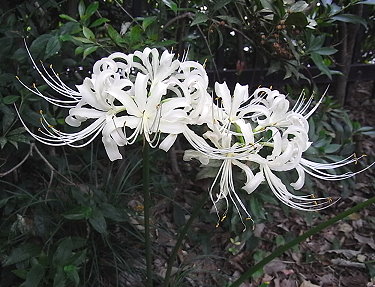
 Higanbana(彼岸花:spider lily, Cluster amaryllis, Lycoris radiata)
Starting to bloom during higan in autumn is responsible for its name. It is regarded as an ominous flower in Japan. It is also known as Manjushage(曼珠沙華) that derives from Buddhist scriptures.
 The bulbs of spider lily are very poisonous, but immersing them in the water can detoxify their toxicity. (It's too dangerous to do it actually.) So it is said that they used to be planted to save people from starvation.
Some people say they are used to surround their paddies and cemeteries to keep the mole and mice away and were planted around the cemetery for ancestors' soul.
 Shirobana Manjushage(白花曼珠沙華)
photos:「季節の花 300」 http://www.hana300.com/ (Japanese version only)
 Spider lilies blooming in front of a vending machine. It's kind of odd.
秋風や むしりたがりし 赤い花 (「おらが春」、小林一茶)
"Autumn breeze, she wanted to pluck, these red flowers," written by Kobayashi Issa(1763-1828) in "Oraga Haru(My Spring)".
Issa came from a troubled family background. At the age of 56, he had his first daughter. However, she died due to smallpox shortly after reaching her 1st birthday. He visited her grave after on the 35th days after her death, the 25th day of the 7th month in the lunar calendar(September 14th in the Gregorian calendar). Then he saught red flowers swaying in the autumn wind. Those are the flowers that she was avid to pluck.
We don't know what kind of flowers those were, but I think that spider lily is appropriate for this haiku poem.
Higan started on September 20th and will end on 26th this year. It is usually cool during the period, but it was very hot on 22th this year. I have the anniversary of my father's death during higan in autumn. I visited my family grave with my family. With temperatures dropping quickly, I caught a cold.

The history of my family dates back over 200 years in this register.
Starting to bloom during higan in autumn is responsible for its name. It is regarded as an ominous flower in Japan. It is also known as Manjushage(曼珠沙華) that derives from Buddhist scriptures.

Some people say they are used to surround their paddies and cemeteries to keep the mole and mice away and were planted around the cemetery for ancestors' soul.
photos:「季節の花 300」 http://www.hana300.com/ (Japanese version only)

秋風や むしりたがりし 赤い花 (「おらが春」、小林一茶)
"Autumn breeze, she wanted to pluck, these red flowers," written by Kobayashi Issa(1763-1828) in "Oraga Haru(My Spring)".
Issa came from a troubled family background. At the age of 56, he had his first daughter. However, she died due to smallpox shortly after reaching her 1st birthday. He visited her grave after on the 35th days after her death, the 25th day of the 7th month in the lunar calendar(September 14th in the Gregorian calendar). Then he saught red flowers swaying in the autumn wind. Those are the flowers that she was avid to pluck.
We don't know what kind of flowers those were, but I think that spider lily is appropriate for this haiku poem.
Thursday, July 29, 2010
Cicada
In Japan, the cicada is associated with the summer season.
Higurashi(蜩,茅蜩,秋蜩,日暮:evening cicada, Tanna japonensis) starts to sing in a nearby grove in mid-July, around the end of the rainy season. It sings at dawn and nightfall or in dark weather, so it is called higurashi which means nightfall. It is also known as kanakana (カナカナ) because it goes kana-kana. I heard it singing in the middle of the night last year.
Although it has been singing up to the middle of Semptember, another cicadas such as abura-zemi(油蝉:Large Brown Cicada), min-min-zemi(ミンミン蝉:Oncotympana maculaticollis) or tsuku-tsuku-boushi(つくつく法師,寒蝉:Meimuna opalifera)start to sing loudly in late July.
Recently, noisy kuma-zemi(熊蝉:Cryptotympana facialis) is increasing around Tokyo. It is thought to be causally related to global warming or transplanted trees.
Ancient Japanese people think that the distance sound of evening cicada is melancholy, and it has been featured in literature. When heard up close, its sound is quite noisy.
Evening cicada is a seasonal word of fall, but large brown cicada, min-min-zemi and semi-shigure(蝉時雨:the chirring of cicadas in chorus) are that of summer in haiku.
閑さや 岩にしみ入る 蝉の声 (「奥の細道」松尾芭蕉)
"At a quiet and empty temple in the deep mountain, a cicada start to sing, but its sound gets sucked into a rock," written by Matsuo Basho in "Oku no Hosomichi"
Oku no Hosomichi (The Narrow Road to the Deep North) is a travel diary including his famous haiku poems. It was published in 1702.
It's generally understood that the cicada in this haiku was nii-nii-zemi(ニイニイゼミ:Platypleura kaempferi).

Semi-bukuro(せみ袋) 製作/藤田康子
"drawstring pouch in the shape of cicada" designed by Yasuko Fujita
Its original work was made in the Meiji Period.
Shigeyoshi Inoue(ed), Yasashiku-Tsukureru-Densyou-no-Chirmenzaiku (Tokyo:Fujin seikatsu-sha,1998),P.25
井上重義監修,やさしく作れる伝承のちりめん細工(東京:婦人生活社,1998年),P.25
The word "utsusemi(空蝉)" comes from the word "utsushimi(現身,living person)". At first it meant "this world". Under the influence of Buddhism, it took on a different meaning, "fugacious this world".
Utsu(空) means vacuity, semi(蝉) does cicada. Finally, it also came to mean the exuvia of a cicada.
うつそみの 人にあるわれや 明日よりは 二上山を いろせとわが見む (「万葉集」大来皇女)
"I am living in this world, so I will consider Mt. Futakami to be my dead brother starting tomorrow," written by Oku no Himemiko (661-701) in "Manyo-shu(Collection of Ten Thousand Leaves)"
she and her brother were members of the imperial family, but he was executed as a rebel. She lamented over his death and made this poem.
"Manyo-shu(Collection of Ten Thousand Leaves)" was realized in the late eighth century and includes approximately 4,500 poems written by people from every walk of life from different regions of Japan over a period of about 300 years.
Its poets consist of a variety of persons such as emperors, aristocrats, commoners, people at the very end of the road, front-line soldiers, punished or executed persons and beggars.
Utsusemi is also the 3rd chapter's title of "The Tale of Genji" written by Murasaki Shikibu. Utsusemi was not beautiful but a daughter of an upper-class aristocrat and was supposed to become a court lady. she married a rural lower class aristocrat because of her father's death, and he was a much older husband.
Hikaru Genji once made her his own, but she threw her sheer coat on the floors and ran away from him. The coat looked like an exuvia.
she has refused to accept his love since then. Knowing her place, she no longer dreams of marrying a prince. In the end, she is supported by Genji financially after renouncing the world.
Thursday, July 8, 2010
hopping frog
Kaeru-Tobi-Gyouji(蛙飛び行事:the ritual of hopping frog) was held at Kinpusen-ji temple(金峯山寺) in Nara Prefecture on July 7th. The ritual dates back over a thousand years.
Legend has it that an big eagle takes an irreligious man away to a bluff. A monk comes by just in time to help him out by changing him into a frog. A high priest turns him back to normal by reciting a sutra.
The ritual sticks to this legend.
Mikoshi (portable shrine) on which a person in a frog suit rides is carried through the city streets to the temple. He hops like a frog on the stage. After a monk recites a sutra, he takes off his suit, bow and greet in silence.

"drawstring pouch in the shape of frog" designed by Mieko Shibata
かえる袋 制作:芝田美恵子
Shigeyoshi Inoue(ed), Yasashiku-Tsukureru-Densyou-no-Chirmenzaiku (Tokyo:Fujin seikatsu-sha,1998),P.36.
井上重義監修,やさしく作れる伝承のちりめん細工(東京:婦人生活社,1998年),P.36.
"Frog" is a seasonal word of spring in haiku.
古池や 蛙飛びこむ 水の音(松尾芭蕉)
"An old pond, a frog jumps in, sound of water," written by Matuso Basho
やせ蛙 負けるな一茶 これにあり(小林一茶)
"A lean frog, don't lose, I'm on your side," written by Kobayashi Issa
He wrote this poem on seeing male frogs' competition for female frogs. He had his sickly baby in mind. But, his hope was dashed. His baby died in 30 days.
Tuesday, July 6, 2010
The Iriya Morning Glory Fair
Some areas in Tokyo and Saitama Prefecture were subjected to local torrential downpours yesterday. In recent years, well-developed thunderclouds by global heating and urban heat island often caused local torrential downpours accompanied with thunder.
Hot humid weather is continuing. We are disgusted with the damp heat.
The Iriya Morning Glory Fair is held on the grounds of Iriya Kishimojin(入谷鬼子母神) at Taito City in Tokyo from July 6th to 8th. Originally, morning glory seeds were highly prized as Chinese herbal medicines. In the Edo Period, morning glories came to be cultivated as an ornamental plant. Iriya was richly cultivated with the flowers, and many new varieties of them were created.
In the Meiji Period, morning glory fairs were held there.
Although their cultivation disappeared from the area temporarily, the fair was restored after World War II.
"Asagao(朝顔)" is Japanese for "morning glory."
Kengyu-ka(牽牛花) is another name for it. Kengyu(牽牛) means a cowherd. The dates of the fair is based on a Chinese legend that the Cowherd Star(Altair) and the Weaver Star(Vega) can meet once a year on the night of July 7th.
Iriya Kishimojin was founded in 1659 and worships Kishimojin as a Buddhist goddess for easy delivery and child rearing. Originally, Kishimojin was a fierce goddess who abducted and ate the children of others even though she absolutely doted on her 100 children. Buddha made her experience the grief of the bereaved mothers by hiding her youngest child and made her embrace Buddhism.
朝顔に 釣瓶とられて もらひ水(加賀千代女)
"I tried to draw water from a well in the early morning, but a morning glory vine has locked its well rope. I couldn't bear to cut its vine to draw water, so I asked a neighbor to share her water", written by Kaga no Chiyojo(1703-1775)
朝がほや 一輪深き 淵のいろ(与謝野蕪村)
"A deep blue morning glory is moist with the morning dew, it reminds me of a deep pool", written by Yosa Buson(1716-1784)

Mezamashi-gusa(目覚草):
Mezamashi-gusa is another name for morning glory and it means wake-up flower.

Monday, June 21, 2010
The Summer Solstice
Yesterday was Father's Day, but it's pale compared to Mother's Day.
Many people are very interested in the World Cup soccer games now.
Hanashoubu(花菖蒲:Japanese water iris) are now at their peak.
Warnings of heavy rains and local flooding are issued for Kyushu now.
五月雨を 集めてはやし 最上川(「奥の細道」松尾芭蕉)
"Gathering as much early summer rain as possible, the Mogami River comes rushing down in a torrent", written by Matsuo Bashou (松尾芭蕉,1644–1694) in "The Narrow Road to the Deep North".
Samidare(五月雨) literally means rain falling in the 5th month in the lunar calendar. Originally, it means rain falling in the rainy season.
The Summer Solstice occurs around June 21st each year.
It is marked by the longest day and shortest night of the year.
夏の夜は まだ宵ながら 明けぬるを 雲のいづこに 月やどるらむ(「古今集」清原深養父)
"Summer nights are short, so I felt that dawn succeeded night during the early evening. Where in clouds does the moon spend night?", written by Kiyohara no Fukayabu(清原深養父), Sei Shounagon's great-grandfather.
五月闇 短き夜半の うたたねに 花たちばなの 袖に涼しき(「新古今集」慈円)
"When I am dozing off at a short night in the rainy season, wind carries the smell of tachibana(橘:Citrus tachibana) and makes me feel the cool air through my sleeves", written by Jien(慈円,1155–1225), who was a Japanese poet, historian and Buddhist monk.
We have few sun exposure and rarely see the shining moon and stars in the rainy season. Satsuki-yami(五月闇) means moonless night or dark weather in the rainy season.

Seiryu(清流:limpid stream)
Sweetfishes are swimming in the limpid stream, and beans are used to resemble stones in the riverbed.
Friday, May 14, 2010
this year's first catch of bonitos
目には青葉 山ほととぎす はつ松魚 (山口素堂)
"Now, we can see the fresh green of trees, hear lesser cuckoos' songs in mountains and this year's first catch of bonitos has arrived at fish markets." is a haiku written by Yamaguchi Sodou(1642-1716).
Katsuo(鰹,松魚:bonito):
Bonitos are in season now. They ride the warm Kuroshio(Black Current) north from spring to summer and come down from the north in autumn. They reach off the coast of Kyusyu from February to March and are landed in fishing ports near Tokyo around May.
The first catch of bonito is highly prized for the superstition that eating the first crop (or catch) of the season extended lifespan in the Edo Period. So they were often traded at a high price and the price of one bonito hit a historic high of 400,000 yen. To prevent overheating, the official release date is fixed by a law as the first day of the 4th month in the lunar calendar.
May 14th is that day this year. Now, bonitos go on sale by April.

illustration: M/Y/D/S動物のイラスト集 (Japanese version only)
all rights reserved
Hototogisu(杜鵑、時鳥、子規、不如帰、杜宇、蜀魂、田鵑:lesser cuckoo or cuculus poliocephalus):
Ancient people valued lesser cuckoos because their song herald the arrival of summer. They often appear with tachibana(橘:Citrus tachibana)or unohana(卯の花:deutzia) in Japanese classical literature. They feature sing loudly, even at night.
A lesser cuckoo appears in the following song "Natsu-wa-kinu(夏は来ぬ:Summer has come)", which was written by Nobutsuna Sasaki(佐々木 信綱 1872-1963) and was composed by Sakunosuke Koyama(小山 作之助 1864-1927).
卯の花の匂う 垣根に
時鳥 早も来鳴きて
忍び音もらす 夏は来ぬ
"A lesser cuckoo perched on a branch of scented deutzia hedge.
I've heard this year's first song of the cuckoo.
It announced summer has come."
Tuesday, May 4, 2010
Greenery Day
April 29th, the birthday of the Showa Emperor, was decided to be a national holiday called named "Midori no Hi(みどりの日:Greenery Day) after his death. However, this holiday moved to May 4th in 2007.
It was hot today. But this April was rainy and cold. It didn't look like April.
I haven't seen a butterfly yet in my yard.

蝶の小袋 作った人/田中みちよ
"drawstring pouch in the shape of butterfly" designed by Michiyo Tanaka
Shigeyoshi Inoue(ed), Yasashiku-Tsukureru-Densyou-no-Komonosyugei (Tokyo:Fujin seikatsu-sha,1994),P.34.
井上重義監修,やさしく作れる伝承のこもの手芸(東京:婦人生活社,1994年),P.34.

oboro-zuki(朧月:misty moon)
There is a confection named oboro-zuki.
大原や蝶の出て舞ふ朧月 (内藤丈草)
"At Ohara, a butterfly flits about in the misty moonlight",written by Naito Jousou(1622-1704)
Many people enjoyed digging clams at the beach during Golden Week holidays. Clams are in seasnon.
Today is the last day of spring according to the lunar calendar.
"butterfly", "misty moon" and "clam digging" are seasonal words of spring.

The season of fresh greenery has come.
Decade ago, cherry blossoms have not yet bloomed when I went into the hospital. A month later, I felt new green leaves were too bright on the way home from the hospital.

Shinryoku(新緑:fresh green)

Wakakusa-yama(若草山)

Tsuyabukusa(つやぶくさ)
Thursday, January 21, 2010
ume:the Japanese apricot
梅(ume:the Japanese apricot)
The Japanese apricot trees have only partially blossomed in the yard.

梅一輪 一輪ほどの あたたかさ (服部嵐雪「玄峯集」)
"Finding a blossom of the Japanese apricot, I feel slight warmth of spring approaching, its slightness is equivalent to one blossom of it",written by Ransetsu Hattori,"Genpou-syu"
Although it was "the coldest day in winter" yesterday, temperature stood at 19 degrees Celsius in Tokyo. it had been warm for these two or three days.
In ancient times the Japanese apricot blossom was considered to be symbolic of Japan.

福梅(fuku-ume: lucky Japanese apricot)

梅結び(ume-musubi: knot tied in the shape of Japanese apricot blossom)
A drawstring bag for tea utensil is often tied with this knot.


ねじ梅(neji-ume:a Japanese apricot with twisted petals)
These in the shape of a Japanese apricot blossom are formed in a mold for dry confectionery.

梅袋(ume-bukuro:a pouch in the shape of ume)
made based on:
Kazuo Kobayashi(ed),Saiji-wo-Kazaru-12kagetsu-no-osaikumono(Tokyo:Nihon Vogue-sha Co, Ltd.,2000)P.15
小林和雄編、歳時を飾る12ヵ月のお細工物、(東京:日本ヴォーグ社、2000年),P.15
Wednesday, January 13, 2010
Seijin-no-Hi & Kagami-Biraki
Coming of Age Day (成人の日:Seijin-no-Hi)
The second Monday of January, 11th this year, is a national holiday called Coming-of-Age Day in Japan. Coming-of-age ceremonies are held all over Japan. The ceremonies by upper-class people date back centuries.
We can see many women wearing long-sleeved kimono called furisode on this day. When wearing a furisode, we used to tie obi(帯) in the back with a bow like this doll. The bow is called fukurasuzume(福良雀:full sparrow) because it looks like a sparrow with spread out wings. A sparrow fluffed up its feathers to keep out the cold with warm air. Its full figure is associated with prosperity.


成人式(seijin-shiki:coming of age ceremonies) made based on:
Akiko Sadamori,Kisetsu-no-Chirimen-Komono,(Tokyo:Patchwork Tsushin Co., Ltd.,2009), p.33
定森朗子・美保・加奈著,季節のちりめんこもの(東京:パッチワーク通信社,2009年),p33.
 This is a homemade dry confection called rakugan(落雁) in the shape of fukurasuzume.

The Eurasian Tree Sparrow is the most familiar bird to the Japanese. Although the sparrow eats crop pest, it eats grains of rice during the harvest. So it has both a good and a negative image.
a sparrow has a good image in the well-known haiku poems written by Kobayashi Issa(1763-1828).
雀の子 そこのけそこのけ お馬がとおる
"Young sparrow, clear the way, toy horse comes by"
われと来て 遊べや 親のない雀
"Come and play with me, orphan sparrow"
"a sparrow" is a seasonal word of spring in haiku. As a child, I used to take care of a baby sparrow that dropped out of the nest.
Meanwhile grilled sparrows are eaten in some areas. The folk tale called "The Sparrow's Inn" does not judge a sparrow as right or wrong. One year is a typical lifespan of the tree sparrow in Japan. Recently its population has decreased sharply.
鏡開き(Kagami-Biraki)
On January 11th New Year's rice cakes(Kagami-mochi) are cooked and served with stewed red beans and sugar. I use homemade tsubu-an(つぶ餡) which is made by mixing boiled adzuki beans and sugar,retaining the original form of beans. The an(餡) can freeze well.


Subscribe to:
Posts (Atom)