The 63rd Japan Traditional Kogei Exhibition(日本伝統工芸展) is taking place at Mitsukoshi department store in Tokyo from September 21 to October 3. The exhibition requires the applicants to create sophisticated design based on high degree of professional skill in Japanese traditional techniques. The exhibition's winning works are available in each venue, but their prices are not indicated.
See the Japan Kogei Association site for further information:
http://www.nihonkogeikai.or.jp/ (Japanese version only)
Japan Traditional Kogei Exhibition:
http://www.nihonkogeikai.or.jp/exhibition/honten (Japanese version only)
The Exhibition will travel through the following venues:
Mitsukoshi Nihonbashi Main Store, Tokyo
September 21-October 3, 2016
Mitsukoshi Nihonbashi Main Store:
http://mitsukoshi.mistore.jp/store/nihombashi/index.html
Mitsukoshi Nagoya Sakae Store, Nagoya City, Aichi Prefecture
October 5-10, 2016
Mitsukoshi Nagoya Sakae Store:
http://mitsukoshi.mistore.jp/store/nagoya/index.html
Takashimaya Kyoto Store, Kyoto Prefecture
October 12-17, 2016
Takashimaya Kyoto Store:
http://www.takashimaya.co.jp/kyoto/store_information/index.html
Ishikawa Prefectural Museum of Art, Kanazawa City, Ishikawa Prefecure
October 28-November 6, 2016
Ishikawa Prefectural Museum of Art:
http://www.ishibi.pref.ishikawa.jp/english/index.html
the Okayama Prefectural Museum of Art, Okayama City, Okayama Prefecture
November 17-December 4, 2016
The Okayama Prefectural Museum of Art:
http://www.pref.okayama.jp/seikatsu/kenbi/en/index_en.html
Shimane Art Museum, Matsue City, Shimane Prefecture
December 7-25, 2016
Shimane Art Museum:
http://www.shimane-art-museum.jp/en/
the Kagawa Museum, Takamatsu City, Kagawa Prefecture
January 2-22, 2017
The Kagawa Museum:
http://www.pref.kagawa.lg.jp/kmuseum/foreign/
Mitsukoshi Sendai Store, Sendai City, Miyagi Prefecure
January 25-30, 2017
Mitsukoshi Sendai Store:
http://mitsukoshi.mistore.jp/store/sendai/index.html
Mitsukoshi Fukuoka Store, Fukuoka City, Fukuoka Prefecture
February 3-8, 2017
Mitsukoshi Fukuoka Store:
http://www.m.iwataya-mitsukoshi.co.jp/index.html
Takashimaya Osaka Store, Osaka Prefecture
February 16-20, 2017
Takashimaya Osaka Store:
http://www.takashimaya.co.jp/osaka/store_information/index.html
Hiroshima Prefectural Art Museum, Hiroshima City, Hiroshima Prefecture
February 23-March 12, 2017
Hiroshima Prefectural Art Museum:
http://www.hpam.jp/
Mitsukoshi Matsuyama Store, Matsuyama City, Ehime Prefecture
March 14-19, 2017
Mitsukoshi Matsuyama Store:
http://mitsukoshi.mistore.jp/store/matsuyama/index.html
Thursday, September 22, 2016


Monday, May 30, 2016
Rice is equal to parents
 | |
| Doya-tanada, Fukushima-cho, Matsuura City, Nagasaki Prefecure At this terraced rice paddies, rice planting starts in the late April. (one of Japan's Top 100 tanadas) Photo by Yokaphoto.net |
Rice played a vital role in feeding the Asian expanding population. Now more than 90% of the world's rice is grown and consumed in Asia. Wet rice cultivation in Japan dates back to 3000 years ago. The Japan's population increased dramatically as the expansion of paddy fields increased rice production.
In Japan rice was levied as a tax in the middle of the 7th century. Peasants delivered rice to the Imperial Court until the 10th century, to their aristocratic lords in the middle ages, to feudal lords in the Edo Period, to landlords in the period between the Meiji Period and the postwar agrarian reform.
There were some areas which have little suitable lands for cultivating rice. Its residents couldn't pay tribute such as rice, local products to the Imperial Court. Instead, tax was paid in the form of labor.
The Tokugawa Shogunate imposed rice as tax on feudal lords according to production capacity of their lands. The feudal lords paid rice as stipends to their samurai retainers. They could gain cash by selling the rice.
At the Kannamesai festival in October and the Niinamesai festival in November, the emperor dedicates newly harvested rice to Amaterasu-Ohmikami, the Goddess of the Sun, an imperial ancestor. Unlike Kannamesai, the emperor eats these offerings at Niinamesai. The festival dates back at least to 677. Today the emperor plants rice for Niinamesai in May and harvests it in September by his own hands in the paddies of the Imperial Palace. Emperor Showa (Hirohito) started it.
Japan's earliest rice planting(replanting rice seedlings in rice paddy fields) starts in some islands of Okinawa in January. In many areas of Okinawa rice planting starts in March. Other areas starts planting rice from April to June. Most areas of the Kyushu Region start rice planting in June after harvesting wheat. Typhoons often destroy ready-to-harvest rice in Kyushu, so farmers are accustomed to plant wheat to ensure food security. Last month big earthquakes caused crack in rice paddies and leakage in the drainage pipe in Kumamoto. Many rice farmers can't still plant seedlings.
Many people had longed for stuffing themselves with white rice before Japan made the leap toward prosperity in the post war period. We were taught by parents or grandparents to eat every grain of rice in our bowl, to not waste food. When we left grains in the bowl they often said, "We are sorry for rice farmers." They told us not to waste crop that farmers paid hard work for." I eat every grain of rice in my bowl. Unfortunately consumption of rice is in a sustained decline due to the spread of Westernized diet. I eat bread for breakfast.
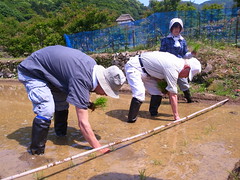
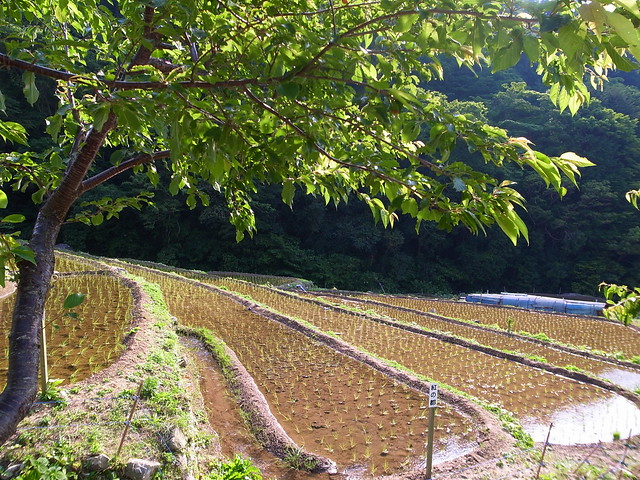
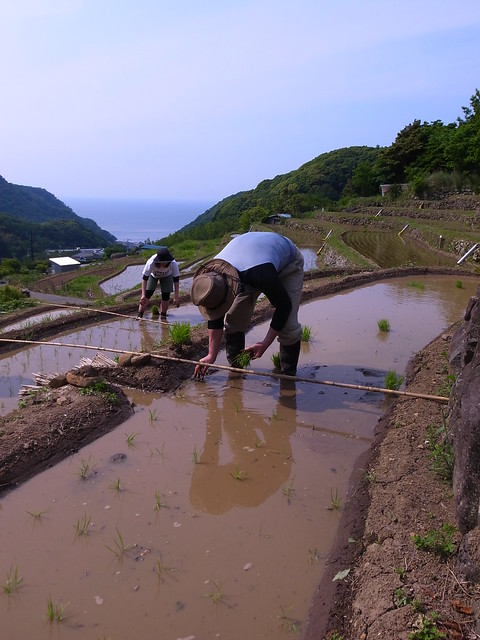
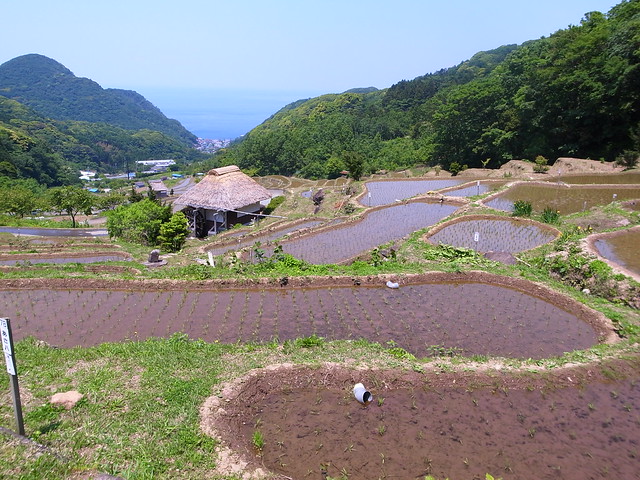
Tanada (terraced rice paddies along steep hills) is one of beautiful scenery, but it requires great care because much of the work is done by hand. Most of Tanada are preserved as a tourist spot.
 |
| photo: 2012 田植え by na0905 /flickr |
The planting work was done by hand because each paddy is relatively small,
 |
| 2012 田植え by na0905 /flickr |
 |
| 2012 田植え by na0905 /flickr |
 |
| 2012 田植え by na0905 /flickr |
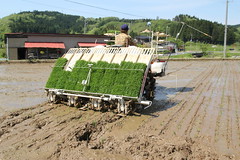 |
| 100523_taue_akita by ivva /flickr |
rice planting machine
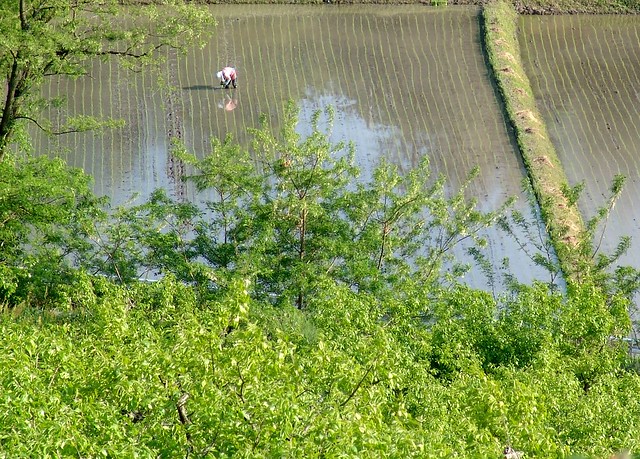 |
| rice planting. 田植え by T.Kiya /flickr |
Doya-tanada(土谷棚田), Fukushima-cho, Matsuura City, Nagasaki Prefecure
At this tanada, rice planting starts in the late April.
At this tanada, rice planting starts in the late April.
 |
| Doya-tanada Photo by Yokaphoto.net |
 |
| Doya-tanada Photo by Yokaphoto.net |
 |
| Doya-tanada Photo by Yokaphoto.net |
 |
| Doya-tanada Photo by Yokaphoto.net |
 |
| Doya-tanada Photo by Yokaphoto.net |
 |
| Doya-tanada Photo by Yokaphoto.net |
 |
| Ueyama no Tanada(うへ山の棚田), Kami Town, Hyogo Prefecture(one of Japan's Top 100 tanadas) photo by 神戸観光壁紙写真集 |
 |
Nishigaoka no Tanada西ヶ岡の棚田, Kami Town, Hyogo Prefecture
(one of Japan's Top 100 tanadas)
photo by 神戸観光壁紙写真集
|
 |
| Yamada no Tanada photo by 神戸観光壁紙写真集 |
Yamada no Tanada(山田の棚田), Kami Town, Hyogo Prefecture
 |
| Bekku no Tanada photo by 神戸観光壁紙写真集 |
Bekku no Tanada別宮の棚田,Yabu City, Hyogo Prefecture
 |
| Bekku no Tanada photo by 神戸観光壁紙写真集 |
 |
| Akiu no taue odori photo by MIYAGI PREFECTURE |
Akiu no taue odori (秋保の田植踊) is a traditional rice-planting dance in Akiu-cho, Taihaku Ward, Sendai City, Miyagi Prefecture. The dance was inscribed on the UNESCO Representative List of the Intangible Cultural Heritage of Humanity in 2009. The dance is performed at Nagabukuro Shinmeisha(長袋神明社, Shinto shrine) on the third Sunday of April, at Akiu Otaki Fudoson (秋保大滝不動尊, Buddhist temple) on April 29, at Yumoto Yakushido(湯元薬師堂, Buddhist temple) on May 5.
 |
| Akiu no taue odori photo by MIYAGI PREFECTURE |
Saturday, April 16, 2016
2016 Kumamoto earthquakes
Real time media distribution (Japan TV stations):
http://news.yahoo.co.jp/story/148
My sisiter's husband is from Kumamoto City. His family are safe but not all his relatives are confirmed as safe. His sister is a nurse and has been working at her hospital since the first quake.
Most foreign media such as BBC refer only to magnitude. Most of them have yet to experience an earthquake. Seismic damage depends on many factors including the length of the fault, magnitude, the depth of the quake, the distance from the epicentre, the duration, the frequency of the quake, and foundation strength.
Seismic intensity scales vary in different countries or areas. The Japan Meteorological Agency seismic intensity scale runs from 0 to 7, with 7 being the strongest. When an earthquake with a seismic intensity of a lower 5 or greater on the seven-point Japanese scale is predicted, a warning is given to the affected areas.
5-lower Most unstable items fall
5-upper heavy furniture fall
6-lower Less earthquake-resistant buildings easily receive heavy damage
6-upper Many walls collapse, or at least are severely damaged
7 Most or all buildings (even earthquake-resistant ones) suffer severe damage
Seismic intensity 3 or upper earthquakes hit Kumamoto area 105 times.
Earthquakes have caused massive damage to roads, an airport, railroad. Thirty four people are confirmed dead and more than 1,000 injured. A lot of buildings collapsed. Mudslides were triggered by the earthquakes. A bridge collapsed. Kumamoto Castle, Aso Shrine suffered severe damage.
In the area heavy rain and wind gusts are expected later tonight.
date(Japan time) area magnitude seismic intensity(lower 5 or greater)
April 14, 2016 21:26 Kumamoto area, Kumamoto Prefecure 6.4 7
April 14, 2016 22:07 Kumamoto area, Kumamoto Prefecure 5.7 6-lower
April 14, 2016 22:38 Kumamoto area, Kumamoto Prefecure 5.0 5-lower
April 15, 2016 0:03 Kumamoto area, Kumamoto Prefecure 6.4 6-upper
April 15, 2016 1:53 Kumamoto area, Kumamoto Prefecure 4.8 5-lower
April 16, 2016 1:25 Kumamoto area, Kumamoto Prefecure 7.1 6-upper
April 16, 2016 1:44 Kumamoto area, Kumamoto Prefecure 5.3 6-lower
April 16, 2016 1:46 Kumamoto area, Kumamoto Prefecure 6.0 6-lower
April 16, 2016 3:03 Aso area, Kumamoto Prefecure 5.8 5-upper
April 16, 2016 3:55 Aso area, Kumamoto Prefecure 5.8 6-upper
April 16, 2016 7:11 central Oita Prefecture 5.3 5-lower
April 16, 2016 7:23 Kumamoto area, Kumamoto Prefecure 4.8 5-lower
April 16, 2016 9:48 Kumamoto area, Kumamoto Prefecure 5.4 6-lower
April 16, 2016 16:02 Kumamoto area, Kumamoto Prefecure 5.3 5-lower
http://news.yahoo.co.jp/story/148
My sisiter's husband is from Kumamoto City. His family are safe but not all his relatives are confirmed as safe. His sister is a nurse and has been working at her hospital since the first quake.
Most foreign media such as BBC refer only to magnitude. Most of them have yet to experience an earthquake. Seismic damage depends on many factors including the length of the fault, magnitude, the depth of the quake, the distance from the epicentre, the duration, the frequency of the quake, and foundation strength.
Seismic intensity scales vary in different countries or areas. The Japan Meteorological Agency seismic intensity scale runs from 0 to 7, with 7 being the strongest. When an earthquake with a seismic intensity of a lower 5 or greater on the seven-point Japanese scale is predicted, a warning is given to the affected areas.
5-lower Most unstable items fall
5-upper heavy furniture fall
6-lower Less earthquake-resistant buildings easily receive heavy damage
6-upper Many walls collapse, or at least are severely damaged
7 Most or all buildings (even earthquake-resistant ones) suffer severe damage
Seismic intensity 3 or upper earthquakes hit Kumamoto area 105 times.
Earthquakes have caused massive damage to roads, an airport, railroad. Thirty four people are confirmed dead and more than 1,000 injured. A lot of buildings collapsed. Mudslides were triggered by the earthquakes. A bridge collapsed. Kumamoto Castle, Aso Shrine suffered severe damage.
In the area heavy rain and wind gusts are expected later tonight.
date(Japan time) area magnitude seismic intensity(lower 5 or greater)
April 14, 2016 21:26 Kumamoto area, Kumamoto Prefecure 6.4 7
April 14, 2016 22:07 Kumamoto area, Kumamoto Prefecure 5.7 6-lower
April 14, 2016 22:38 Kumamoto area, Kumamoto Prefecure 5.0 5-lower
April 15, 2016 0:03 Kumamoto area, Kumamoto Prefecure 6.4 6-upper
April 15, 2016 1:53 Kumamoto area, Kumamoto Prefecure 4.8 5-lower
April 16, 2016 1:25 Kumamoto area, Kumamoto Prefecure 7.1 6-upper
April 16, 2016 1:44 Kumamoto area, Kumamoto Prefecure 5.3 6-lower
April 16, 2016 1:46 Kumamoto area, Kumamoto Prefecure 6.0 6-lower
April 16, 2016 3:03 Aso area, Kumamoto Prefecure 5.8 5-upper
April 16, 2016 3:55 Aso area, Kumamoto Prefecure 5.8 6-upper
April 16, 2016 7:11 central Oita Prefecture 5.3 5-lower
April 16, 2016 7:23 Kumamoto area, Kumamoto Prefecure 4.8 5-lower
April 16, 2016 9:48 Kumamoto area, Kumamoto Prefecure 5.4 6-lower
April 16, 2016 16:02 Kumamoto area, Kumamoto Prefecure 5.3 5-lower
Friday, January 1, 2016
New Year's Day 2016
Happy New Year!
May the New Year bring many good things to you.
According to the Chinese zodiac, 2016 is the Year of the Monkey.
Each of the 12 Chinese zodiac signs is related to a characteristic animal.
Hear no evil, see no evil, speak no evil.
(three wise monkeys)
Its origin is not clear.
snow monkeys soak in their onsen bath
During the New Year holidays, boys used to enjoy kite-flying or top-spinning.
Girls used to enjoy Hanetsuki which is a game similar to badminton. It is played with a wooden battledore and a hard black seed with feathers like a shuttlecock. This girl's play is said to have started to wish to protect children from mosquito bites at New Year's.
*Dezome-shiki is an firefighters' event on the first work day of the new year. It began in the Edo Period.
Firefighters perform acrobatic feats on a ladder.
*lion dance as a thing doing epidemic extermination
*New Year's pine and bamboo decorations
Red sea bream is an auspicious fish because of play on words linking "Tai(red sea bream)" and "Mede-tai(happy)."
Ozoni is soup containing vegetables and rice cakes for New Year's Day.
Nanten(heavenly bamboo) is an auspicious plant because ancient people associated a phrase "Nan wo Ten-zuru(難を転ずる)" which means to overcome difficulties or to get out of trouble with its name "Nanten."
Ready-made New Year's dishes including many traditional ingredients are set in three-tiered boxes.


May the New Year bring many good things to you.
According to the Chinese zodiac, 2016 is the Year of the Monkey.
Each of the 12 Chinese zodiac signs is related to a characteristic animal.
 |
| New Year's card |
Hear no evil, see no evil, speak no evil.
(three wise monkeys)
Its origin is not clear.
 |
| New Year's card |
snow monkeys soak in their onsen bath
 |
| New Year's card |
During the New Year holidays, boys used to enjoy kite-flying or top-spinning.
Girls used to enjoy Hanetsuki which is a game similar to badminton. It is played with a wooden battledore and a hard black seed with feathers like a shuttlecock. This girl's play is said to have started to wish to protect children from mosquito bites at New Year's.
 |
| New Year's card |
*Dezome-shiki is an firefighters' event on the first work day of the new year. It began in the Edo Period.
Firefighters perform acrobatic feats on a ladder.
*New Year's pine and bamboo decorations
 |
| New Year's card |
Red sea bream is an auspicious fish because of play on words linking "Tai(red sea bream)" and "Mede-tai(happy)."
 |
| New Year's card |
Ozoni is soup containing vegetables and rice cakes for New Year's Day.
Nanten(heavenly bamboo) is an auspicious plant because ancient people associated a phrase "Nan wo Ten-zuru(難を転ずる)" which means to overcome difficulties or to get out of trouble with its name "Nanten."
Ready-made New Year's dishes including many traditional ingredients are set in three-tiered boxes.


Wednesday, September 16, 2015
The 62nd Japan Traditional Art Crafts Exhibition
The 62nd Japan Traditional Art Crafts Exhibition(日本伝統工芸展) will be held at Mitsukoshi department store in Tokyo from September 16 to 28.
The exhibition requires the applicants to create sophisticated design based on high degree of professional skill in Japanese traditional techniques.
See the Japan Kogei Association site for further information:
http://www.nihonkogeikai.or.jp/ (Japanese version only)
The Exhibition will travel through the following venues:
Mitsukoshi Nihonbashi Main Store, Tokyo
September 16-28, 2015
Mitsukoshi Nihonbashi Main Store:
http://mitsukoshi.mistore.jp/store/nihombashi/index.html
Mitsukoshi Nagoya Sakae Store, Nagoya City, Aichi Prefecture
September 30 - October 5, 2015
Mitsukoshi Nagoya Sakae Store:
http://mitsukoshi.mistore.jp/store/nagoya/index.html (Japanese version only)
Takashimaya Kyoto Store, Kyoto Prefecture
October 7-12, 2015
Takashimaya Kyoto Store:
http://www.takashimaya.co.jp/kyoto/store_information/index.html
Sakishima Hall, Osaka Prefectural Government Sakishima Building(Cosmo Tower)(2F), Osaka City, Osaka Prefecture
October 17-23, 2015
Cosmo Tower:
http://www.wtc-cosmotower.com/ (Japanese version only)
Ishikawa Prefectural Museum of Art, Kanazawa City, Ishikawa Prefecure
October 30 - November 8, 2015
Ishikawa Prefectural Museum of Art:
http://www.ishibi.pref.ishikawa.jp/english/index.html
Okayama Prefectural Museum of Art, Okayama City, Okayama Prefecture
November 12-29, 2015
The Okayama Prefectural Museum of Art:
http://www.pref.okayama.jp/seikatsu/kenbi/index-e.html
Shimane Art Museum, Matsue City, Shimane Prefecture
December 2-23, 2015
Shimane Art Museum:
http://www1.pref.shimane.lg.jp/contents/sam/index.html
Kagawa Museum, Takamatsu City, Kagawa Prefecture
January 2-17, 2016
The Kagawa Museum:
http://www.pref.kagawa.lg.jp/kmuseum/foreign/
Mitsukoshi Sendai Store, Sendai City, Miyagi Prefecure
January 21-26, 2016
Mitsukoshi Sendai Store:
http://mitsukoshi.mistore.jp/store/sendai/index.html (Japanese version only)
Mitsukoshi Fukuoka Store, Fukuoka City, Fukuoka Prefecture
February 2-7, 2016
Mitsukoshi Fukuoka Store:
http://www.m.iwataya-mitsukoshi.co.jp/index.html
Mitsukoshi Matsuyama Store, Matsuyama City, Ehime Prefecture
February 16-21, 2016
Mitsukoshi Matsuyama Store:
http://mitsukoshi.mistore.jp/store/matsuyama/index.html (Japanese version only)
Hiroshima Prefectural Art Museum, Hiroshima City, Hiroshima Prefecture
February 24-March 13, 2016
Hiroshima Prefectural Art Museum:
http://www.hpam.jp/
The exhibition requires the applicants to create sophisticated design based on high degree of professional skill in Japanese traditional techniques.
See the Japan Kogei Association site for further information:
http://www.nihonkogeikai.or.jp/ (Japanese version only)
The Exhibition will travel through the following venues:
Mitsukoshi Nihonbashi Main Store, Tokyo
September 16-28, 2015
Mitsukoshi Nihonbashi Main Store:
http://mitsukoshi.mistore.jp/store/nihombashi/index.html
Mitsukoshi Nagoya Sakae Store, Nagoya City, Aichi Prefecture
September 30 - October 5, 2015
Mitsukoshi Nagoya Sakae Store:
http://mitsukoshi.mistore.jp/store/nagoya/index.html (Japanese version only)
Takashimaya Kyoto Store, Kyoto Prefecture
October 7-12, 2015
Takashimaya Kyoto Store:
http://www.takashimaya.co.jp/kyoto/store_information/index.html
Sakishima Hall, Osaka Prefectural Government Sakishima Building(Cosmo Tower)(2F), Osaka City, Osaka Prefecture
October 17-23, 2015
Cosmo Tower:
http://www.wtc-cosmotower.com/ (Japanese version only)
Ishikawa Prefectural Museum of Art, Kanazawa City, Ishikawa Prefecure
October 30 - November 8, 2015
Ishikawa Prefectural Museum of Art:
http://www.ishibi.pref.ishikawa.jp/english/index.html
Okayama Prefectural Museum of Art, Okayama City, Okayama Prefecture
November 12-29, 2015
The Okayama Prefectural Museum of Art:
http://www.pref.okayama.jp/seikatsu/kenbi/index-e.html
Shimane Art Museum, Matsue City, Shimane Prefecture
December 2-23, 2015
Shimane Art Museum:
http://www1.pref.shimane.lg.jp/contents/sam/index.html
Kagawa Museum, Takamatsu City, Kagawa Prefecture
January 2-17, 2016
The Kagawa Museum:
http://www.pref.kagawa.lg.jp/kmuseum/foreign/
Mitsukoshi Sendai Store, Sendai City, Miyagi Prefecure
January 21-26, 2016
Mitsukoshi Sendai Store:
http://mitsukoshi.mistore.jp/store/sendai/index.html (Japanese version only)
Mitsukoshi Fukuoka Store, Fukuoka City, Fukuoka Prefecture
February 2-7, 2016
Mitsukoshi Fukuoka Store:
http://www.m.iwataya-mitsukoshi.co.jp/index.html
Mitsukoshi Matsuyama Store, Matsuyama City, Ehime Prefecture
February 16-21, 2016
Mitsukoshi Matsuyama Store:
http://mitsukoshi.mistore.jp/store/matsuyama/index.html (Japanese version only)
Hiroshima Prefectural Art Museum, Hiroshima City, Hiroshima Prefecture
February 24-March 13, 2016
Hiroshima Prefectural Art Museum:
http://www.hpam.jp/
Friday, July 31, 2015
Osorezan, border between this world and the underworld (2)
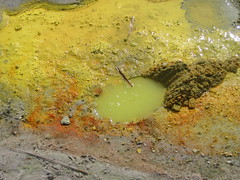 |
| Mmmm, fresh sulfur by Joe Jones /flickr |
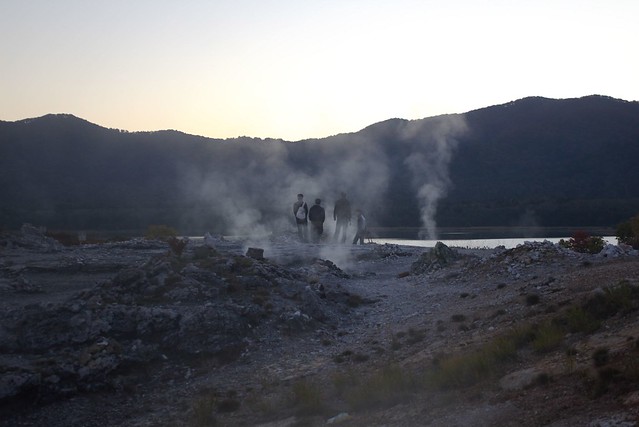
The smell of sulfur wafted over its ground.
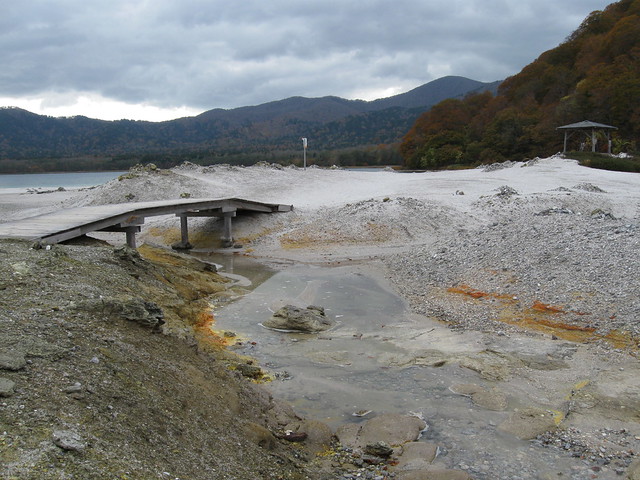 |
| Hell at Osore-zan, Honshu by shirokazan /flickr |
The temple has 136 hells and a paradise. In Japan, there are a lot of hells(jigoku) such as Owakudani(Great Boiling Valley) in Kanagawa, jigoku of Beppu in Oita. People in the past thought the view of a volcanic area resembled a hellish picture in Japanese Buddhism.
Blood Pond Hell is said to be a pond located in Hell. It is said the water looks red due to color change in algae. It doesn't always look red.
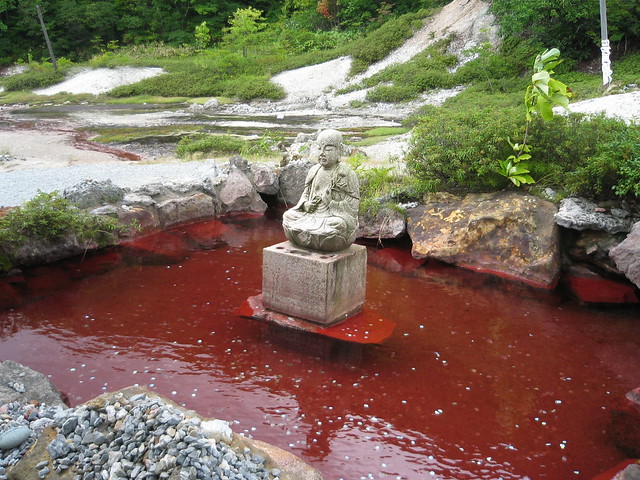 |
| IMG_3113.jpg by vera46 /flickr |
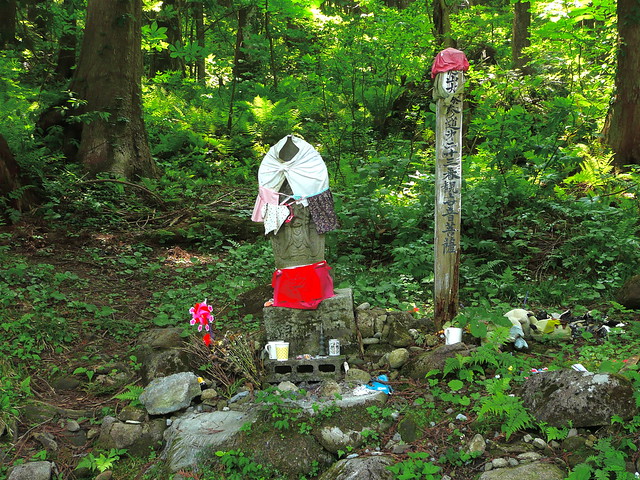
Jizo(Ksitigarbha) is one of Buddhist bodhisattvas. His mission is to save people between Buddha's death and the appearance of Maitreya(弥勒菩薩, Miroku-bosatsu). Yama(閻魔大王, Enma Daio) is the lord of death and give sentence on the dead. Jizo and Yama are opposite sides to the same coin. Ancient people associated Jizo with a belief in a travelers' guardian deity, so its statues were located to hornor it by roadsides around Japan.
He is also regarded as the guardian of children because he saves children who have to pile stones eternally like Sisyphus at Sai-no-kawara, the banks of the Sanzu River. The children can't cross the Sanzu River because they predeceased their parents. They are bullied by ogres at Sai-no-kawara.
Stone piles were build by the bereaved to console the spirits of their deceased family members. Leave them alone.
Lake Usori-ko and Sai-no-kawara
Straw sandals and white cloth tied to trees were also done by the bereaved. Leave them alone.
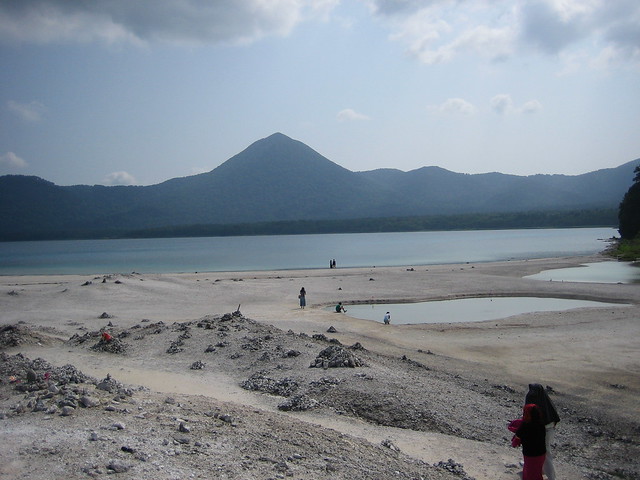
Lake Usori-ko(or Lake Usoriyama-ko)
This is an acid lake in Japan with the water pH of 3.4 -3.8, but Japanese dace live in the water.
Lake Usori-ko and Sai-no-kawara
He is also regarded as the guardian of children because he saves children who have to pile stones eternally like Sisyphus at Sai-no-kawara, the banks of the Sanzu River. The children can't cross the Sanzu River because they predeceased their parents. They are bullied by ogres at Sai-no-kawara.
Stone piles were build by the bereaved to console the spirits of their deceased family members. Leave them alone.
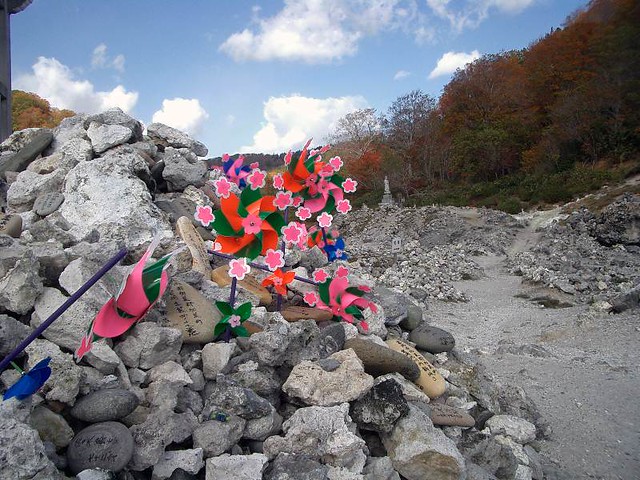 |
| Osorezan #6 by tsuda /flickr |
 |
| Fear Mountain - Osorezan / Japanexperterna.se |
Lake Usori-ko and Sai-no-kawara
 |
| photo by APTINET Aomori Sightseeing Guide |
 |
| photo by APTINET Aomori Sightseeing Guide |
 |
| photo by APTINET Aomori Sightseeing Guide |
 |
| photo by APTINET Aomori Sightseeing Guide |
 |
| photo by APTINET Aomori Sightseeing Guide |
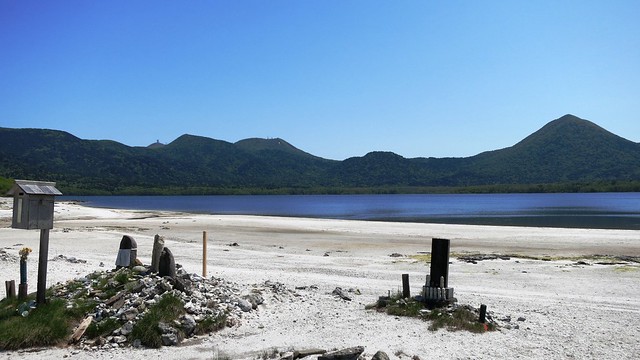 |
| Osorezan by macchi /flickr |
Straw sandals and white cloth tied to trees were also done by the bereaved. Leave them alone.
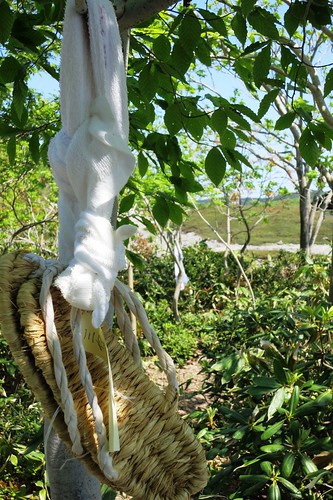 |
| Osorezan by macchi /flickr |
Lake Usori-ko(or Lake Usoriyama-ko)
This is an acid lake in Japan with the water pH of 3.4 -3.8, but Japanese dace live in the water.
 |
| Lake Usori by blueskyfantasie /flickr |
 |
| Osorezan by Joe Jones /flickr |
 |
| Osorezan by blueskyfantasie /flickr |
 |
| photo by APTINET Aomori Sightseeing Guide |
Gokuraku-hama
Gokuraku-hama is the Lake Usori-ko's beach. It means the beach of the Buddhists' paradise filled with happiness. Gokuraku' and 'sukhaavatii' are Sanskrit words used to refer to Amitabha's pure land. This white sand beach is reminiscent of the pure land.
 |
| Osorezan by blueskyfantasie /flickr |
The bereaved also burn incense and offer flowers there.
 |
| Osorezan by blueskyfantasie /flickr |
The use of fire is limited on the temple's ground because Osorezan is a volcanic area with active sulphur vents.
 |
| Osorezan #1 by tsuda /flickr |
The reverse side of the Earthquake Memorial Monument (jizo for the victims of the Great East Japan Earthquake in 2011)
This monument was build on Gokuraku-hama beach in 2012 because the temple's worshippers include the earthquake and tsunami victims. The temple hopes each of visitors will commemorate the victims by putting one's hand into one of 60 different handprints that fits one's size.
This monument was build on Gokuraku-hama beach in 2012 because the temple's worshippers include the earthquake and tsunami victims. The temple hopes each of visitors will commemorate the victims by putting one's hand into one of 60 different handprints that fits one's size.
 |
| Osorezan by blueskyfantasie /flickr |
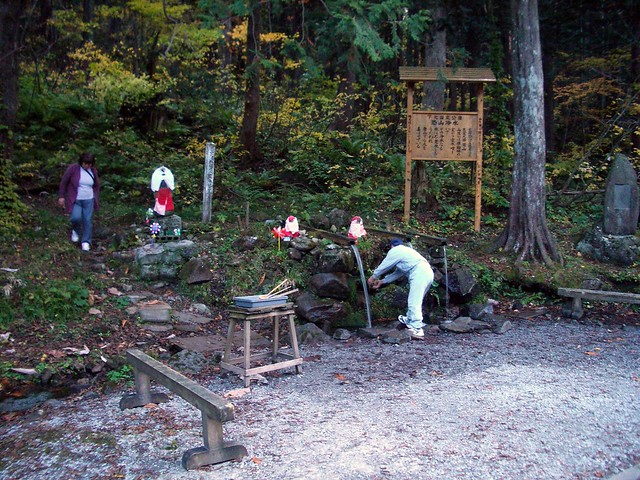
Hiyamizu(spring located on the way to Osorezan)
It is about 4 kirometers away from Osorezan. Legend has it that eating a cup of the water will take off 10 years, two cups wil do 20 years. Many visitors get spring water.
 |
| Hiyamizu by tsuda /flickr |
 |
| Osorezan by HerryLawford /flickr |
Subscribe to:
Posts (Atom)