Events:
Cherry Blossom Forecast 2026
https://www.japan-guide.com/sakura/
https://n-kishou.com/corp/news-contents/sakura/?lang=en
https://sakura.weathermap.jp/ (Japanese version only)
https://tenki.jp/sakura/expectation/ (Japanese version only)
https://www.otenki.jp/sp/art/sakura/?pg=11 (Japanese version only)

when and where to see fall foliage(Japanese version only):
https://hanami.walkerplus.com/
https://sp.jorudan.co.jp/hanami/

Sunday, January 15, 2012

Sagicho

The annual National Center Test for University Admissions is being conducted throughout Japan on January 14th and 15th. The test serves as the preliminary hurdle for those seeking entrance to public universities.

Dontosai Festival(どんと祭) in Sendai


Dontosai Festival in Sendai

The 15th day in the lunar calendar is the day of full moon. The 15th day of the 1st month in the lunar calendar has been called Ko-shogatsu(小正月). Shogatsu(正月) means New Year's Day.

According a theory, the day of full moon was the original first day of the month and the 15th day of the 1st month was New Year's Day.
Ancient people had the custom of eating rice gruel with sweet adzuki beans on this day.

Sagicho(左義長) is an event held across the country on January 14th or 15th. 

Dontosai Festival in Sendai
People burn New Year's decorations or the first calligraphy works of the year to pray for good harvests, good health and the safety of families or to send the god of the New Year back to the sky by burning things related to Shogatsu.

Dontosai Festival in Sendai
Daruma dolls are also burned.

The event has 20 other names including Dondo-yaki(どんど焼き), Tondo-yaki(とんど焼き), Saito-yaki(さいと焼き).

Dontosai Festival in Sendai

photo by City of Sendai

仙臺写眞館-Sendai photo gallery-


Donto-yaki at Harimano-kuni Sosha(播磨国総社) in Himeji, Hyogo Prefecture

photo by 神戸観光壁紙写真集

Friday, January 13, 2012

Utakai Hajime

Utakai Hajime (歌会始, Imperial New Year's Poetry Reading) was held at the hall named Matsu-no-Ma(松の間) of the Imperial Palace on January 12. The reading of traditional tanka poetry is convened by the Emperor.  This year's theme was "kishi(岸, shore)" and next year's theme is "ritsu(立)".

The hall is very quiet. A facilitator conducts this ceremony without saying a word. Music is not played. Attendees including the imperial family members, poem selectors, the writers of the selected poems and ambassadors from various countries don't even clap their hands. This ceremony includes only chants of traditional tanka poems.

All of poems are chanted by members of the former peerage. After one of the members reads out  writer's name and chants his/her poem, the other five members chant the poem (the Empress's poem twice and the Emperor's poem three times)in a special intonation.


At first, the 10 poems that was chosen from more than 18,830 entries from the public were chanted in ascending order of writers' ages. The youngest writer's poem was read first.

The writers of the poems include a 17-year-old high school girl, a 81-year-old man who used to take the Joban Line(destroyed by the tsunami) train to work, an earthquake victim living in Fukushima, a man who removed land mines in Cambodia and a man whose son survived the tsunami during a business trip. They were invited to the ceremony.

Following that, the poems by one of selectors, a person invited by the Emperor, one of the imperial family members, the Crown Princess and the Crown Prince were chanted.

At last, the Empress's poem were chanted twice and the Emperor's poem were done three times.

Many applicants, most of the imperial family members thought of the seashores damaged by the tsunami on March 11th.

Tuesday, January 10, 2012

Ebessan


Ebisu
at Yanagihara Hiruko Jinja Shrine(柳原蛭子神社)
Ebisu is regarded as the god who brings people success in business and the safety of their families and is affectionately called Ebessan(えべっさん) in the Kansai area.

Ebisu holds a rod with his right hand and a red sea bream under his left arm.


Yanagihara Hiruko Shrine

Toka-Ebisu(十日えびす) is a festival to pray for the prosperity of business and is being held at the shrines dedicated to Ebisu from January 9th to 11th.

Nishinomiya Shrine
 Strong voices call out the well-known phrase, "Shobai-hanjo de sasa mottekoi!(商売繁盛でササ持って来い)" at the shrines.


kumade(熊手,bamboo rake) with  good luck charms
at Yanagihara Hiruko Jinja Shrine(柳原蛭子神社)

 There are several possible meanings of the phrase.
"Ebisu will let you succeed in business if you bring a bamboo branch."
"If you want to succeed in business, offer sake(alcoholic beverages) to Ebisu."
"If you succeeded in business by the grace of Ebisu, offer sake(alcoholic beverages) to Ebisu."

Ebisu and Daikoku masks,
shrine maidens of  Nishinomiya Shrine
 
Nishinomiya Jinja Shrine(西宮神社) in Nishinomiya City of Hyogo Prefecture is the head shrine that is dedicated to Ebisu.


good luck charms

An annual race to determine this year's lucky man called "fuku-otoko" was held on the January 10th at the Nishinomiya Shrine in Hyogo Prefecture.

prayer at
Yanagihara Hiruko Jinja Shrine(柳原蛭子神社)
As soon as the main gate was opened at six in the morning of January 10th, 1300 men rushed into the main hall to win laurels as "Lucky Man". A 21-year-old university student won the race this year.


at Harimano-kuni sosha(播磨国総社)
in Himeji, Hyogo Prefecture
 Fuku-musume(福娘:Lucky Girls) bestow a moso bamboo branch on visitors and attach a talisman and auspicious objects called kiccho(吉兆)  for the three days.

Fuku-musume girls wear golden headgears called eboshi(烏帽子).

at Inazumehama Ebisu Jinja(稲爪浜恵比須神社)
 An annual contest to select fuku-musume starts in October and prize winners are selected from among applicants in late November.


prayer by fuku-musume
 at Iwaya Jinja Shrine(岩屋神社)
Unmarried women between the ages of 18 and 23 can enter the contest. Fifty fuku-musume girls of this year including 10 foreign students were selected from among 2984 applicants.

fukuzasa at Nishinomiya Shrine
 Fukuzasa or fukusasa(福笹) is a lucky bamboo branch with auspicious objects called kiccho(吉兆).

Gohei at Nishinomiya Shrine

Gohei (御幣) are wooden wands with two zigzag  paper streamers used in Shinto rituals.

okakedai at Nishinomiya Shrine

Pairs of dried red sea breams called okakedai(御掛鯛) are offered to the god.


tuna at Nishinomiya Shrine

Visitors put money offerings on a tuna to attract good fortune.

tuna at Iwaya Jinja Shrine(岩屋神社)

The establishment of Kobe Central Wholesale Market East Division in 1969 inspired a fish offering to the shrine. In 1970, a tuna and a red sea bream were offerred to the shrine.


Hoekago procession
at Harimano-kuni sosha in Himeji, Hyogo Prefecture
Hoekago procession(宝恵駕籠行列, Hoekago Gyoretsu) parades. The parade dates back to the middle of the 18th century when dressed geisha visited the shrine on palanquins.

Hoekago procession


Hoekago procession


Hoekago procession


Hoekago procession

Harimano-kuni sosha
 Fuku-musume girls say their prayers and bestow a talisman called shinpu (神符) on street shops. This shrine's shinpu is a piece of wood with the shrine's name and phrases used for prayers written on it.


Harimano-kuni sosha
 breaking open a ceremonial sake barrel


photo by 神戸観光壁紙写真集

Monday, January 9, 2012

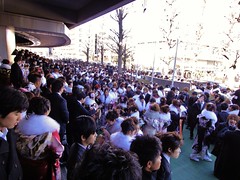
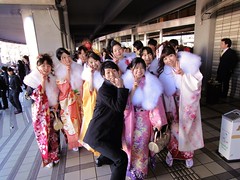
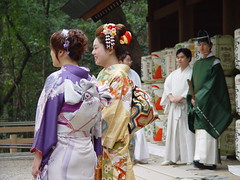
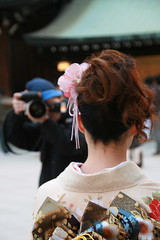
Coming-of-Age Day

The second Monday of January is Coming-of-Age Day.

Coming-of-Age ceremonies are held on this day in most areas and done during the New Year's holidays or the Bon Festival period in some areas.

In tsunami-hit areas, bereaved new adults and new adults with photos of their deceased classmates attended the ceremonies.

The new adults who evacuated their hometowns due to the nuclear accident in Fukushima attended the ceremonies at a point distant from their hometowns.


Coming of Age Day Ceremony / Dick Thomas Johnson


Coming of Age Day / Dick Thomas Johnson


成人式 / kaidouminato


/ Techamaki


Harajuku, Hold that pose. / moguphotos

Sunday, January 8, 2012

karuta

Ceremony of the First Karuta Play of the New Year is held on January 3rd at Yasaka-jinja Shrine(八坂神社) in Kyoto and on January 8th at Omi Jingu Shrine.

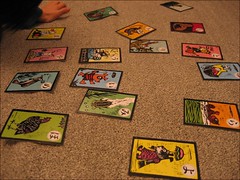
Iroha-garuta is the most traditional karuta, each of which starts with one of the 47 characters of the old Japanese alphabet. Forty-seven Japanese proverbs are written on cards for reading and the 47 characters and pictures are written on cards for taking.

This alphabet is also a poem which consists of 47 different letters.

いろはにほへと ちりぬるを
わかよたれそ つねならむ
うゐのおくやま けふこえて
あさきゆめみし ゑひもせす

i-ro-ha-ni-ho-he-to chi-ri-nu-ru-wo
wa-ka-yo-ta-re-so tsu-ne-na-ra-mu
u-wi-no-o-ku-ya-ma ke-fu-ko-e-te
a-sa-ki-yu-me-mi-shi we-hi-mo-se-su

This poem have several possible meanings. One of them is as follows.

The petals fall after blooming.
Everything changes in this world.
I got over a steep mountain in my life today.
I don't want to dream an empty dream when being sober.

Iroha-garuta cards for taking

Karuta / Gilgongo


Iroha-garuta cards for reading and taking

(c) .foto project


Kyogi Karuta


Karuta Practice / JoshBerglund19


Karuta Practice / JoshBerglund19


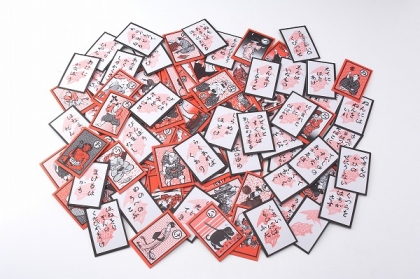
Ogura Hyakunin-isshu karuta

(1) cards made in the Edo Period(1603-1868)


in the late Edo period

the poem of Empress Jito (持統天皇, 645-702)

春すぎて 夏来にけらし 白妙の
衣ほすてふ 天の香具山

Only the upper poem is written on cards made in the Edo Period.


in the late 17th century
Empress Jito


in the mid Edo period
Empress Jito


(2) cards made in the Meiji Period(1868-1912)


Empress Jito

Empress Jito


(3) cards made in the Taisho Period(1912-1926)


Empress Jito


Empress Jito


Empress Jito


Empress Jito


Saturday, January 7, 2012

The annual karuta competition

The annual karuta competition to decide the male and female champions in Japan was held at Omi Jingu Shrine(近江神宮) in Shiga Prefecture on January 7th. Each of last year's male and female champions fought for title against a winner of the preliminaries participated in the tournament. The event was broadcast live on the Net and will be broadcast on a satelite TV program.

The last year's male champion won five-set match and had achieved 14 consecutive victories. The last year's female champion won two straight sets and achieved 8 consecutive victories.

Karuta is a Japanese card game. This competition uses one hundred waka poem cards based on Ogura Hyakunin-isshu which is a famous poetry anthology selected by Fujiwarano Teika in the Heian period and includes one hundred waka poems by one hundred poets. A waka poem consisits of 31 syllables and is divided into the upper poem(the first three lines of 5, 7, and 5 syllables) and the lower poem(the remaining two lines of 7 and 7 syllables.)

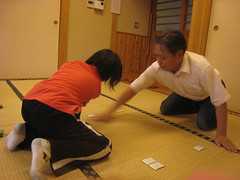
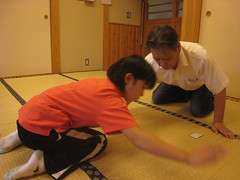
Each of two opponents lines up 25 cards in three rows on own side. As soon as the reader calls out a poem, players must quickly search for the card with the same poem on the tatami mat and try to pick it up. A player who eliminated all 25 cards from the own side first is the winner.
If a player gets a card on opponent side or his opponent touch a wrong card, the player sends a card on own side to opponent side.

However, only the lower poem is written on the card on the mat.  Although the reader calls out one hundred poems, only 50 cards are on the mat. So players are prone to touch a wrong card.

The competition is called Kyogi Karuta and played by the rule established by All-Japan Karuta Association.
Kyogi Karuta is a kind of sports. Karuta players need to have cat-like-reflex. Their hand movements are too fast for the naked eye to see. We need to watch them again in slow motion.

Omi Jingu Shrinen started the competition in 1955 because the shrine is dedicated to Emperor Tenji (天智天皇,626-671) and Ogura Hyakunin-isshu begins with a poem by him.


card for taking
(Emperor Tenji's poem)

card for reading
(Emperor Tenji's poem)


Friday, January 6, 2012

Dezome-shiki

According to system of 24 seasonal divides that originated in ancient China, today is the second coldest day called Shokan(小寒) and February 4th is the first day of spring called Rissyun(立春.) It's very cold during the period from Shokan to Rissyun. January 21st is the coldest day in winter called Daikan(大寒) this year. We are having a cold and snowy winter this year.

ladder trucks of Kobe City Fire Department

Dezome-shiki(出初式, The New Year parade of fire brigades) is an event of the first work day of the new year held by fire fighting officials in early January.


Kobe City Fire Department helicopter rescue demonstration

Dates of the event differ from region to region. The event includes modern firefighting demonstration, traditional firefighters' acrobatic performances on ladders and performances by fire department bands.


water-discharge exercise by Kobe City Fire Department fireboats
The Tokyo Fire Department holds dezome-shiki on January 6th and it is broadcast on NHK every year.


water-discharge exercise by Kobe City Fire Department firetrucks
It is said that the event dates back to 1659 when firefighting demonstration was held by firefighters under the control of direct retainers of the shogun at Ueno Toshogu Shrine on the fourth day of the 1st month.

Kobe City Fire Department Band


Himeji Fire Department color guard


traditional firefighters' acrobatic performances on ladders


performance at Kakogawa City Fire Department dezome-shiki


firemen's standards at the Himeji Fire Department dezome-shiki


performances at the Himeji Fire Department dezome-shiki


performance at the Kakogawa City Fire Department dezome-shiki


photos by 神戸観光壁紙写真集