Events:
Cherry Blossom Forecast 2026
https://www.japan-guide.com/sakura/
https://n-kishou.com/corp/news-contents/sakura/?lang=en
https://sakura.weathermap.jp/ (Japanese version only)
https://tenki.jp/sakura/expectation/ (Japanese version only)
https://www.otenki.jp/sp/art/sakura/?pg=11 (Japanese version only)

when and where to see fall foliage(Japanese version only):
https://hanami.walkerplus.com/
https://sp.jorudan.co.jp/hanami/

Sunday, February 5, 2017

Drift ice attached to coasts of Hokkaido

White lines of drift ice had been spotted off the coast of Wakkanai on January 25, according to the Wakkanai Local Meteorological Observatory. The ice came 19 days earlier than usual. Abashiri Local Meteorological Observatory reported this year's first drift ice came into view off the Abashiri coast On January 31 ten days later than usual and the ice became attached to the land on February 2.

Cape Notoro surrounded by sea ice, Abashiri
photo by 網走市観光課提供 (Abashiri City Hall Tourism Division)

Monbetu City announced that the ice became attached to the land on February 3.

icebreaker Garinko II at Monbetsu Port
photo by 動物写真集(アザラシ・シロクマ・旭山動物園)

Each year, the Wakkanai, Kushiro and Abashiri local meteorological observatories announce the first day that this ice can be seen with the naked eye from the coast, the last day that the ice could be seen, the day that sea routes became unnavigable due to the ice attached to the land along coastlines and the day that sea routes became navigable.

Fast ice along the Shiretoko Peninsula with a mountain range forming the backbone of the peninsula
photo by Shiretoko Shari-cho Tourist Association

Utoro Port, Shiretoko
photo by Shiretoko Shari-cho Tourist Association

Drift ice can usually be seen from January until early April. its peak season is February. Today seasonal ice drift in Hokkaido attract many tourists with Icebreaker cruises, guided tours to walk and swim in the icy ocean.


sea ice, Shiretoko
photo by Shiretoko Shari-cho Tourist Association

ice hummocks, Abashiri
photo by 網走市観光課提供 (Abashiri City Hall Tourism Division)


ice hummocks, Abashiri
photo by 網走市観光課提供 (Abashiri City Hall Tourism Division)
ice hummocks, Shiretoko
photo by Shiretoko Shari-cho Tourist Association

ice slush, Abashiri
photo by 網走市観光課提供 (Abashiri City Hall Tourism Division)

sea ice, Abashiri
photo by 網走市観光課提供 (Abashiri City Hall Tourism Division)
pancake ice, Abashiri
photo by 網走市観光課提供 (Abashiri City Hall Tourism Division)

Brash ice viewed from Mombetsu Okhotsk-tower (http://www.o-tower.jp/)
photo by 動物写真集(アザラシ・シロクマ・旭山動物園)


pack ice like an anvil, Abashiri
photo by 網走市観光課提供 (Abashiri City Hall Tourism Division)

mirage, Abashiri
photo by 網走市観光課提供 (Abashiri City Hall Tourism Division)

pack ice, Abashiri
photo by 網走市観光課提供 (Abashiri City Hall Tourism Division)

However observations of drift ice started to ensure the safety of navigation. Sea ice is a barrier to shipping, and making it impossible for fishing vessels to access fishing grounds. Abashiri Weather Station(current Abashiri Local Meteorological Observatory) has observed drift ice since 1892. The Ice Information Center by 1st Regional Coast Guard Headquarters provides information about drift ice in coastal waters off northeastern Hokkaido.

The following web site provides information on drift ice for tourists:
http://www.noah.ne.jp/ice/index.html
photo by Shiretoko Shari-cho Tourist Association
http://www.shiretoko.asia/world/index.html


pack ice and Oshinkoshin Falls bus stop, Shiretoko
photo by Shiretoko Shari-cho Tourist Association

pack ice, Shiretoko
photo by Shiretoko Shari-cho Tourist Association
pack ice, Shiretoko
photo by Shiretoko Shari-cho Tourist Association


pack ice, Shiretoko
photo by Shiretoko Shari-cho Tourist Association


pack ice, Shiretoko
photo by Shiretoko Shari-cho Tourist Association


pack ice, Shiretoko
photo by 動物写真集(アザラシ・シロクマ・旭山動物園)


 ice hummocks, Abashiri
photo by 網走市観光課提供 (Abashiri City Hall Tourism Division)

Cape Puyuni, Shiretoko

fast ice viewed from Yuhidai, Shiretoko


Cape Puyuni, Shiretoko
photo by Shiretoko Shari-cho Tourist Association


On the other hand, drift ice is the key driver of the coastal waters' ecosystem. Fresh water of the Amur River flows into the surface layer of the Sea of Okhotsk. Suraface sea water diluted with river water freezes more easily than ordinary sea water. Salt gets left in the liquid as salt water starts to freeze. The concentrated salt water sinks to the ocean bottom resulting in a mixing of the layers. Dense salt waters bring cold, nutrient-rich deep waters to the ocean surface, replacing nutrient-depleted surface water. The nutrient-rich upwelled water fosters the intense growth of phytoplankton called ice algae, which live in and under the drift ice is the foundation of the bountiful marine food web. Krill feeds on phytoplankton that grows on the underside of sea ice and provides an important food source for sea creatures.


Clione limacina
photo by 網走市観光課提供 (Abashiri City Hall Tourism Division)

Clione limacina, known as sea angel, are carried to the Sea of Okhotsk by the northern coast of Hokkaido, clinging to the undersides of the ice. Its earliest-stage larvae feed on phytoplankton and adults feed exclusively on a small herbivorous sea snail, Limacina helicina. They are pray for salmons. Visitors can also see them at the Okhotsk Ryuhyo(drift ice) Museum (https://www.ryuhyokan.com/)

sea ice and seabirds, Shiretoko
photo by Shiretoko Shari-cho Tourist Association

seals on pack ice, Shiretoko
photo by Shiretoko Shari-cho Tourist Association


Screw-propelled icebreaker Garinko II departs from Monbetsu:
http://www.garinko.com/

icebreaker Garinko II,  Monbetsu
photo by 動物写真集(アザラシ・シロクマ・旭山動物園)


Icebreaker Aurora departs from Abashiri:
https://www.ms-aurora.com/abashiri/


icebreaker Aurora,  Abashiri
photo by 網走市観光課提供 (Abashiri City Hall Tourism Division)


Abashiri  Drift Ice Heli-Cruising
Visitors can take a helicopter tour from Abashiri to see drift-ice field.


Ice Floe and Bird Watching Cruise from Rausu on the eastern side of the Shiretoko Peninsula: 

Steller's sea eagle, Shiretoko
photo by Shiretoko Shari-cho Tourist Association

Steller's sea eagle, Shiretoko
photo by Shiretoko Shari-cho Tourist Association


Drift Ice Walking Tour in Utoro, Shari on western side of the Shiretoko Peninsula: 

Drift Ice Walk, Shiretoko
photo by Shiretoko Shari-cho Tourist Association

Drift Ice Walk, Shiretoko
photo by Shiretoko Shari-cho Tourist Association


Drift Ice Diving in Rausu, Shiretoko Peninsula: 
http://www.aurens.or.jp/~sdiving/ (Japanese version only)

diving, Shiretoko
photo by Shiretoko Shari-cho Tourist Association


diving, Shiretoko
photo by Shiretoko Shari-cho Tourist Association


diving, Shiretoko
photo by Shiretoko Shari-cho Tourist Association


The 52th Abashiri Okhotsk Drift Ice Festival
10-12 February, 2017

Abashiri Okhotsk Drift Ice Festival
photo by 網走市観光課提供 (Abashiri City Hall Tourism Division)


The  55th Drift Ice Festival 2017 in Monbetsu
10-12 February, 2017
http://good-hokkaido.info/monbetsu-ryuhyo-festival/ (2016)

Shiretoko drift ice fes 2017
30 January -28 February, 2017

Tuesday, January 3, 2017

Tamaseseri

What do you associate with Japanese festivals?

I see barely clothed men run in my head... They run, compete for something, soak in the cold water even in winter. Of course there are many different types of Japanese festivals.

Tamatori-sai, known as Tamaseseri, is an annual Shinto ritual held at Hakozakigu Shrine, Fukuoka Prefecture on January 3rd. It dates back to 500 years. Two groups compete for a sacred wooden ball, which is believed to bring good luck to those who touched it.


Water is showered on participators.


Sunday, January 1, 2017

New Year's Day 2017

Happy New Year!

It's a nice sunny and calm day in Yokohama.
Best wishes for a safe New Year.

2017 is the Year of the Rooster according to the Chinese zodiac. Each of the 12 Chinese zodiac signs is related to a characteristic animal.


New Year's card


New Year's card


New Year's card


New Year's card


New Year's card


It is said to be particularly good luck to dream of Mt. Fuji, a hawk or an eggplant in the first night of the year.


New Year's card


Ready-made New Year's dishes are set in three-tiered boxes. Most of the ready-made New Year's dishes are sold frozen and we thaw them at room temperature.


We eat soup called ozouni(お雑煮) containing vegetables and rice cakes for New Year's Day. Its contents used to be offerings to gods. The soup is cooked in various ways according to regional custom.

Ozouni Kenkyujo(OZOUNIYA.co.ltd) is a website about ozouni (sorry, Japanese version only):
http://www.zouni.jp/category/topic1/


Aotama Jinja
photo by 高画質壁紙写真集無料壁紙


New Year's pine decoration at Aotama Jinja Shrine(青玉神社), Hyogo Prefecture

The deity of the year bringing a good harvest goes down from the sky to New Year's pine and bamboo decorations or New Year pine decorations.

This small shrine has several old Japanese cedar trees including 1000-year-old one.


Aotama Jinja
photo by 高画質壁紙写真集無料壁紙


Aotama Jinja
photo by 高画質壁紙写真集無料壁紙


Aotama Jinja
photo by 高画質壁紙写真集無料壁紙


Thursday, September 22, 2016

The 63rd Japan Traditional Kogei Exhibition

The 63rd Japan Traditional Kogei Exhibition(日本伝統工芸展) is taking place at Mitsukoshi department store in Tokyo from September 21 to October 3.  The exhibition requires the applicants to create sophisticated design based on high degree of professional skill in Japanese traditional techniques. The exhibition's winning works are available in each venue, but their prices are not indicated.

See the Japan Kogei Association site for further information:
http://www.nihonkogeikai.or.jp/  (Japanese version only)
Japan Traditional Kogei Exhibition:
http://www.nihonkogeikai.or.jp/exhibition/honten  (Japanese version only)

The Exhibition will travel through the following venues:

Mitsukoshi Nihonbashi Main Store, Tokyo
September 21-October 3, 2016
Mitsukoshi Nihonbashi Main Store:
http://mitsukoshi.mistore.jp/store/nihombashi/index.html
  
Mitsukoshi Nagoya Sakae Store, Nagoya City, Aichi Prefecture
October 5-10, 2016
Mitsukoshi Nagoya Sakae Store:
http://mitsukoshi.mistore.jp/store/nagoya/index.html

Takashimaya Kyoto Store, Kyoto Prefecture
October 12-17, 2016
Takashimaya Kyoto Store:
http://www.takashimaya.co.jp/kyoto/store_information/index.html

Ishikawa Prefectural Museum of Art, Kanazawa City, Ishikawa Prefecure
October 28-November 6, 2016
Ishikawa Prefectural Museum of Art:
http://www.ishibi.pref.ishikawa.jp/english/index.html

the Okayama Prefectural Museum of Art, Okayama City, Okayama Prefecture
November 17-December 4, 2016
The Okayama Prefectural Museum of Art:
http://www.pref.okayama.jp/seikatsu/kenbi/en/index_en.html

Shimane Art Museum, Matsue City, Shimane Prefecture
December 7-25, 2016
Shimane Art Museum:
http://www.shimane-art-museum.jp/en/
  
the Kagawa Museum, Takamatsu City, Kagawa Prefecture
January 2-22, 2017
The Kagawa Museum:
http://www.pref.kagawa.lg.jp/kmuseum/foreign/

Mitsukoshi Sendai Store, Sendai City, Miyagi Prefecure
January 25-30, 2017
Mitsukoshi Sendai Store:
http://mitsukoshi.mistore.jp/store/sendai/index.html
 
Mitsukoshi Fukuoka Store, Fukuoka City, Fukuoka Prefecture
February 3-8, 2017
Mitsukoshi Fukuoka Store:
http://www.m.iwataya-mitsukoshi.co.jp/index.html

Takashimaya Osaka Store, Osaka Prefecture
February 16-20, 2017
Takashimaya Osaka Store:
http://www.takashimaya.co.jp/osaka/store_information/index.html

Hiroshima Prefectural Art Museum, Hiroshima City, Hiroshima Prefecture
February 23-March 12, 2017
Hiroshima Prefectural Art Museum:
http://www.hpam.jp/

Mitsukoshi Matsuyama Store, Matsuyama City, Ehime Prefecture
March 14-19, 2017
Mitsukoshi Matsuyama Store:
http://mitsukoshi.mistore.jp/store/matsuyama/index.html

Monday, May 30, 2016

Rice is equal to parents

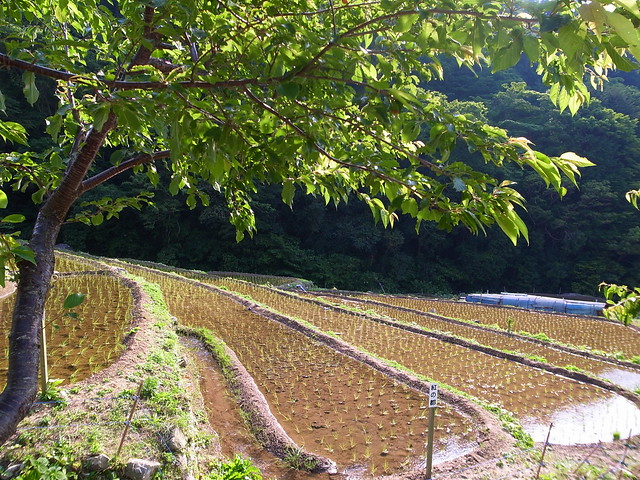
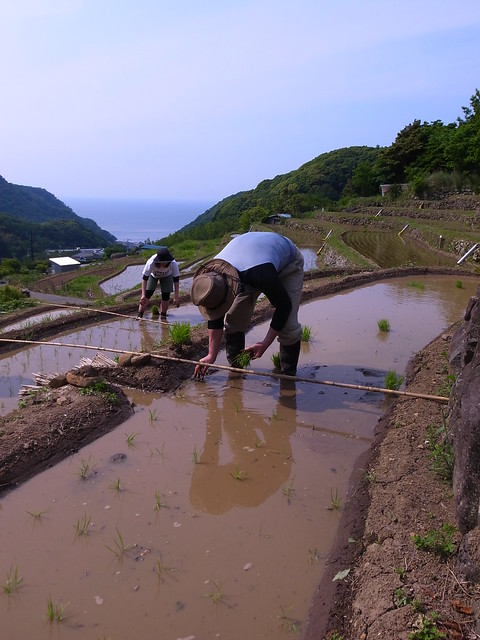
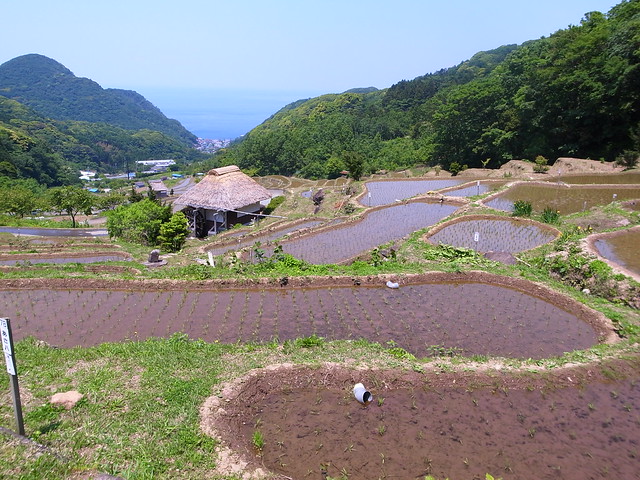
Doya-tanada, Fukushima-cho, Matsuura City, Nagasaki Prefecure
At this terraced rice paddies, rice planting starts in the late April.
(one of Japan's Top 100 tanadas)
Photo by Yokaphoto.net


In 1987 Hong Kong action film A Better Tomorrow 2, some gangsters threw a bowl of fried rice on the floor at a Chinese restaurant in America. Chow Yun-fat(周潤發) as Ken "Gor" Lee said to them, "For us Asians, rice is equal to our parents. Anyone who hurts my parents will answer to me."

Rice played a vital role in feeding the Asian expanding population. Now more than 90% of the world's rice is grown and consumed in Asia. Wet rice cultivation in Japan dates back to 3000 years ago. The Japan's population increased dramatically as the expansion of paddy fields increased rice production.

In Japan rice was levied as a tax in the middle of the 7th century. Peasants delivered rice to the Imperial Court until the 10th century, to their aristocratic lords in the middle ages, to feudal lords in the Edo Period, to landlords in the period between the Meiji Period and the postwar agrarian reform.

There were some areas which have little suitable lands for cultivating rice. Its residents couldn't pay tribute such as rice, local products to the Imperial Court. Instead, tax was paid in the form of labor.

The Tokugawa Shogunate imposed rice as tax on feudal lords according to production capacity of their lands. The feudal lords paid rice as stipends to their samurai retainers. They could gain cash by selling the rice.

At the Kannamesai festival in October and the Niinamesai festival in November, the emperor dedicates newly harvested rice to Amaterasu-Ohmikami, the Goddess of the Sun, an imperial ancestor. Unlike Kannamesai, the emperor eats these offerings at Niinamesai. The festival dates back at least to 677. Today the emperor plants rice for Niinamesai in May and harvests it in September by his own hands in the paddies of the Imperial Palace. Emperor Showa (Hirohito) started it.

Japan's earliest rice planting(replanting rice seedlings in rice paddy fields) starts in some islands of Okinawa in January. In many areas of Okinawa rice planting starts in March. Other areas starts planting rice from April to June. Most areas of the Kyushu Region start rice planting in June after harvesting wheat. Typhoons often destroy ready-to-harvest rice in Kyushu, so farmers are accustomed to plant wheat to ensure food security. Last month big earthquakes caused crack in rice paddies and leakage in the drainage pipe in Kumamoto. Many rice farmers can't still plant seedlings.

Many people had longed for stuffing themselves with white rice before Japan made the leap toward prosperity in the post war period. We were taught by parents or grandparents to eat every grain of rice in our bowl, to not waste food. When we left grains in the bowl they often said, "We are sorry for rice farmers." They told us not to waste crop that farmers paid hard work for." I eat every grain of rice in my bowl. Unfortunately consumption of rice is in a sustained decline due to the spread of Westernized diet. I eat bread for breakfast.


Tanada (terraced rice paddies along steep hills) is one of beautiful scenery, but it requires great care because much of the work is done by hand. Most of Tanada are preserved as a tourist spot.


photo: 2012 田植え by  na0905 /flickr


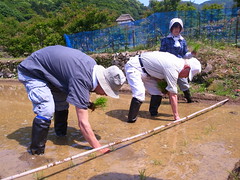
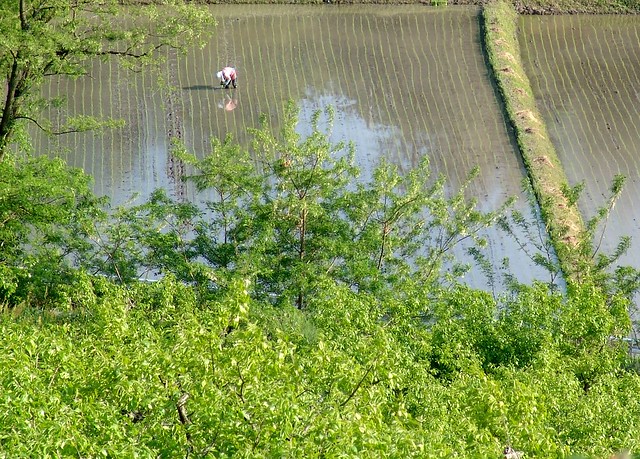
The planting work was done by hand because each paddy is relatively small,


2012 田植え
2012 田植え by na0905 /flickr


2012 田植え
2012 田植え by na0905 /flickr


2012 田植え
2012 田植え by na0905 /flickr


100523_taue_akita by  ivva /flickr


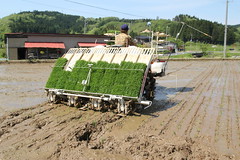
rice planting machine

rice planting. 田植え
rice planting. 田植え by T.Kiya /flickr


Doya-tanada(土谷棚田), Fukushima-cho, Matsuura City, Nagasaki Prefecure
At this tanada, rice planting starts in the late April.

Doya-tanada
Photo by Yokaphoto.net


Doya-tanada
Photo by Yokaphoto.net


Doya-tanada
Photo by Yokaphoto.net


Doya-tanada
Photo by Yokaphoto.net


Doya-tanada
Photo by Yokaphoto.net


Doya-tanada
Photo by Yokaphoto.net


Ueyama no Tanada(うへ山の棚田), Kami Town, Hyogo Prefecture(one of Japan's Top 100 tanadas)
photo by 神戸観光壁紙写真集


Nishigaoka no Tanada西ヶ岡の棚田, Kami Town, Hyogo Prefecture
(one of Japan's Top 100 tanadas)

Yamada no Tanada
photo by 神戸観光壁紙写真集


Yamada no Tanada(山田の棚田), Kami Town, Hyogo Prefecture


Bekku no Tanada
photo by 神戸観光壁紙写真集


Bekku no Tanada別宮の棚田,Yabu City, Hyogo Prefecture


Bekku no Tanada
photo by 神戸観光壁紙写真集


Akiu no taue odori
photo by MIYAGI PREFECTURE


Akiu no taue odori (秋保の田植踊) is a traditional rice-planting dance in Akiu-cho, Taihaku Ward, Sendai City, Miyagi Prefecture. The dance was inscribed on the UNESCO Representative List of the Intangible Cultural Heritage of Humanity in 2009. The dance is performed at Nagabukuro Shinmeisha(長袋神明社, Shinto shrine) on the third Sunday of April, at Akiu Otaki Fudoson (秋保大滝不動尊, Buddhist temple) on April 29, at Yumoto Yakushido(湯元薬師堂, Buddhist temple) on May 5.


Akiu no taue odori
photo by MIYAGI PREFECTURE