Events:
Cherry Blossom Forecast 2026
https://www.japan-guide.com/sakura/
https://n-kishou.com/corp/news-contents/sakura/?lang=en
https://sakura.weathermap.jp/ (Japanese version only)
https://tenki.jp/sakura/expectation/ (Japanese version only)
https://www.otenki.jp/sp/art/sakura/?pg=11 (Japanese version only)

when and where to see fall foliage(Japanese version only):
https://hanami.walkerplus.com/
https://sp.jorudan.co.jp/hanami/

Tuesday, June 28, 2011

Hydrangeas(1)

The rainy season ended in Okinawa on the 9th and started in Tohoku Region on the 21st of June. We are in the middle of rainy season, but sunny and hot weather lasted for three days. I couldn't sleep well. Kumagaya City in Saitama Prefecture reached 39.7 degrees Celsius on the 24th.  Meanwhile some areas were ravaged by torrential rains.
We're back to the rainy season again.

Ajisai(紫陽花:hydrangea) is a representative blossom in the rainy season.

The Hakone Tozan Railway (箱根登山鉄道) is a mountain railway extending from Odawara to Gora. Its tracks are lined with hydrangeas in full bloom on either side.

In Kamakura, Meigetsu-in Temple(明月院) is famous as "hydrangea temple". Most of hydrangeas at Meigetsu-in are Hydrangea macrophylla amoena(姫紫陽花, hime-ajisai) which is an old variety of Japanese hydrangeas. Its flower color doesn't change.

photo by skyseeker.net


Mimuroto-ji Temple(三室戸寺) in Kyoto


Sairin-ji Temple(西林寺) and Tsuma-no-sato Hydrangea Garden(都麻乃郷あじさい園)


Aino Hydrangea Garden(相野あじさい園) in Hyogo Prefecture


Anjikamo Jinja Shrine(安志賀茂神社) and Hydrangea Garden in Hyogo Prefecture


Gansen-ji Temple(岩船寺) in Kyoto


Yata-dera Temple(矢田寺) in Nara


Kobe Municipal Arboretum(神戸森林植物園)


Hydrangea and columnar jointed basalt at the Genbudo(basaltic caves) Park


photos by
神戸観光壁紙写真集
高画質壁紙写真集無料壁紙


Wednesday, June 15, 2011

Hanashobu(Japanese water iris)

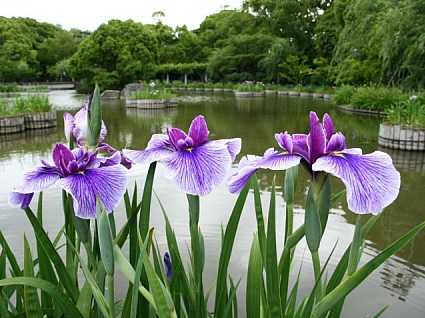
Japanese water irises(花菖蒲, hanashobu) are in full bloom in many iris gardens.

Horikiri(堀切) has always been famous for Japanese water irises.  Japanese water irises at Horikiri appear in "One Hundred Famous Views of Edo (名所江戸百景)" which is a series of prints by Utagawa Hiroshige.
Horikiri Iris Garden(堀切菖蒲園) in Katsushika Ward of Tokyo has 6,000 irises of 200 different species and is open to all visitors free of charge. The garden has the hanashobu varieties that have been improved at Horikiri since the early Edo period.


Yamasaki Japanese Iris Garden(播州山崎花菖蒲園, Bansyu Yamasaki Hanashoubu-en) created in 1979 in Hyogo Prefecture


Nishishinjuku Iris Garden of Grandpa and Grandma(西新宿おじいちゃんとおばあちゃんの花菖蒲園) in Hyogo Prefecture

In 1996, elderly people started to develop abandoned rice paddies. They planted 10,000 irises there. Now you can see half a million irises of 170 different species.


Eitaku-ji Iris Garden(永沢寺花菖蒲園) in Hyogo Prefecture

Hanashobu have grown wild on the site of Eitaku-ji Temple for 600 years.
You can see more irises of Eitaku-ji on this site.


Takeda-teramachi Street and Takeda River(竹田川) in Hyogo Prefecture


Hyogo Prefectural Flower Center Iris Garden(兵庫県フラワーセンター花しょうぶ園)


Amagasaki Agricultural Park(尼崎農業公園) in Hyogo Prefecture

photos by 神戸観光壁紙写真集
Kamo Garden(加茂花菖蒲園) in Shizuoka Prefecture

This garden was created before the gate of the Kamo family's house built in the middle of the Edo Period.
The memers of the Kamo family served as a village headman for generations.

photo by 日本列島お国自慢


Magatama-ike Iris Garden(勾玉池菖蒲園)

In 1954, an iris garden was created in Magatama-ike Pond on the site of Ise Jingu Shrine Geku(伊勢神宮外宮) in Mie Prefecture.

Yagyu Iris Garden(柳生花しょうぶ園) in Nara prefecture


Expo Commemoration Park (万博記念公園) in Osaka
Takitani Irs Garden(滝谷花しょうぶ園) in Nara Prefecture


photos by 高画質壁紙写真集無料壁紙


Kagurame-ko Iris Garden(神楽女湖菖蒲園) in Oita Prefecture

The garden is located next to Lake Kagurame.


Ishibashi Cultural Center(石橋文化センター) in Fukuoka Prefecture


Photos by Yokaphoto.net


Bonari Plateau Ayame Garden(母成高原あやめ園)

Ayame means Siberian iris. The garden has various types of irises.

photo by 日本列島お国自慢


Maekawa Iris Garden(前川あやめ園)


Suigo Itako Ayame Festival(水郷潮来あやめまつり) is being held from May 21st to June 26th in Itako in Fukushima Prefecture. Suigo means a riverside district. The earthquake in Tohoku Region did partial damage to a part of venues for the festival. This festival shows not ayame(Siberian irises) but Hanashoubu(Japanese water irises).
Waterways were a common part of people's lives in riverside districts such as Itako.
Brides used to head for their grooms' houses by boat. Now some brides dressed in white kimono take a boat during the festival.  Only the couples decided by lot can take part in this wedding event as a part of the festival. During the festival, young women move a Sappa boat with tourists by pulling an oar.
The Suigo Sawara Aquatic Botanical Garden (水郷佐原水生植物園) in Katori City in Chiba Prefecture


photos by  花とハイキングでエンジョイ


Shakujii Park(石神井公園) in Tokyo


Monday, June 13, 2011

Chagu Chagu Umakko Festival


Chagu Chagu Umakko(チャグチャグ馬コ) is a festival held on the second Saturday of June.
A parade featuring bedecked 100 head of horses along a 15-kilometer(this year, 14km) course from Onikoshi Sozen Shrine(鬼越蒼前神社) in Takizawa Village to Morioka Hachimangu Shrine(盛岡八幡宮) in Morioka City lasts about four hours.

"Chagu Chagu" comes from the sound of bells worn by the horses. "Umakko" means horses.

Present-day Iwate Prefecture has been famous for horse breeding since the eighth century. Many farmers in the area cared about their farm horses and lived under one roof with them.

The festival derives from the custom that farmers visited Onikoshi Sozen Shrine with their horses to pray for the animals' health on the 5th day of the 5th month in the lunar calendar.

Both farmers and horses were in a state of complete burnout around that time when rice was planted. Farmers expressed appreciation for their horses at the festival.

This year the afflicted children in Tohoku rode the festival horses.

Saturday, June 11, 2011

Three months after tsunami

Three months have passed since the quake and tsunami in Tohoku Region. Today the afflicted people participated in a silent prayer at 2:46 p.m., the exact time the earthquake occurred.

I guess foreign media are no longer reporting circumstances in the disaster areas except the nuclear accident in Fukushima. Japanese media have been reporting daily on the afflicted people and areas since March 11th. The names of recently-identified victims appear in a newspaper every day.

Many people are still searching for their family members.
As of June 10, 15,405 people died, 8,059 are missing and 99,172 are staying in temporary shelters. Drowning due to the tsunami accounted for 95 percent of the total deaths in the areas. Bad odor and dust rubble trouble the afflicted people.

Piles of rubble still remain in the areas. Workers can't use construction equipments to clear away the rubble because keepsakes and bodies are still buried under rubble. Even now, damaged dead bodies get beached on a shore in some area. Divers are struggling to search for missing people in the sea. It takes time to identify a body by use of DNA analsys.

The nuclear accident in Fukushima is not over yet.

Local governments are building temporary housing, but housing stock is not enough. Most of the disaster victims want to live their hometowns, but there are not many building lots suitable for temporary housing.

Thursday, June 9, 2011

Satsuki

The Ritz-Carlton Kyoto will be constructed on the site of the Hotel Fujita Kyoto. A founder's wooden villa called Ebisugawa-tei(夷川邸) on its site will be demolished, but its parts having historic value such as ranma(欄間, architectural details like a transom) will be preserved.
The villa with a Japanese garden was built about 100 years ago. People living in Kyoto feel sorry to miss the villa.

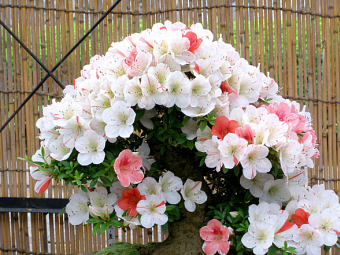
Satsuki(皐月) is a type of azaleas. They are still blooming here and there. They are often used as a foundation plant. Satsuki is also one of typical bonsai subjects.

Satsuki(皐月) means the 5th month in Japanese. The name of the plant is derive from the fact that the 5th month in the lunar calendar corresponds approximately to its bloom time from mid-May to mid-June.

Bonsai exhibits of Satsuki are held around the end of May.